A client once asked me a simple question with a complicated legal answer. If a celebrity says he pays about $200,000 a month in child support, what does that number tell the rest of us about how support really works in Texas?
Quite a bit, if you look at it as a case study instead of celebrity gossip.
Kountry Wayne's reported support situation gets attention because the number is large. For a Texas family law attorney, the more useful point is what a number like that usually signals. High income, multiple households, possible private agreements, and the gap between what someone says publicly and what a court can verify and enforce.
Those are the same issues that matter in non-celebrity cases. A parent may own a business, earn irregular income, receive cash from several sources, or make voluntary payments without a clear court order. The dollar amount changes. The legal analysis does not.
The practical questions are consistent. What counts as net resources under Texas law? What happens after income goes past the guideline cap? What evidence persuades a judge? And if support needs to change, what has to be proved to modify the order?
The $200,000 Question Kountry Wayne's Child Support Story
A parent says publicly that he pays about $200,000 a month for his children. That number gets headlines. In a Texas child support case, it raises a different set of questions. Is that figure based on court orders, private agreements, voluntary payments, or some combination of all three?
Public reporting has described Kountry Wayne as saying, in a May 22, 2026 interview, that he pays about $200,000 each month, or roughly $2.4 million a year, for 10 children with five different mothers, as noted earlier in this article.

What he publicly said
The reported details matter because they suggest a complicated support structure across multiple households. Public coverage tied to his interviews has also described one mother receiving a much larger monthly amount than the others, and Wayne reportedly framed the payments as part of his personal responsibility to his children.
From a Texas lawyer's standpoint, that distinction matters. A parent can choose to pay more than the law requires. A parent can also enter private arrangements that never appear cleanly in the court record. Neither point tells you, by itself, what a judge ordered or what amount would be enforceable through contempt, wage withholding, or a modification action.
Headlines focus on the total. Courts focus on what can be proved.
Why this matters in Texas
This story is useful because it exposes the gap between public numbers and legal numbers. Celebrity coverage usually stops at the dollar amount. A Texas court starts with documents, testimony, and statutes.
In a high-income case, I look first at how the money is earned, where it is reported, whether payments are consistent, and whether multiple children are covered by separate orders. Those facts change the analysis fast. A touring comedian, business owner, influencer, or self-employed parent rarely has the clean payroll records that make support calculations easy.
If you want a practical reference point before court, this guide on how to calculate child support in Texas explains the framework judges use before they decide whether a case justifies more than the standard guideline amount.
The practical takeaway for parents
High income does not automatically produce a massive child support order. Low documentation creates problems for both sides.
The paying parent needs tax returns, bank records, business documents, and proof of any support already being paid for other children. The receiving parent needs evidence of the child's actual needs, not just the other parent's lifestyle. School costs, medical expenses, tutoring, childcare, housing-related expenses tied to the child, and recurring activity costs usually matter far more than social media clips or celebrity headlines.
That is the key value of the Kountry Wayne story. It gives readers a recognizable example of an issue Texas courts see every day in less public cases. Big income numbers get attention, but the outcome still turns on proof.
How Texas Calculates Guideline Child Support
Texas uses a guideline formula for most child support cases. The core statute is Texas Family Code §154.125. The court first determines the paying parent's net monthly resources, then applies the guideline percentage tied to the number of children before the court.

The formula courts start with
The author's brief correctly highlights the updated cap of $11,700 in net monthly resources effective September 1, 2025. In a standard case, the court applies the guideline percentages only up to that cap. If the paying parent earns less than the cap, the math is more direct. If the parent earns more, the guideline amount is still the starting point, but not always the ending point.
For readers who want a deeper walk-through of the formula, How Child Support Is Calculated in Texas discusses the Texas guideline formula and how net resources determine the support amount. A related guide on calculating child support in Texas is also useful when you're trying to understand how courts approach the numbers.
Guideline percentages under Texas Family Code §154.125
| Number of Children | Percentage of Net Resources |
|---|---|
| 1 child | 20% |
| 2 children | 25% |
| 3 children | 30% |
| 4 children | 35% |
| 5 or more children | 40% |
This is the baseline chart Texas parents need to know. The court doesn't stop with gross pay. It works from net resources, which is a legal term under the Family Code, not just a casual reference to take-home pay.
What counts in real cases
In practice, courts look closely at income proof. That can include wage records, tax returns, business income records, commissions, bonuses, self-employment records, and other financial documents that show actual earning capacity. The exact mix depends on the parent's financial life.
A straightforward case is usually easier. A salaried employee with consistent payroll records is simpler to calculate than a parent paid through multiple entities, distributions, contract work, or inconsistent commissions. Self-employment cases are often where disputes start because parents disagree about what is income, what is business expense, and what is personal spending disguised as overhead.
Practical rule: The cleaner your records, the harder you are to overstate or understate in court.
A practical courtroom example
Suppose a parent's proven net monthly resources fall at or below the statutory cap. The judge identifies the number of children before the court, applies the corresponding percentage under §154.125, and then addresses related support issues such as health insurance and medical support under other Family Code provisions.
That sounds simple. It often isn't.
Parents frequently get tripped up by three issues:
- Wrong income proof: Bringing incomplete pay records or year-end numbers that don't match current earnings.
- Ignoring net resources: Focusing on gross income when the statute requires a net-resource analysis.
- Forgetting the scope of the case: The percentage depends on how many children are before the court and whether the parent supports other children in another household.
When the case stays within the guideline range, judges usually want organized math and clean supporting records. When the case goes beyond that range, the fight becomes much more fact-intensive.
Beyond the Cap Child Support for High-Income Earners
High-income child support cases are where people get surprised. They assume Texas has a cap, so that must mean support is capped. That isn't how the law works.
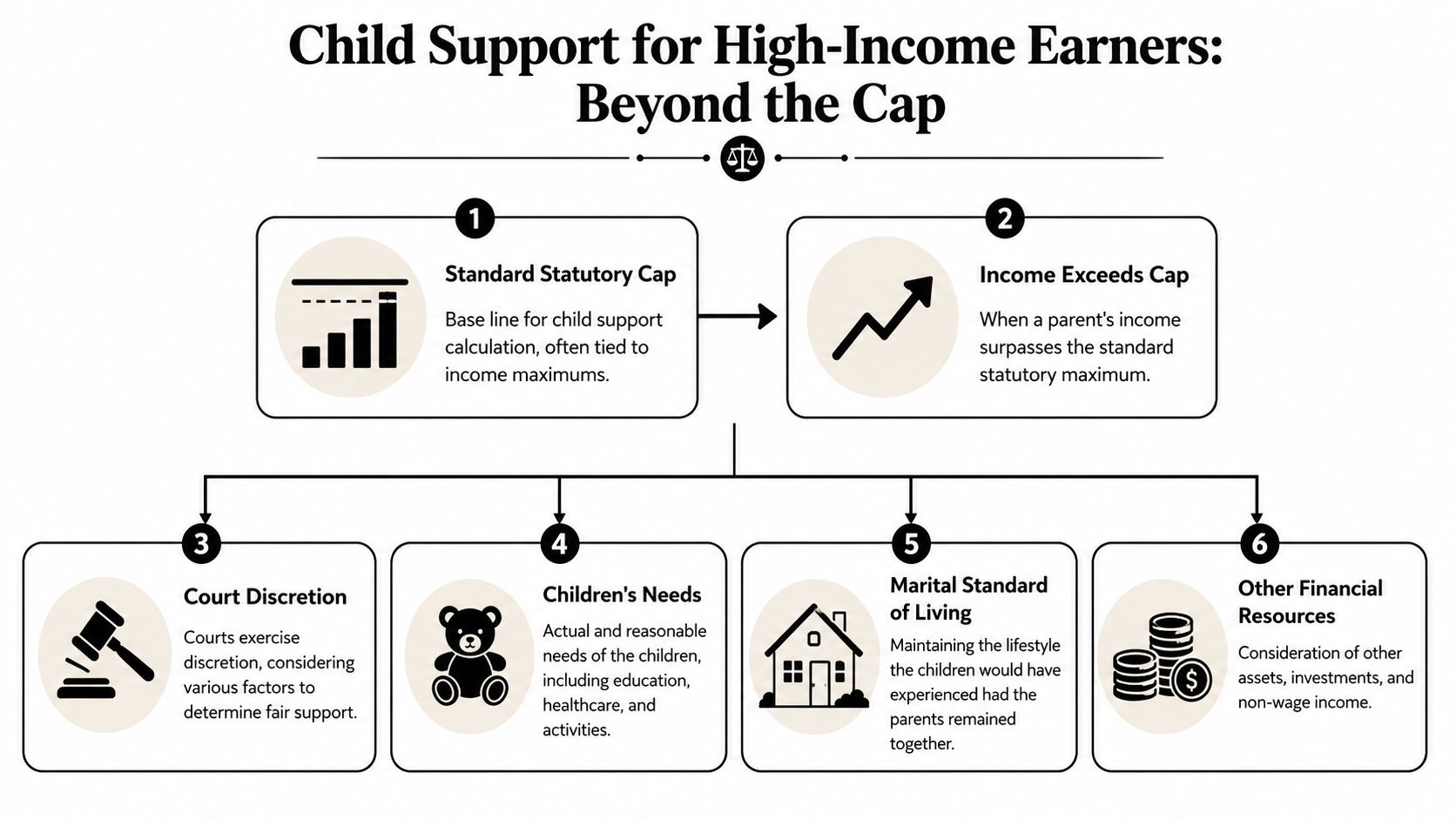
Under Texas Family Code §154.123, the court may deviate from standard guideline support when the evidence justifies it. The key issue in these cases is usually the proven needs of the child. For high earners, the statutory cap is the guideline starting point. It is not an automatic ceiling in every case.
A useful discussion of that issue appears in high-income child support in Texas, which addresses how these disputes move beyond the ordinary guideline calculation.
What courts look for beyond the guideline amount
Texas courts don't award higher support merely because one parent earns a lot. The parent seeking additional support still has to present evidence. In real litigation, that usually means records that tie actual expenses to the child's needs.
Those needs can include items like:
- Education costs: Tuition, tutoring, school fees, and required academic expenses if those costs are established and supported by evidence.
- Health-related needs: Ongoing medical, dental, therapeutic, or developmental expenses not covered elsewhere.
- Activity and development costs: Sports, lessons, camps, and structured activities if they are part of the child's actual life and not just aspirational wish lists.
- Lifestyle continuity evidence: In some cases, attorneys argue for support that reflects the standard of living the child would have experienced, but that argument still needs documentation and context.
Why the Wayne story fits this legal framework
Public reporting tied to Wayne's interviews describes his case as a benchmark for Texas Family Code §154.123, which allows deviation from standard guidelines when the child's needs justify additional support, especially when the obligor's resources far exceed the statutory cap, as noted in the People Magazine post discussing that framework.
That doesn't mean every high-income parent in Texas faces a comparable outcome. It means the law leaves room for support above the guideline amount if the evidence supports it. In celebrity cases, people see a headline and assume the money alone drives the result. In court, judges still ask the same question they ask in non-celebrity cases: what are the child's proven needs, and what amount is supported by admissible evidence?
This short video gives a useful overview of how high-income support disputes are often framed:
What works and what fails in these cases
High-income cases are won with disciplined evidence, not theatrics.
What works:
- Detailed expense summaries: Organized by category and supported with invoices, statements, and payment records.
- Credible income tracing: Especially in business-owner and self-employment cases.
- Focused requests: Asking for support tied to actual child needs rather than using the hearing as a referendum on the other parent's wealth.
What fails:
- Lifestyle arguments without documents
- Inflated budgets that mix child expenses with adult spending
- Assuming a judge will punish a wealthy parent just because the parent can afford more
The Legal Process for Establishing and Modifying Support
Kountry Wayne's reported support situation gets attention because the number is large. The legal lesson is more useful than the headline. In Texas, support is set and changed through procedure, evidence, and signed orders. High-income parents feel that pressure more sharply because income can be harder to trace and disputes over a child's needs tend to be more detailed.
Establishing an original support order
An original support case usually starts with the right petition in the right court. That sounds basic, but filing under the wrong case type or asking for incomplete relief creates avoidable problems later. In practice, I watch parents focus on the monthly number and ignore the order's structure. That is a mistake. The order also needs to address medical support, dental support, payment method, start date, and sometimes retroactive child support.
Service of process is the next pressure point. If service is defective, the hearing may be delayed, or the order may be exposed to attack later. Celebrity or non-celebrity, the court still expects the same thing. Proper notice, proper pleadings, and admissible proof.
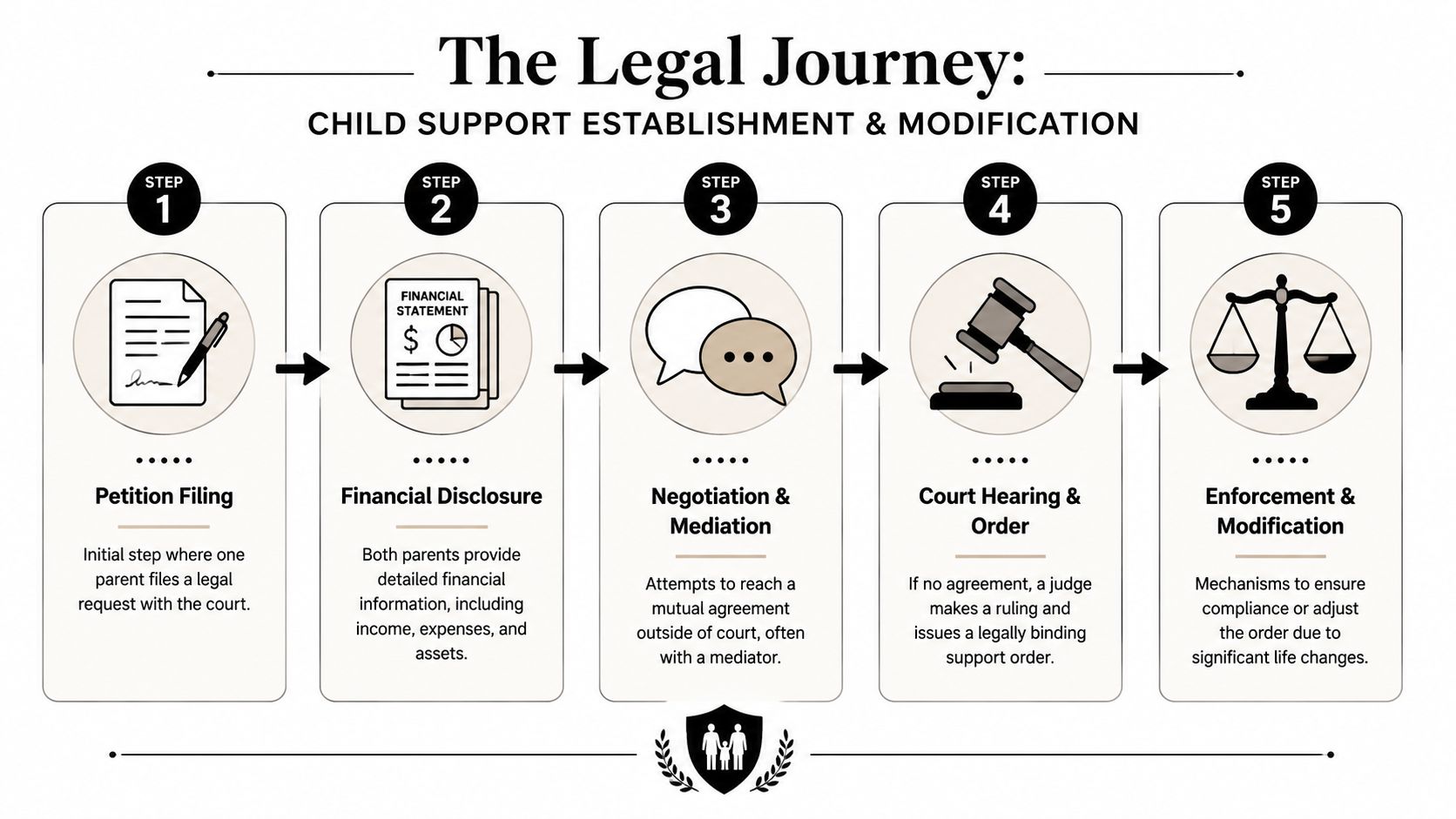
Most cases then move through four stages:
Filing and pleadings
The petition has to ask for the specific relief the court is allowed to grant. If you want support above guideline levels, retroactive support, or reimbursement of certain child-related expenses, your pleadings should make that clear.Financial exchange and discovery
Each parent gathers income records and other financial documents. In a high-income case, this often means business records, account statements, contract income, and proof that separates personal spending from child-related spending.Negotiation or mediation
Many support disputes settle here. Settlement saves time and cost, but only when both sides are working from real numbers instead of assumptions.Final hearing or trial
If no agreement is reached, the judge decides the disputed issues under the Texas Family Code and the evidence presented in court.
Modifying an existing order
Support orders do not update themselves when income rises, work changes, or a child's expenses increase. Until a new order is signed, the old one controls.
To modify support, a parent usually must show a material and substantial change in circumstances since the prior order. That may involve a job change, a business income swing, a change in custody time, or increased needs for the child. Parents dealing with that issue can review how to modify child support in Texas for a practical outline of the process.
Timing matters here. A parent may have a strong reason to seek modification and still lose months of relief by waiting too long to file.
Problems that create arrears and enforcement fights
The biggest mistake is informal side deals. Parents agree by text or phone to reduce or increase support, then assume the agreement changed the legal obligation. It did not.
That usually leads to three problems:
- Underpayment under the existing order: The paying parent follows the informal agreement instead of the signed order.
- Arrears that keep accruing: The state's payment record may continue charging the prior amount.
- Enforcement exposure: The receiving parent can still enforce the written order unless the court signed a modification.
Another common problem is treating irregular income casually. A parent with bonuses, self-employment income, performance revenue, or business distributions needs a clean record that shows what was earned and what was available for support. In higher-income cases, vague testimony is rarely enough.
Bring a judge organized records and a clear request. Bring confusion, and the case gets harder and more expensive.
Where legal help fits
A well-prepared support case is built long before the hearing date. Counsel can help identify the controlling order, frame the request correctly, gather the records the judge will consider, prepare exhibits, and test whether the proposed amount fits Texas law and the available proof.
The Texas Child Support Law Office of Bryan Fagan handles cases involving establishment, modification, enforcement, and disputes over guideline and above-guideline child support.
Verifying Information and Preparing for Court
Celebrity interviews create attention, but they don't create admissible evidence. That distinction matters.
Wayne's self-reported $200,000 figure highlights the right legal lesson for Texas parents. Public statements are not court orders. In Texas child support litigation, support turns on official net-resource calculations and proven needs, not public discussion, as reflected in Wayne's public interview record on Sherri's program clip.
What courts care about
A judge doesn't decide child support based on a headline, a rumor, or what someone said on a podcast. The court wants records.
That usually means:
- Income documents: Pay stubs, tax returns, business records, profit-and-loss statements, and bank records when appropriate.
- Expense proof: School bills, medical invoices, insurance costs, therapy records, and activity expenses tied to the child.
- Order history: Prior court orders, payment histories, and any enforcement record if arrears are at issue.
How to prepare the right way
The parents who present best in court usually do three things well.
- They separate child expenses from adult expenses. If your exhibit binder mixes groceries, rent, personal shopping, and child-specific costs without explanation, the judge will notice.
- They organize records before the hearing. Dumping a stack of unsorted statements on counsel the night before court is expensive and ineffective.
- They avoid arguments built on suspicion. If you think the other parent is hiding income, you need discovery and documents, not guesses.
The practical lesson from public cases
Family law records are often harder for the public to verify than entertainment stories suggest. Privacy concerns, sealed materials, and limited public access can all affect what outsiders can see. That's why experienced lawyers treat media reporting as background noise unless it lines up with evidence that can be admitted.
If you're preparing for court, think like a trial lawyer, not a spectator. Build your case with records, timelines, and proof you can hand to a judge.
Frequently Asked Questions About Texas Child Support
Does 50 50 custody eliminate child support in Texas
No. Equal possession doesn't automatically eliminate support. Texas courts still analyze income, net resources, the terms of the parenting order, and whether one parent should pay support to balance the children's financial support across households.
Can a high-income parent limit support to the guideline cap
Not always. The guideline amount based on the cap is the starting point under §154.125, but in the right case a court can go above that amount under §154.123 if the child's proven needs support more.
What if the paying parent is self-employed
Expect more scrutiny. Self-employment cases often turn on business records, bank activity, tax filings, and disputes over whether claimed business expenses are legitimate for child support purposes. These are document-heavy cases, and they reward preparation.
Do voluntary payments count the same as court-ordered support
Not necessarily. Voluntary payments may matter, but they do not replace the need for a signed court order. If you want enforceable terms, you need an enforceable order.
Can child support be changed after an order is entered
Yes, if the legal standard for modification is met. The court will look at whether there has been a material and substantial change in circumstances or another basis recognized under Texas law.
What should I bring to my first meeting with a lawyer about child support
Bring what proves the case, not just what tells the story.
Start with:
- Current orders: Any divorce decree, SAPCR order, modification order, or Attorney General paperwork.
- Income records: Recent pay information, recent tax returns, and business records if you're self-employed.
- Child expense documents: Health insurance records, school invoices, medical bills, therapy costs, and activity expenses.
- Communication history: Messages or emails that show disputed issues, payment discussions, or changes in possession arrangements.
What mistakes hurt parents most in support cases
Three show up constantly.
- Waiting too long to file: Support problems usually don't fix themselves.
- Relying on informal agreements: A side deal without a court order creates enforcement problems.
- Treating the case like a fairness debate instead of an evidence case: Judges decide based on the Family Code and the record in front of them.
Is a celebrity support figure useful in my own case
Yes, but only as an illustration of how the law can work at the high end. It is not a template for your order. Your case will turn on your income, your child's needs, the governing Texas statutes, and the evidence you can prove.
If you're dealing with support establishment, modification, high-income calculations, or an income dispute under the Texas Family Code, Texas Child Support Law Office of Bryan Fagan provides case-specific guidance for parents across Texas. The most effective next step is to review your order, your income proof, and your child-related records with counsel before you file or respond.