You're about to close on a home sale, refinance a property, transfer a vehicle title, or collect settlement money after an injury claim. Then someone tells you the deal can't move forward because of a Texas child support lien. That's the moment panic sets in.
For the parent who owes support, this usually feels sudden, even when it shouldn't. For the parent trying to collect unpaid support, it can feel like the first real advantage you've had in a long time. Both reactions are understandable. Both sides also make costly mistakes when they don't understand how aggressive Texas law can be.
A child support lien in Texas isn't a technical footnote. It's an enforcement weapon built into the Texas Family Code. It can tie up property, intercept money before you touch it, and stay in place until the underlying support debt is fully dealt with. If you're walking into court, negotiating with the Office of the Attorney General, or trying to clear title before a transaction, you need a strategy, not guesswork.
The Unexpected Obstacle to Your Financial Future
A father gets a call from his title company two days before closing. He expects routine paperwork. Instead, he learns there's a lien tied to unpaid child support. The sale can't proceed cleanly until that issue is addressed. He's frustrated because he thought making recent payments would be enough. It wasn't.
A mother waiting on overdue support gets a different call. She's told the other parent may receive funds from a claim, settlement, or sale. For her, the lien is not a surprise problem. It's the first sign that Texas enforcement tools may finally force payment.
Those are the two sides of a child support lien Texas case. One side sees a frozen asset. The other sees overdue support that should've been paid long ago.
Practical rule: If arrears exist, assume any significant transaction involving the obligor can trigger enforcement problems until you confirm the lien status in writing.
What matters most is speed and accuracy. If you owe support, you need to verify the balance, identify what property is encumbered, and stop relying on assumptions. If you're owed support, you need to act before the money disappears into fees, transfers, or avoidable delay.
The biggest mistake I see is passivity. Parents wait for the closing date, the settlement date, or the court date. That's backwards. A lien problem should be addressed as soon as arrears become part of the conversation.
Here's the hard truth. In Texas, unpaid child support can follow your property, your proceeds, and your financial opportunities. If you're the parent trying to collect, that reach is useful. If you're the parent trying to clear the lien, delay only makes the process harder.
How a Texas Child Support Lien Is Created
A lien problem usually surfaces at the worst possible time. The obligor is trying to close a sale, refinance property, or collect funds. The obligee is trying to stop money from slipping away before arrears are paid. In Texas, that fight often starts before either parent fully understands the timing. A child support lien can arise by law once support is due and unpaid. Waiting for a fresh court order is a costly mistake.
Under Texas Family Code §157.311, a child support lien arises by operation of law against the obligor's real and personal property for child support that is due and owing, including retroactive support. That rule gives the obligee immediate legal advantage. It also puts the obligor at risk long before a closing agent, lender, or title company raises the issue.

Automatic lien versus enforceable notice
This is the distinction parents miss. The lien can exist automatically, but collecting against property and forcing third parties to respond usually depends on proper notice and filing. If you represent the obligee, do not confuse having lien rights with having a lien that will stop a transaction. If you are the obligor, do not assume no real problem exists just because you have not seen a judge sign a new enforcement order.
Texas law also requires specific content in the lien notice. If the notice is sloppy, incomplete, or inaccurate, the obligee can lose pressure at the exact moment pressure matters. As summarized by DivorceNet's discussion of Texas child support liens under Chapter 157, notice details affect whether the lien is effective against others handling the property.
The sequence is straightforward:
- A support order sets the payment duty.
- The obligor misses payments and arrears accrue.
- The lien arises by law for the unpaid amounts.
- A notice of lien is filed or delivered to perfect and enforce that right against others.
- Buyers, lenders, insurers, title companies, and other holders of property or funds respond to the lien.
That timing creates strategy for both sides. The obligee should move early and file correctly. The obligor should get the exact arrearage amount, review the notice line by line, and stop guessing.
Where and how the lien gets filed
Filing location matters because the goal is to put the right people on notice. The notice may be filed where the obligor lives, where the obligor owns property, or where the court of continuing jurisdiction sits, as explained in this Texas child support enforcement overview. Different assets can require different steps to make the lien effective in practice.
Vehicles are a common trap. Parents assume arrears alone will immediately block a transfer. The process is narrower than that. DivorceNet's summary notes that a vehicle lien is perfected when a subsequent title reflects the child support lien. That filing detail can decide whether the obligee has real power or just an argument.
What each parent should do once arrears exist
If you are the obligee, act like delay helps the obligor. Get the payment record. Confirm the arrears. Make sure the notice of lien is accurate before funds are disbursed or property is transferred. A late or defective filing can turn a strong collection tool into a missed opportunity.
If you are the obligor, get organized fast. Pull the support order, payment history, interest calculation, and any filed lien notice. Check whether the arrears amount is correct and whether the notice matches the statute. If the underlying support amount traces back to a disputed order, the support calculation issue may need separate attention. How Child Support Is Calculated in Texas explains that framework.
A Texas child support lien is not just paperwork. It is a pressure point. The obligee should use it carefully and early. The obligor should treat it as an immediate legal and financial threat, because that is exactly what it is.
What Property a Child Support Lien Can Attach To
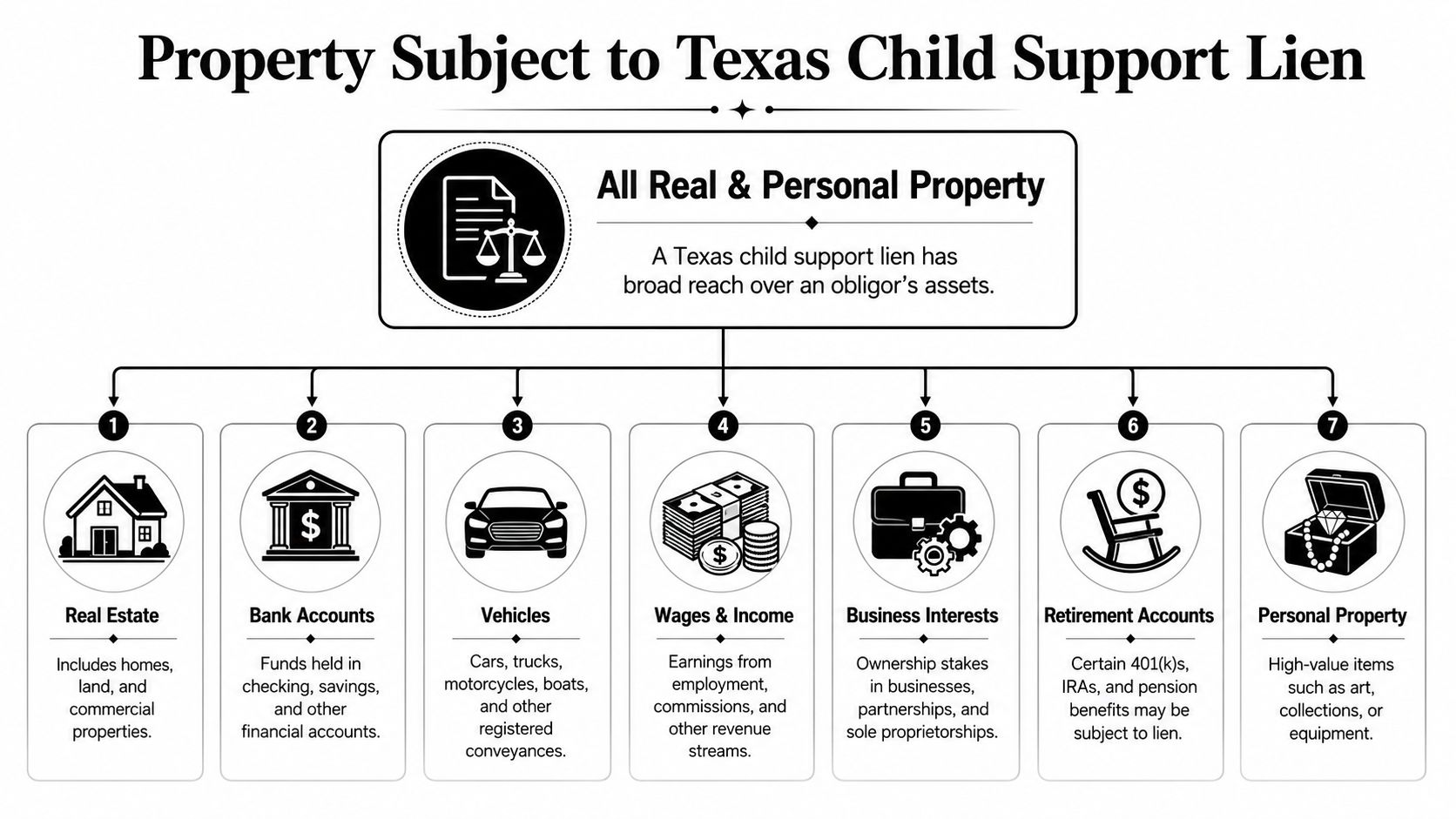
Texas gives child support liens broad reach. If you owe substantial arrears and think the problem is limited to your paycheck, you're underestimating the statute.
Under the discussion of Texas Family Code §157.317 and child support liens on personal injury recoveries, a child support lien attaches to all non-exempt real and personal property, including proceeds from insurance policies, settlements for personal injury claims, and other compensation awards, securing the full amount of past-due support plus interest. That's why lien cases often surface at exactly the wrong moment, when money is about to change hands.
Real property and titled assets
Real estate is the obvious category. Homes, land, and other non-exempt real property can become tangled in title problems when a lien exists. If the obligor tries to sell or refinance, the title review can expose the issue.
Vehicles also matter, but with an important wrinkle. A secured lien on a vehicle has priority over the child support lien according to the verified Texas lien summary. That means a prior car lender may stand ahead of the child support claimant as to that collateral. Still, the child support lien can remain a serious obstacle to transferring title or collecting sale proceeds.
Consider these common examples:
| Asset type | Typical lien consequence |
|---|---|
| House or land | Sale or refinance can stall until lien issues are resolved |
| Vehicle | Title transfer may be blocked or complicated |
| Bank funds | Account can be frozen in the lien amount when proper steps are taken |
| Insurance or settlement proceeds | Funds can be intercepted before the obligor receives them |
Financial claims and lump sum recoveries
Obligors often get blindsided. Texas doesn't limit child support liens to physical property sitting in your name. The lien can reach money you are entitled to receive, including compensation claims and certain proceeds.
That includes:
- Insurance proceeds: Claim money can be reached before it lands in your hands.
- Personal injury settlements: The lien can attach to the net amount payable after attorney's fees, medical bills, and expenses are deducted.
- Annuities and compensation awards: These can also fall within the lien's reach.
- Bank accounts: The lien can be delivered to financial institutions to freeze funds in the lien amount under the Texas procedures summarized earlier.
That “net amount payable” concept matters. The lien doesn't automatically swallow gross recovery without regard to case costs. But don't mistake that limitation for protection. Many obligors expect a check and discover the available balance is far smaller because the child support claim comes out of what remains.
What both sides should do with this information
If you're the obligee, think strategically about where value sits. The obligor may not have obvious wage income, but may have equity, account funds, or pending proceeds.
If you're the obligor, stop moving assets around in hopes that the problem will disappear. That usually creates more scrutiny and less flexibility.
A child support lien is most dangerous when the obligor assumes only wages are at risk. Texas law reaches far beyond a paycheck.
The phrase non-exempt property matters too. Some assets may be protected by exemption law, while others are fair game. That's a fact-sensitive issue. Treat it like one. Don't assume an asset is safe just because you need it or because you've always viewed it as personal.
The Real-World Consequences of an Active Lien
You line up a home closing, expect sale proceeds to wipe out other debt, and then the title company tells you the deal cannot fund until the child support lien is addressed. Or you settle an insurance claim and learn the carrier may send money through the required child support process before you ever touch the check. That is how these cases hit people in real life. The lien stays quiet until an asset is about to turn into cash, then it controls the transaction.

For the obligor, an active lien strips away timing and bargaining power. For the obligee, it creates real collection pressure, but only if used with discipline. That strategic tension matters. The parent who owes support usually wants speed, privacy, and room to negotiate. The parent enforcing support wants the asset identified, the payoff confirmed, and the proceeds captured before they disappear.
Closings, refinances, and title pressure
Real estate is where many obligors finally understand the seriousness of a child support lien. Title companies and lenders do not ignore recorded claims. If the lien is tied to the seller or the property records raise a problem, the transaction can stall until the balance, release terms, or disbursement instructions are resolved.
That creates three immediate problems for the obligor:
- Closing deadlines get tighter: A scheduled sale or refinance can turn into a rush to verify the payoff amount.
- Paperwork starts to control the deal: Missing lien information, old payment records, or inconsistent arrearage figures can delay funding.
- Negotiating power drops fast: The obligor is no longer negotiating from a calm position. The calendar, the buyer, and the lender are now applying pressure.
The obligee should not waste that pressure. If there is a pending sale, get accurate payoff information in writing and make sure the closing agent has clear instructions. Sloppy enforcement can reduce proceeds or create a dispute that postpones collection.
Insurance and settlement money can be intercepted before you receive it
An obligor who is waiting on an insurance payment or other claim proceeds often assumes the money will arrive first and the child support issue can be sorted out later. That is a bad assumption. Texas administrative rules require insurers to check for child support judgments in covered situations and to handle payment accordingly when a match appears. In practice, that means the funds may be redirected before the obligor deposits anything.
The same pressure shows up in settlement discussions. A parent expecting a net recovery may find that lien resolution becomes part of the payout conversation immediately. That changes case value, settlement timing, and distribution strategy for everyone involved.
If you want the blunt version of how missed support turns into collection pressure, read what happens if child support is not paid.
The lien changes the transaction, not just the paperwork
An active lien affects more than legal records. It changes how other people deal with the obligor's money and property.
| Situation | What usually happens |
|---|---|
| Pending property sale | Closing funds are held up until the lien issue is addressed |
| Refinance application | Lender or title review may stop the file until payoff and release terms are clear |
| Insurance claim payout | Funds may be redirected through the child support process before payment reaches the obligor |
| Settlement negotiations | Expected net proceeds shrink because lien resolution must be accounted for |
| Asset transfers | Banks, carriers, and other third parties act cautiously once the lien appears in their review |
Both sides should treat timing as the central issue.
If you are the obligor, do not wait until the week of closing, settlement, or payout to ask what is owed. Get the balance, compare it to your records, and fix discrepancies before a third party is holding your money. If you are the obligee, do not assume the lien alone does the work. Follow the asset, confirm who is paying out funds, and press for clean disbursement instructions.
A child support lien becomes most effective at the moment an asset is about to convert into usable cash. That is the point where strategy beats denial, and where preparation usually decides who controls the outcome.
How to Release or Challenge a Child Support Lien
A lien doesn't disappear because you're frustrated, because a closing is scheduled, or because you made some payments recently. It ends when the legal basis for it is satisfied or when a court determines it shouldn't stand as filed.
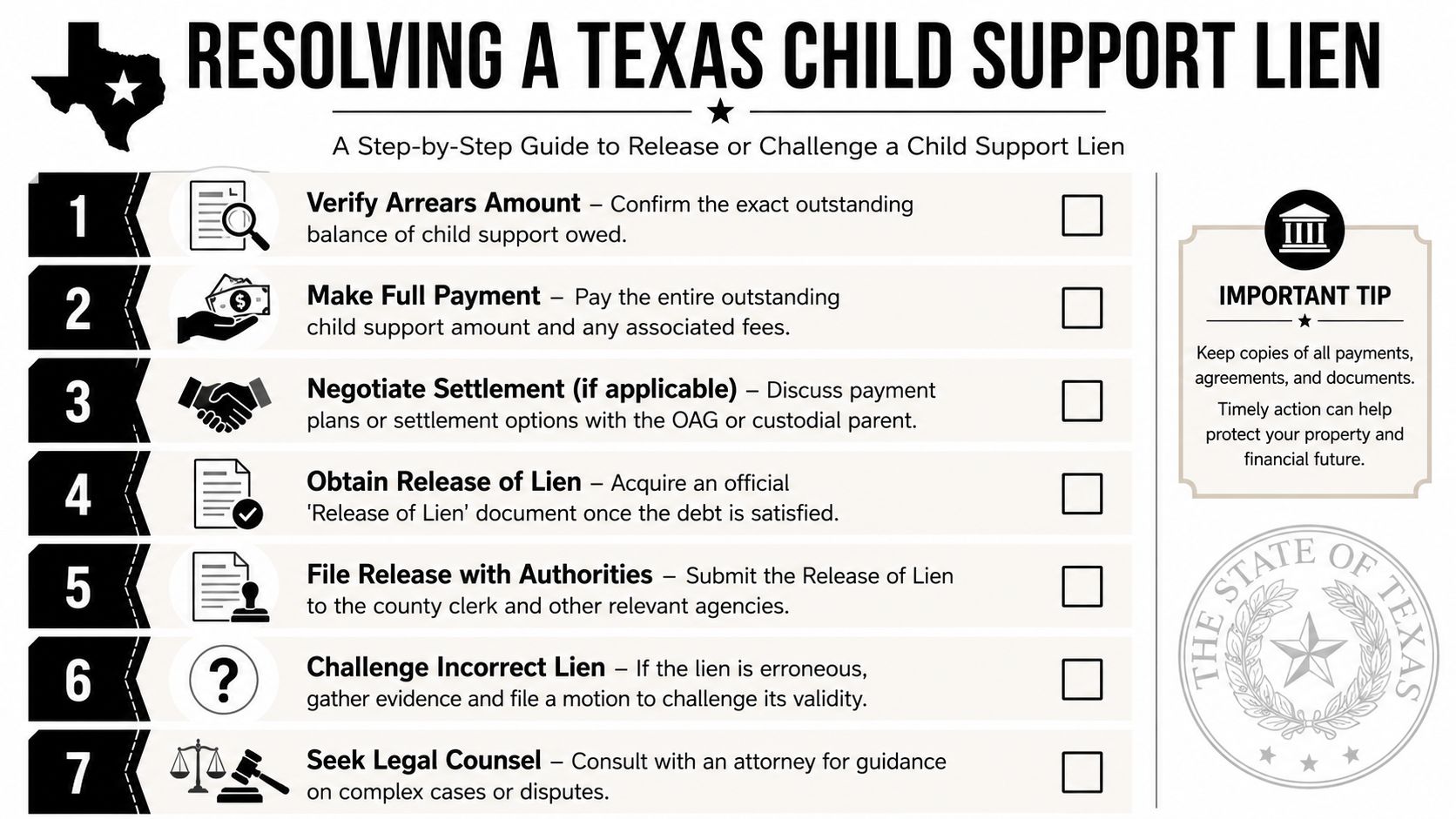
Texas law is strict here. Under Texas Family Code §157.318 as summarized by FindLaw, a child support lien is legally effective until all current support, arrearages, attorney's fees, and court costs are fully paid, and it automatically attaches to non-exempt property including insurance proceeds and settlement awards. If you still owe part of the enforceable balance, don't expect a full release.
When the lien should be released
If you've paid everything required, move fast and document everything. Don't assume the release will magically record itself.
Use this checklist:
Confirm the exact balance
Get the current arrearage figure and confirm whether it includes interest, attorney's fees, and court costs.Gather payment proof
Keep receipts, account statements, disbursement records, and any agency confirmation.Request the release in writing
Ask the enforcing party or agency for a formal release document.File the release where the lien was recorded
If the notice was filed with a county clerk or tied to other property records, the release has to be filed there too.Verify the records were updated
Don't stop at filing. Confirm the county and any relevant title or asset records reflect the release.
If a transaction is pending, your lawyer should coordinate directly with the title company, insurer, or institution holding funds. Timing matters.
When the lien is wrong or overstated
Not every lien is valid as filed. Some are challenged because the amount is wrong. Others involve mistaken identity, bad records, or notice defects.
A challenge usually requires evidence, not outrage. Useful documents include:
- The original support order
- Any modification orders
- Payment history
- Agency records
- Proof identifying the property
- The filed notice of child support lien
If the numbers are wrong, line up your payments against the official ledger. If the wrong person or wrong property was targeted, prove ownership and identity cleanly. If notice requirements weren't met, raise that issue precisely.
Case strategy: The fastest way to lose a lien challenge is to walk into court with a story but no records.
For parents trying to reduce arrears exposure before enforcement gets worse, the firm's discussion of child support arrears in Texas is a useful starting point because arrears accounting drives the entire release process.
Partial relief and negotiated solutions
Sometimes full payment isn't realistic before a closing or payout. In those situations, partial resolution may still be possible. The verified Texas lien summary notes that the Attorney General's Office may waive part of the lien to allow the obligor partial recovery when lien value exceeds remaining funds after fees and expenses, reducing the arrearage balance without eliminating it.
That can be a practical option when everyone wants the transaction to go through. The obligee gets money now. The obligor gets some movement. The arrears don't vanish, but the impasse can break.
If you're the obligee, don't reject a structured resolution out of spite. If you're the obligor, don't treat a partial waiver as forgiveness. It's not.
Strategic Child Support Management for Parents
You learn about the lien when a refinance stalls, a settlement check gets frozen, or a property transfer gets flagged. By then, the advantage usually belongs to the parent who acted first. That is why smart child support management starts long before lien enforcement shows up.
For obligors, the central mistake is waiting for arrears to become an enforcement case. Texas courts enforce written orders, not private understandings and not reduced payments you decided were reasonable. If your income drops or possession changes, fix the order fast. Under Texas Family Code §154.125 as summarized here, guideline support starts with a percentage of net monthly resources, and §154.123 allows deviation when the facts support it. The point is simple. Know the baseline amount, know whether a deviation argument exists, and do not guess.
For obligees, delay is expensive. If payments start slipping, document the shortfall, confirm the running balance, and push enforcement before the arrears story gets muddied by excuses, off-the-books payments, and missing records. A parent who stays organized usually controls the dispute.
Modification is the pressure valve. Use it.
Under Texas Family Code §156.401, as summarized by this overview of Texas child support modification procedure, modification turns on a material and substantial change in circumstances or the passage of three years with a qualifying difference under the guidelines. That matters to both sides. The obligor uses modification to stop a bad order from producing new arrears. The obligee uses it to correct an outdated order that no longer reflects the other parent's actual earning ability or the child's needs.
Here is the strategy I recommend.
- If you are the obligor: Audit your case early. Read the current order, confirm what is due each month, and compare that number to your payment history and present income. If the order no longer fits reality, file for modification before arrears stack up.
- If you are the obligee: Treat missed payments as an evidence problem first and an emotional problem second. Keep a clean ledger, save communications, and act while the records are easy to prove.
- If either side disputes income: Use tax returns, pay stubs, bank records, and employer records. Judges trust documents far more than explanations.
- If there is a chance of settlement: Tie every agreement to a written order or written release terms. Verbal side deals create fresh litigation.
- If the case has turned into enforcement, modification, and lien exposure at the same time: Build one coordinated plan. Do not fight the arrears issue, the monthly support issue, and the property issue in isolation.
The strategic interplay matters. An obligor who files a well-supported modification promptly can limit future damage, narrow the arrears fight, and improve settlement options. An obligee who monitors payments closely and enforces without delay can prevent asset transfers, preserve their advantage, and avoid collection problems that get worse with time.
One more point. Do not confuse hardship with a legal defense, and do not confuse anger with a legal strategy.
A focused option is the Texas Child Support Law Office of Bryan Fagan, which handles establishment, modification, enforcement, and defense of child support matters under the Texas Family Code.
Frequently Asked Questions About Texas Child Support Liens
A child support lien usually becomes urgent when someone is trying to close a sale, refinance a property, settle an injury claim, or access funds that suddenly are not available. At that point, both sides need to think strategically. The obligor needs to confirm the amount and stop avoidable damage. The obligee needs to act fast enough to preserve collection options before money changes hands.
Can a child support lien affect the sale of my home or vehicle
Yes. A recorded or filed lien can block a clean transfer and force the issue into the closing process. Under Texas Family Code Chapter 157, a child support lien can attach to non-exempt real and personal property, so a home sale, vehicle transfer, or refinance can stall until the lien is resolved.
Does a child support lien in Texas only apply to real estate
No. It can reach far more than land. Texas Family Code §§ 157.312 and 157.317 allow child support lien procedures that can affect non-exempt personal property, financial accounts, claims, and proceeds, not just real estate.
Can partial payment remove the lien
Usually no. Partial payment may reduce the balance, but it does not automatically produce a full release. If a transaction is pending, the obligor should push for written payoff terms or a limited release tied to that deal, and the obligee should make sure any release states exactly what balance remains due.
Can I challenge the lien if the amount is wrong
Yes, but proof decides these fights. Pull the payment record, every support order, every modification order, and the filed lien notice. Texas Family Code § 157.323 provides procedures to contest a lien, and a parent who shows up with excuses instead of records usually loses.
Can bankruptcy erase child support lien problems
No one should count on bankruptcy to fix child support arrears. Child support is treated differently from ordinary unsecured debt, and enforcement tied to support obligations often survives the relief people expect from bankruptcy.
Will the lien disappear if enough time passes
Do not assume that. Texas child support enforcement has a long reach, and delay usually helps the parent trying to avoid payment or the parent trying to hide assets. Check the current balance, verify whether a lien notice was properly filed, and deal with it directly.
Can Texas enforce child support issues when money comes from an insurer
Yes. Texas Family Code §§ 157.327 and 157.328 address child support lien procedures involving insurance claims and certain settlements. If insurance money is about to be paid, the obligee should act before disbursement. The obligor should assume those funds may be intercepted.
What's the best move if I know arrears are building
Act now. If you owe support, review whether a modification is justified and get in front of the lien problem before property or proceeds are tied up. If support is owed to you, confirm the arrears, document the assets in play, and press enforcement before the money is gone.
If a child support lien is already affecting your property, settlement funds, or court position, treat it like a live enforcement problem, not paperwork. Texas Child Support Law Office of Bryan Fagan handles establishment, modification, enforcement, and defense of child support matters under the Texas Family Code. The right move depends on which side of the case you are on, what property is exposed, and whether the lien amount will hold up under scrutiny.