If you're headed to a Texas child support hearing and you're worried the other parent is understating income, you're asking the right question. In most cases, the fight isn't about whether support should be paid. The key dispute is over what income number the court will use.
Texas child support isn't based on guesswork. It's built on a statutory formula, and that formula only works if the court has reliable financial proof. If your evidence is thin, incomplete, or poorly organized, the court may rely on the other side's version of events, estimate income from limited records, or reject a modification request that might otherwise have succeeded.
When clients ask me how to prove income for child support in Texas, I don't start with a generic document list. I start with strategy. What kind of income are we dealing with. W-2 wages. Overtime. Cash jobs. Self-employment. Business distributions. Rental income. Bonus compensation. Then I look at what the court needs under the Texas Family Code, what records persuade judges, and what tools are available when the other parent won't cooperate.
The Foundation of a Fair Texas Child Support Order
You get to court. The other parent says they make far less than they used to, hands over a couple of recent pay stubs, and asks the judge to accept that number. If you are not prepared to show the full income picture, that number can frame the entire hearing.
A fair child support order starts with proof that holds up under Texas law. Under Texas Family Code §154.062, the court calculates support from a parent's net resources, which can include far more than base wages. Salary is only part of the analysis in many cases. Overtime, commissions, bonuses, self-employment income, rental income, severance, and other recurring payments can all matter depending on the facts.
Judges are not looking for a stack of papers for its own sake. They are deciding whether the income evidence is complete, credible, and consistent with how the parent earns a living. If the records are thin, the court may rely on limited evidence, draw inferences from what is missing, or hear an argument that income should be imputed under Texas Family Code §154.066 if a parent is intentionally unemployed or underemployed.
What the Court Looks For
Texas child support cases are won or lost on the quality of the income record. The court needs enough detail to identify all sources of income, separate true business expenses from personal spending, and convert uneven earnings into a usable monthly number under the Family Code.
That is why one pay period rarely settles the issue.
In straightforward wage-earner cases, the question is usually whether the file shows a reliable pattern. In harder cases, the strategy changes. A parent paid in cash may require bank record analysis. A business owner may require subpoenas, deposit tracing, or a forensic accountant who can explain whether claimed deductions reduce taxes but do not reduce child support income. If the other parent is hiding the ball, the answer is not to argue louder. The answer is to force better proof through discovery and present the judge with a clean statutory path to the number you want adopted.
For a broader discussion of the records and proof Texas courts expect, review this guide on evidence needed for a child support case in Texas.
Why Preparation Changes the Result
Preparation does more than make you look organized. It gives the court a reason to trust your numbers instead of the other side's estimates.
A strong child support presentation usually does three things:
- Identifies each income source tied to §154.062, including income that does not appear neatly on a paycheck.
- Uses records that can survive cross-examination, especially where earnings fluctuate or business accounts are involved.
- Explains missing information and gives the court a remedy, whether that is additional discovery, an adverse inference, or an imputed-income argument under §154.066.
That last point matters more than many parents realize. In a cooperative case, documents are enough. In a contested case, the better question is how to prove income when the other parent refuses to produce the right documents, mixes personal and business spending, or reports earnings that do not fit their work history or lifestyle. That is where strategy controls the outcome.
Your Essential Income Document Checklist
A child support hearing often turns on a simple problem. One parent shows up with a few pay stubs, the other side points to missing income, and the judge has to decide which set of numbers is credible.
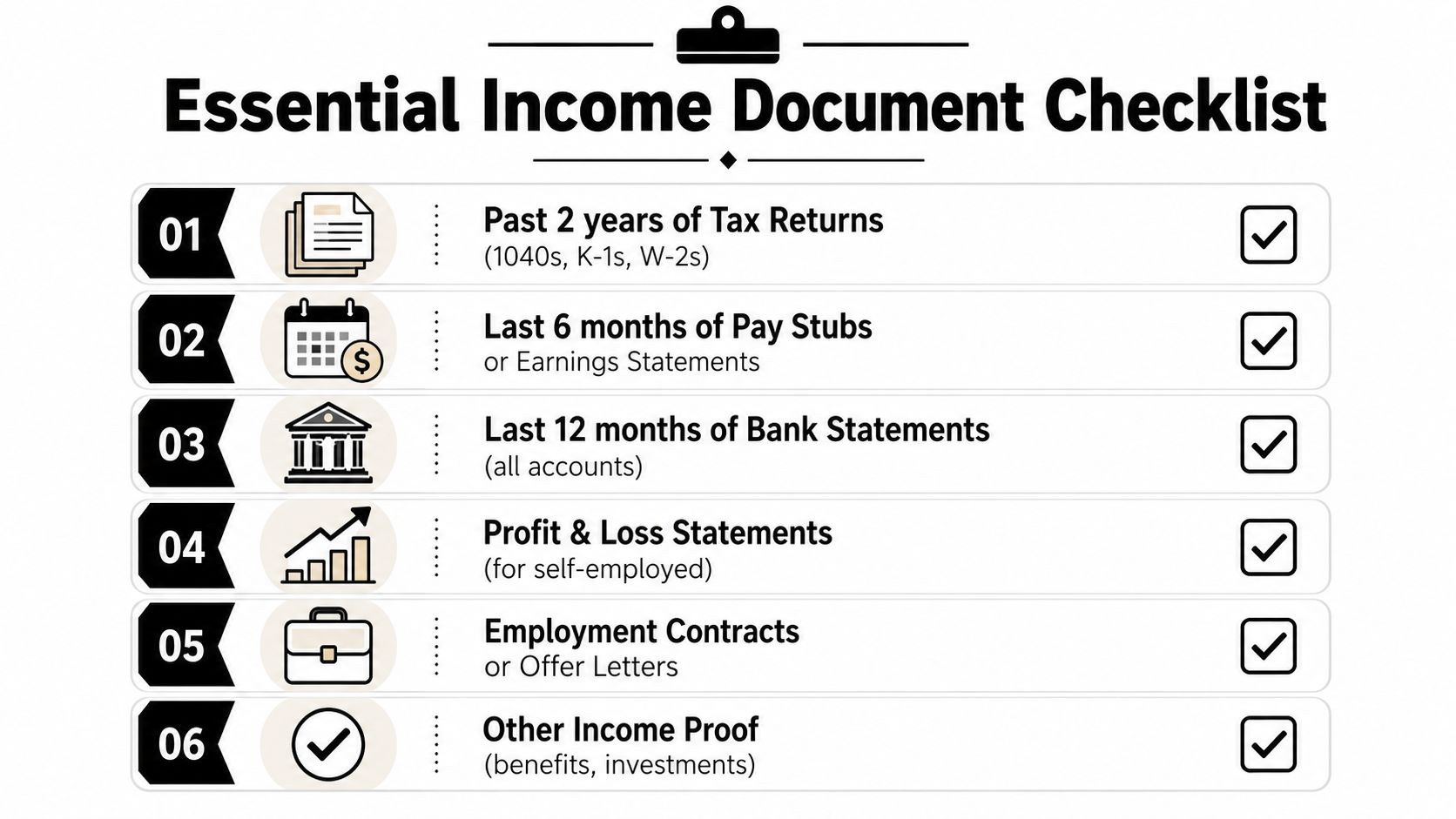
The stronger approach is to build a file that proves income from more than one angle. Under Texas Family Code §154.062, the court is looking for net resources, not a single paycheck in isolation. That means the best document packet confirms earnings over time, exposes side income, and gives you a way to challenge a number that does not make sense.
For a broader list of records Texas courts often expect, review this guide on evidence needed for a child support case in Texas.
The core records that belong in almost every case
Pay stubs
Recent pay stubs usually give the court the cleanest starting point. They show base wages, overtime, commissions, bonuses, retirement deductions, health insurance, and whether the parent is being paid regularly or seasonally.
Bring enough stubs to show a pattern, not a moment. Six months is often more persuasive than two pay periods, especially if the other parent claims hours were cut right before the hearing.
Tax returns
Federal tax returns, with all schedules and attachments, widen the lens. They can show wages, self-employment income, partnership income, dividends, interest, rental receipts, and capital gains that never appear on a payroll statement.
They also create a credibility test. If a parent tells the judge one thing and told the IRS something else, that inconsistency matters.
W-2s and 1099s
W-2s and 1099s help fill gaps that pay stubs and tax returns can blur. They are especially useful when a parent changed jobs, worked for multiple companies, or picked up contract income on the side.
In contested cases, I compare these forms against bank deposits and tax schedules. Missing income often shows up in the mismatch.
Records that usually expose underreported income
The standard checklist is rarely enough in a disputed case. The documents below often decide whether the court accepts the reported income or starts questioning it.
- Bank statements show actual cash flow. Regular deposits that exceed claimed wages can support additional discovery, impeachment, or an argument that income is being understated.
- Employment contracts, offer letters, and bonus plans can prove guaranteed compensation, stock awards, deferred pay, or commission structures that have not hit a paycheck yet.
- Business records such as profit and loss statements, general ledgers, balance sheets, and business account statements matter in self-employment cases. They often show personal expenses paid by the business or revenue that never made it onto a tax return.
- Proof of other income matters under §154.062. That includes rental income, trust distributions, severance, unemployment, disability payments, royalties, and recurring gifts if the facts support treating them as available resources.
One document rarely wins this issue. Consistency across documents does.
How to prepare the file for court
Judges move quickly. A well-organized packet makes your position easier to adopt.
Use date order. Tab each category. Highlight the line items that matter, and prepare a one-page summary that ties each document to a monthly number. If a record is missing, note what is missing and why it matters. That last step is strategic. It sets up a request to compel, a continuance for discovery, or an imputed-income argument under Texas Family Code §154.066 if the other parent has chosen not to cooperate.
Bring a usable record, not a stack of paper. The parent who makes the judge's job easier usually has the advantage.
A practical way to organize the file
| Document category | What it proves | Common problem |
|---|---|---|
| Pay records | Current earnings pattern and payroll deductions | Only producing one or two pay periods |
| Tax filings | Annual income and non-wage income sources | Missing schedules, attachments, or business forms |
| Bank statements | Actual deposits and spending flow | Incomplete months or omitted accounts |
| Business records | Whether claimed self-employment income is reliable | Personal expenses running through the business |
If your case involves a higher-income parent, keep in mind that The 2025 Texas Child Support Income Cap Increase raised the cap from $9,200 to $11,700 effective September 1, 2025 (Texas Family Code § 154.125(a-1)).
Calculating Net Resources and the Guideline Cap
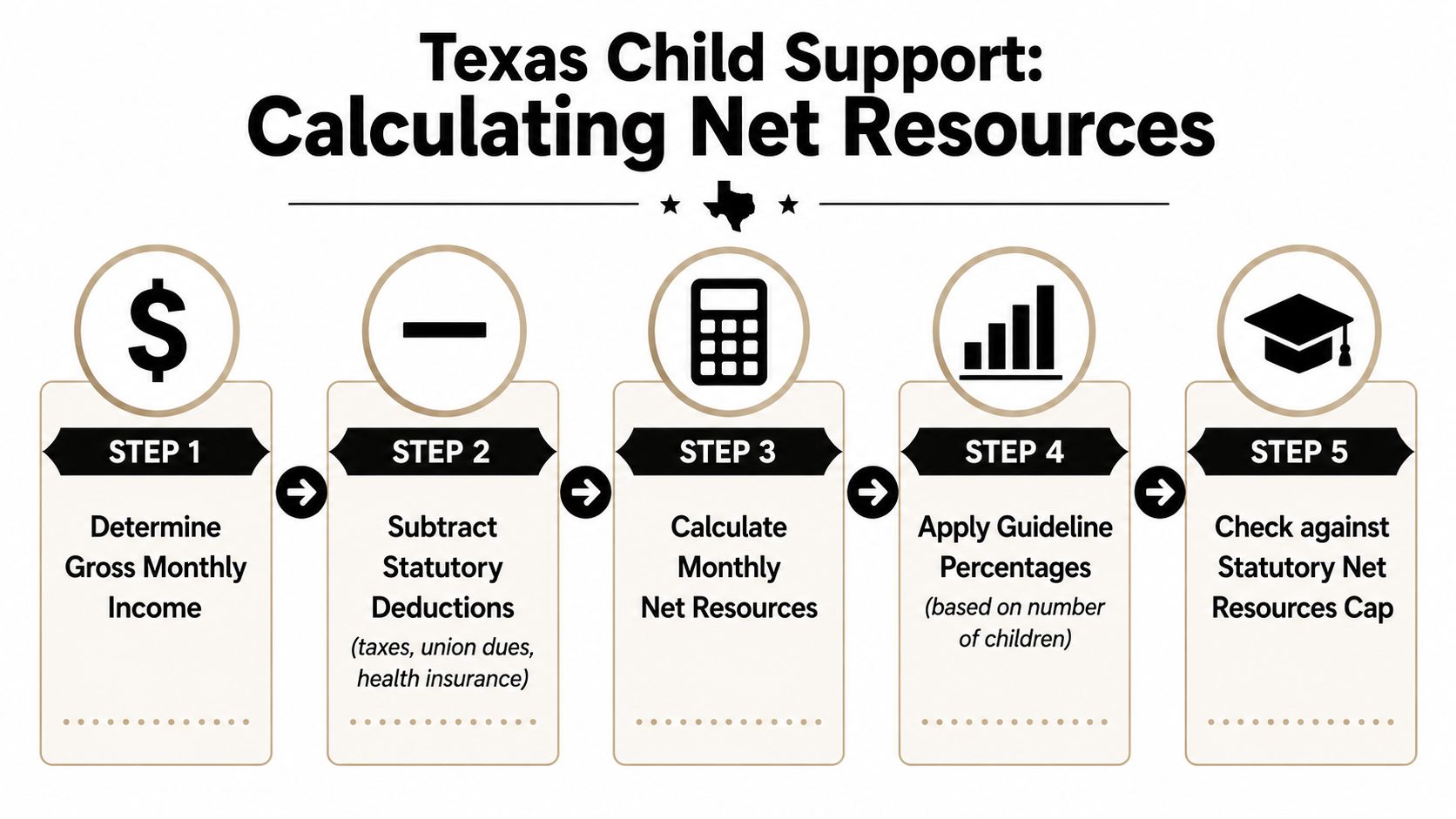
At hearing, income proof either holds up or falls apart. A parent walks in saying, "I make about this much," but the court is not ordering support off estimates or rough ranges. The judge has to calculate monthly net resources under Texas Family Code §154.062 and then apply the guideline percentages in §154.125.
A lot of bad presentations stop at gross pay. That leaves money on the table, or overstates the obligation, depending on which side you represent. The question is not just what came in. The question is what counts, what gets deducted, and what monthly number you can prove with records the court will trust.
For a fuller explanation of the formula, see this guide on how to calculate child support in Texas.
How the math works in court
Judges usually work through the issue in a predictable order:
- Identify gross income from wages, salary, commissions, bonuses, self-employment income, rental income, severance, retirement income, and other sources included by §154.062(b).
- Convert irregular earnings into a monthly figure. That matters in bonus-heavy compensation, sales jobs, and seasonal work.
- Subtract only the deductions the statute allows to reach net resources. Claimed deductions that make sense on a tax return do not always reduce child support.
- Apply the guideline percentage based on the number of children before the court under §154.125(b).
- Address the cap and, if requested, whether the evidence supports child support above guideline based on the child's proven needs.
That sequence sounds simple. The fights usually happen in steps one and three.
For example, bonuses often get minimized as "not guaranteed," but if the history shows they are paid regularly, I treat them as part of the earnings pattern and build the monthly average from actual records. On the other side, I have also argued against inflated averages when a single unusual year would distort the true income picture. The right approach depends on the paper trail and how consistent the income source really is.
Texas guideline percentages are straightforward under §154.125(b): 20% for one child, 25% for two, 30% for three, 35% for four, and not less than 40% for five or more.
A simple courtroom example
Assume the evidence supports a monthly net-resources figure the court accepts. With one child, the guideline amount is 20% of that number. With two children, it is 25%. If the income proof is incomplete, slanted, or missing a compensation stream, the error carries straight into the support order.
That is why I tell clients to prepare the math the way they would want a judge to adopt it. Show the annual source documents, show the monthly conversion, show the deductions claimed under the statute, and show the final guideline number. If the other side wants a different figure, make them explain exactly where your calculation is wrong.
This video gives a useful visual overview of the process:
The cap matters in higher-income cases
In higher-income cases, the guideline calculation applies only to the first $11,700 per month of net resources beginning September 1, 2025, under Texas Family Code § 154.125(a-1). If net resources exceed that amount, the court does not automatically order more.
That is the point many parents miss.
Under §154.126, a party asking for support above the guideline amount has to prove the child's proven needs. Judges do not increase support because one parent has a strong income, owns a business, or lives well. They need evidence tied to the child. Tuition, tutoring, uninsured medical costs, therapy, special educational expenses, and other specific needs tend to matter. General complaints about lifestyle usually do not.
Strategy matters here. If the paying parent is underreporting income, the cap issue may never be analyzed correctly unless you first force reliable financial disclosure. If the reported income is suspiciously low for the lifestyle, that is when discovery, account tracing, and sometimes a forensic accountant can change the case. If the parent still refuses to produce reliable records, you may need to ask the court to infer higher earnings or apply Texas Family Code §154.066 based on intentional unemployment or underemployment.
In higher-income cases, the winning argument usually combines clean math, admissible records, and a specific explanation of the child's needs.
Proving Income for Self-Employed and High Earners
Self-employment cases are where weak preparation shows up fast. A parent may have little W-2 income, a modest tax return, and a very expensive lifestyle. Or the business may legitimately have uneven revenue and heavy expenses. The court has to sort out which is which.

Texas recognizes that standard payroll records may not tell the full story. When a parent is self-employed or paid in cash, courts may look beyond pay stubs and tax returns and may estimate income from local wage data, job opportunities, living situation, and employment factors when records are incomplete or unreliable, as explained in Texas child support guidance for incomplete income records.
For a focused discussion of business-owner cases, see child support when a parent is self-employed in Texas.
What works better than a bare tax return
A tax return is still important, but it rarely ends the inquiry in a business-owner case. Courts often need to see whether the numbers on paper reflect the money available to the parent.
Useful records include:
- Business bank statements that show deposits, transfers, and recurring withdrawals.
- Profit and loss statements that let the court compare reported income to operating expenses.
- Merchant processing records or invoices if the business receives client payments outside payroll.
- Appointment books, contracts, or client ledgers when the parent works in a service business and cash flow doesn't match filed returns.
If I suspect the business is paying personal expenses, I compare the expense categories to the parent's daily life. Vehicle costs, travel, meals, phone expenses, and housing-related items often deserve a closer look when the claimed personal income is far below the apparent standard of living.
Lifestyle evidence has real value
Lifestyle evidence isn't a substitute for financial records, but it can be a powerful cross-check. If someone claims limited income while maintaining a home, vehicles, travel habits, or discretionary spending that don't fit that claim, the court may question the reliability of the records.
That doesn't mean a judge will pick a number out of the air. It means the court may become more willing to estimate or impute income when the testimony and documents don't add up.
A parent doesn't avoid child support scrutiny by making income harder to trace.
High earners require a wider lens
High earners often receive compensation that doesn't fit neatly on a salary line. The issue may involve bonuses, deferred compensation, partnership distributions, restricted payouts, or other non-routine income. In those cases, one pay stub can be misleading in both directions. It can understate actual compensation, or it can overstate what is recurring.
The best approach is comparative. Look at payroll records, year-end tax forms, account statements, and any compensation agreement together. Then decide what is regular, what is episodic, and what should be argued as part of net resources under §154.062.
When expert help is worth the cost
Not every self-employment case needs a forensic accountant. Some do. If the records are dense, the business is closely held, or the parent moves money between entities and personal accounts, an expert can trace funds, identify unexplained transfers, and prepare exhibits the court can follow.
The same is true for legal representation built around complex income disputes. In cases involving guideline calculations, deviations under §154.123, enforcement, and contested income records, Texas Child Support Law Office of Bryan Fagan is one available option for handling establishment, modification, and enforcement proceedings under the Texas Family Code.
Using Legal Tools to Force Income Disclosure
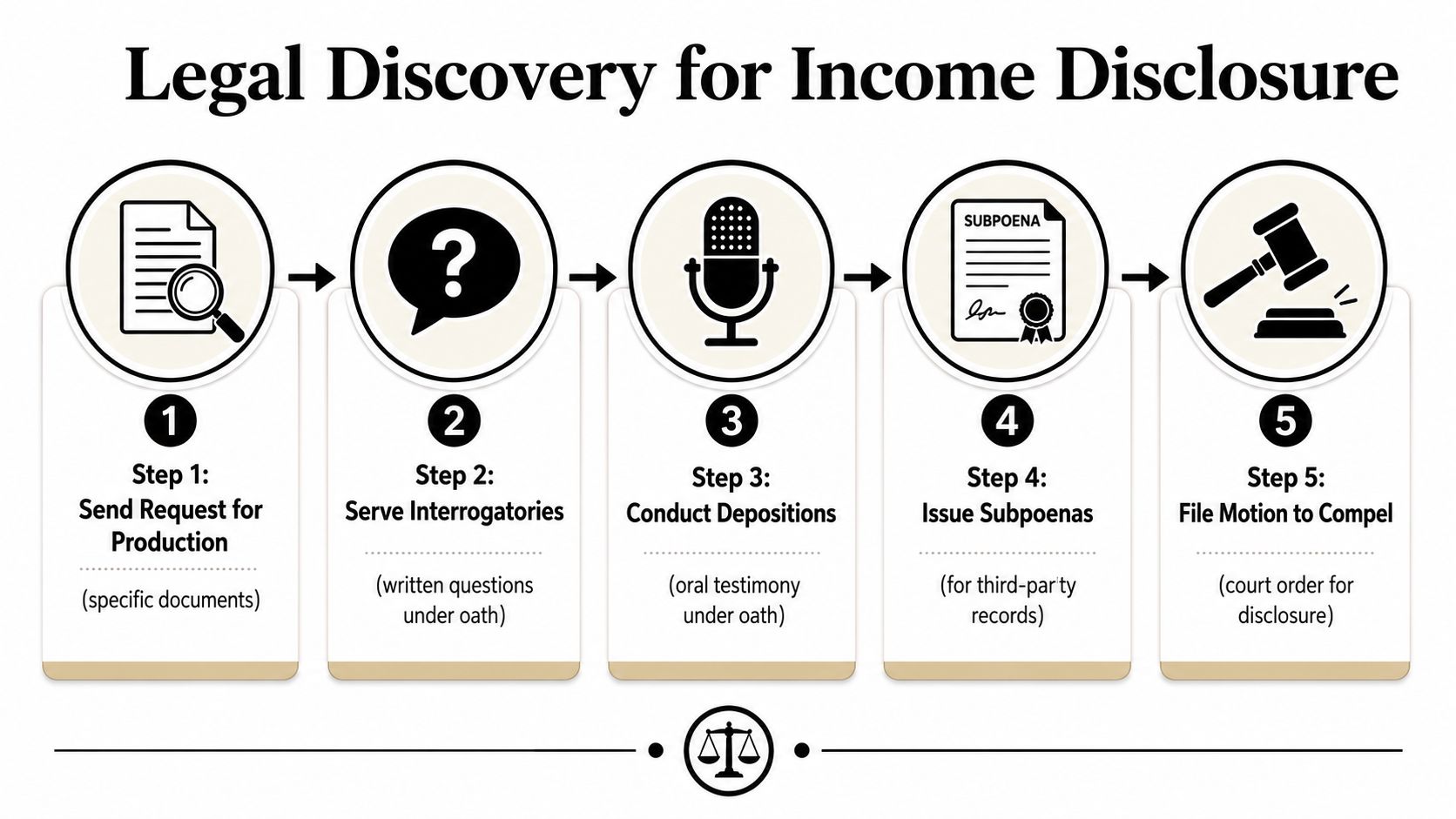
When the other parent won't provide records voluntarily, you don't have to hope the truth surfaces on its own. Texas procedure gives you tools to force disclosure. Used well, those tools often matter more than courtroom argument.
The biggest mistake I see is waiting too long. If you suspect hidden income, delayed production, or manipulated business records, start formal discovery early enough to review what comes back and challenge what doesn't.
The core discovery tools
Requests for production
These demand specific documents. In a child support case, that usually includes tax returns, pay records, bank statements, business records, contracts, and communications tied to compensation. Broad requests are easy to resist. Targeted requests work better.
Interrogatories
These are written questions answered under oath. They can pin down employment history, compensation structure, ownership interests, bank accounts, and claimed expenses. They're useful because they create a written position you can later compare against documents and testimony.
Depositions
A deposition lets you question the parent under oath before the hearing. In income cases, this can be where the story starts to break apart. A person who submits a polished affidavit may struggle to explain undocumented deposits, missing statements, or inconsistent tax filings in live questioning.
Third-party records usually tell the cleaner story
The most effective move in many disputed-income cases is a subpoena duces tecum to someone other than the parent. Banks, employers, payroll processors, and financial institutions usually produce records that are harder to manipulate after the fact.
A strong subpoena plan often focuses on:
- Employer payroll records when pay stubs appear incomplete
- Bank records when deposits exceed reported income
- Business account records when self-employment income is disputed
- Credit-related records when spending patterns matter
If the other side still resists, a motion to compel asks the court to order compliance. Judges generally respond better when you've asked for specific, relevant material and can show why it matters to the child support calculation.
The court can't calculate support fairly if one parent controls the records and refuses to produce them.
When to bring in a forensic accountant
A forensic accountant is most useful when the money trail is layered. Think multiple accounts, business entities, cash-based operations, or personal expenses moving through a company. An expert can convert a confusing file into a chart, summary, or tracing analysis the judge can use.
That isn't necessary in every case. If the dispute is a straightforward employment matter, discovery from the employer may solve the problem. But when the records suggest concealment rather than disorganization, expert review can change the advantage in settlement and at trial.
Frequently Asked Questions About Proving Income in Texas
Can a Texas court impute income if a parent is unemployed on purpose
Yes. Under Texas Family Code §154.067, a court may apply child support based on earning potential if a parent is intentionally unemployed or underemployed. The argument works best when you bring concrete proof such as prior work history, qualifications, recent earnings records, and evidence that jobs are available. In contested cases, the court may also look at surrounding circumstances rather than accepting a claimed lack of income at face value.
What if the parent is paid in cash and says there are no records
That doesn't end the case. Courts can consider indirect proof, including bank deposits, business activity, living situation, and work opportunities. In practice, cash-income cases are won by building a pattern from multiple sources instead of waiting for one perfect document.
What do I need to modify child support in Texas
You need proof of a material and substantial change tied to the prior order and current circumstances. In a modification case, the moving party must compare the income and resources that existed when the old order was entered with the present financial picture, as explained in this discussion of historical income proof in Texas modification cases.
Why do modification cases fail even when income seems different
They often fail because the moving party proves today's income but doesn't prove the baseline from the earlier order. The court needs that time-series comparison to measure change. If you don't bring the old order's assumptions, prior pay records, and current records, the judge may conclude the legal standard hasn't been met.
Does a new spouse's income count for child support
A new spouse's income isn't directly plugged into the guideline formula as the obligor's income. But financial realities in the household can still matter when the court is assessing credibility, claimed expenses, or whether a parent is unable to earn. Keep the focus where it belongs: the parent's own net resources, earning capacity, and the evidence that supports or undermines those claims.
If you're preparing for a hearing and need a clear plan for proving income, challenging unreliable records, or pursuing a modification under the Texas Family Code, Texas Child Support Law Office of Bryan Fagan handles establishment, modification, enforcement, and disputed income cases across Texas.