A lot of parents start looking for a child support modification when the order on paper stops matching the life they're living.
You may be paying support based on a job you no longer have. You may be receiving support under an order entered years ago, before your child needed more medical care, before insurance costs changed, or before the possession schedule shifted into something closer to equal parenting time. In high income cases, another issue now matters in a way it didn't before. Texas changed the guideline cap used in child support calculations effective September 1, 2025, which can materially affect what the numbers look like in court.
That mismatch creates stress fast. The paying parent feels trapped by an outdated number. The receiving parent feels like the current order no longer covers what the child needs. Both sides usually ask the same question. Can this be fixed without making the situation worse?
It can, but only if you approach child support modification in Texas strategically. Courts don't rewrite support orders because life feels unfair. They modify orders when the legal standard is met, the math is done correctly under the Texas Family Code, and the evidence is strong enough to support the change.
When Your Texas Child Support Order No Longer Fits Your Life
You signed a child support order when the other parent had the child most school nights, you exercised a standard possession schedule, and your income was stable. Two years later, the facts are different. You may now have the child half the time, pay for more day-to-day expenses directly, or earn far less than you did when the order was set. The paper order still reflects the old case.
That is usually the point where support becomes a legal problem instead of a household annoyance.
I see this often in 50/50 cases. Parents assume equal parenting time automatically cancels child support. Texas does not work that way. In many shared custody arrangements, support is still owed, but the right strategy may shift from a basic guideline calculation to a stronger argument about who is covering more of the child's actual expenses, whether a deviation makes sense, and how the new income cap affects the math.
The September 1, 2025 increase in the guideline cap to $11,700 in net monthly resources adds another layer. For higher-income parents, that change can matter even if the possession schedule is close to equal. A parent who previously paid guideline support on a lower capped amount may face a different starting number under Texas Family Code §154.125. At the same time, a true 50/50 schedule can support an argument that the guideline result should not be the final result if it does not match how the child's costs are really being split.
Here is the practical tension that many online guides miss. The new cap can push the presumptive amount up, while a shared parenting schedule can support pushing the final number down from that presumption. Both points may be valid in the same case. The outcome often turns on which issue is framed first, how clearly the financial records are organized, and whether the court sees the shared schedule as real equal parenting or a label that does not match the child's actual routine.
A simple example shows why strategy matters. If one parent has net monthly resources at or above the new cap, the guideline starting point for one child is calculated from $11,700, not the old cap. But if the other parent also has substantial income and the parents are splitting time and expenses close to evenly, the court may be asked to depart from the presumptive number under §154.123. That does not mean the court will erase support. It means the argument should be built around fairness to the child and the actual allocation of costs, not around slogans about “equal custody.”
If your order no longer fits the facts, the first question is not whether the current amount feels unfair. The first question is whether the change is legally significant and provable. Texas courts modify orders based on evidence, not informal side agreements or general complaints. If you are unsure whether your facts rise to the required level, start with a clear explanation of what counts as a substantial change in circumstances under Texas law.
Waiting usually costs more. Overpayments add up. Underpayments create arrears. And in a 50/50 case, delay often hardens a bad number because each parent gets used to paying certain expenses without a clear written allocation.
The goal is to fix the order in a way a Texas judge can sign. That requires more than saying life changed. It requires showing what changed, how the new $11,700 cap affects the guideline analysis, whether a shared custody deviation is justified, and what the corrected support amount should be.
Qualifying for a Child Support Modification in Texas
Texas doesn't allow child support modifications just because one parent is frustrated. You need a legal basis under Texas Family Code §156.401.
The rule is straightforward. Under Texas Family Code §156.401, a court may modify a child support order if (1) the circumstances of the child or a person affected by the order have materially and substantially changed, OR (2) it has been at least three years since the last order and the new guideline-based amount differs from the current amount by at least 20% or $100, as summarized by UNT Dallas College of Law on child support modifications.
Material and substantial change
This is the most common gateway.
A material and substantial change can involve a parent's incarceration, a shift in the child's medical needs, or a meaningful change in custodial arrangements. Texas courts look for real change, not minor movement in income or ordinary fluctuations in expenses. The point is whether the facts now are meaningfully different from the facts that supported the current order.
Examples that often matter in practice include:
- Income loss that can be documented: Pay stubs, termination records, or business records may show that the current order no longer matches actual earnings.
- A child's changed medical situation: Increased treatment needs, insurance changes, or uncovered medical expenses can support a new look at support.
- Custody and possession changes: If the parenting schedule now works very differently than the order assumed, support may need to be reconsidered.
- A parent's inability to work at prior capacity: Courts want proof, not broad statements.
For a closer discussion of what courts look for, see substantial change in circumstances explained.
The three year review rule
The second gateway is more mechanical. If the order is old enough, the court can compare the current support amount to the new guideline amount. If the difference is large enough under the statute, modification may be available even without a dramatic event.
Texas law allows review when the order is at least three years old and the newly calculated amount differs by at least 20% or $100. That threshold matters because it prevents repeated litigation over minor changes while still allowing correction when the gap becomes substantial, as discussed in Jason Wright Law's review of Texas modification standards.
What works and what doesn't
Here is the practical difference between a case that gets traction and a case that stalls:
| Situation | Likely court response |
|---|---|
| You can tie the requested change to §156.401 and support it with records | The court will seriously evaluate modification |
| You rely on a verbal agreement or rough estimates | The case weakens quickly |
| You claim income changed but bring no documents | Judges usually treat that as inadequate proof |
| You show the current order is old enough and the new guideline number crosses the statutory threshold | The case has a clear legal path |
One resource that addresses this framework directly is Modifying Child Support Under §156.401, which focuses on when and how a Texas child support order can be modified.
Courts don't need a perfect life history. They need a legally recognized reason to act and enough evidence to sign a new order with confidence.
The Official Step-by-Step Modification Process
A parent loses a job in June. The other parent starts exercising a true 50/50 schedule in August. By September 2025, the higher-income parent is asking why the new $11,700 cap should still drive support when overnights are split evenly. That is how modification cases usually arrive. Not as abstract legal questions, but as a mismatch between an old order and current facts.
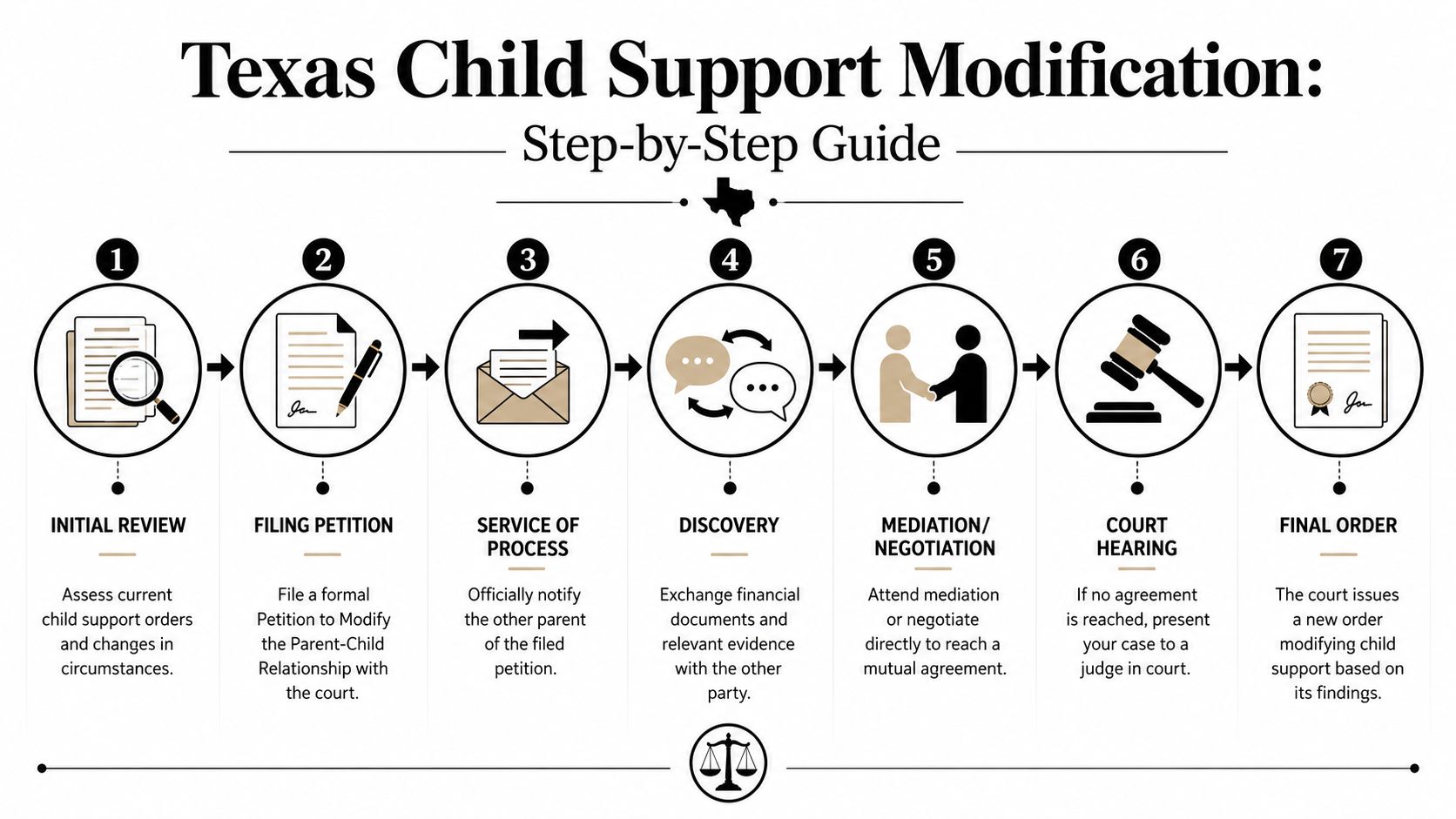
Step one through step three
Start with the right court and the right pleading. In most cases, that means filing a Petition to Modify the Parent-Child Relationship in the court with continuing jurisdiction over the child. If you file in the wrong court, you create delay and expense before the judge ever reaches the support issue.
Then serve the other parent properly. A text message, email, or verbal warning does not start the response deadline. Formal service does. After service, the responding party usually has until the Monday next following 20 days after service at 10:00 a.m. to file an answer, unless the court sets a different deadline or a waiver applies. Flatiron Legal's overview of changing a Texas child support order describes the same procedural sequence: filing, service, financial exchange, mediation, and then a final hearing if no agreement is reached.
The first part of the case is mostly about control. Get the current order, confirm which provisions govern support, and identify the relief requested with precision. If the dispute involves a 50/50 possession schedule, be careful here. Texas does not have an automatic equal-time formula that erases support. In higher-income cases after September 1, 2025, the increased cap can push the guideline number up, while the equal schedule gives the other side a stronger fairness argument for a downward adjustment. That tension should shape the petition from the start, not as an afterthought at mediation.
Discovery and document exchange
Discovery decides whether your position is credible.
For a straight wage-earner case, the document exchange may be fairly narrow. For a self-employed parent, a parent paid partly in bonuses, or a parent arguing that a 50/50 schedule justifies a guideline deviation, discovery usually gets more detailed and more expensive. Judges want records they can trust.
Typical requests include:
- Recent pay stubs and payroll summaries
- Tax returns and W-2s or 1099s
- Business records if income is not simple salary
- Health insurance cost information for the child
- Proof of who is covering day-to-day expenses under the current schedule
- Calendars, school records, or communications showing the actual possession pattern
This is also where strategy starts to matter more than slogans. A parent asking for guideline support under the new cap may focus on income proof and keep the case simple. A parent resisting that number in a true equal-possession arrangement usually needs more. That parent has to prove why guideline support would be unjust or inappropriate under the facts, and that requires a clean paper trail. If you need a refresher on the math behind the numbers being argued, use this guide to calculating child support in Texas.
Mediation is where many cases are decided
Most Texas courts expect serious mediation efforts before trial. The parents who do well there usually arrive with documents organized, a guideline calculation prepared, and a fallback position that reflects what the judge may do.
In 50/50 cases, mediation often turns on a practical question. Is this a guideline case with a minor adjustment, or a deviation case supported by strong facts? Those are not the same thing. If one parent earns far more and the case now falls under the $11,700 cap, the starting support number may be higher than older articles or old orders suggest. But equal parenting time still gives room to argue about duplicated household costs, who pays insurance, who pays school and activity expenses, and whether a full guideline amount is fair.
A simple example shows the pressure point. If one child is involved and the obligor's net monthly resources reach or exceed the new cap, the guideline starting point is based on that capped amount. In a standard possession case, that often gives the receiving parent a strong position. In a true 50/50 case, the paying parent may still owe support, but the negotiation shifts to whether the court should stay at guideline, move below it, or offset expenses in another way. Good mediation preparation means knowing which argument you are making.
Final hearing and signed order
If the case does not settle, the judge hears evidence and makes the call. That hearing is usually less dramatic than people expect and more document-driven. The court wants a clear record on income, the current parenting schedule, the child's expenses, and why the requested number fits the statute.
The signed order is the only event that changes the legal obligation. Filing the case does not reduce what is due. Informal agreements do not reduce what is due. Until a new order is signed, arrears can continue to build under the old one.
Most modification cases move faster when the facts are clean and the records are complete. Cases involving disputed income, self-employment, or a fight over whether a 50/50 schedule should change the guideline result usually take longer and cost more. That is the essential trade-off. The more you ask the court to move away from the default formula, especially now that the 2025 cap raises the starting point in upper-income cases, the more proof you need and the more process you should expect.
How to Calculate the New Child Support Amount
A lot of parents are surprised here. They assume a 50/50 schedule means no child support, or they assume the new 2025 cap automatically decides the number. Texas law is not that simple.
The basic guideline structure
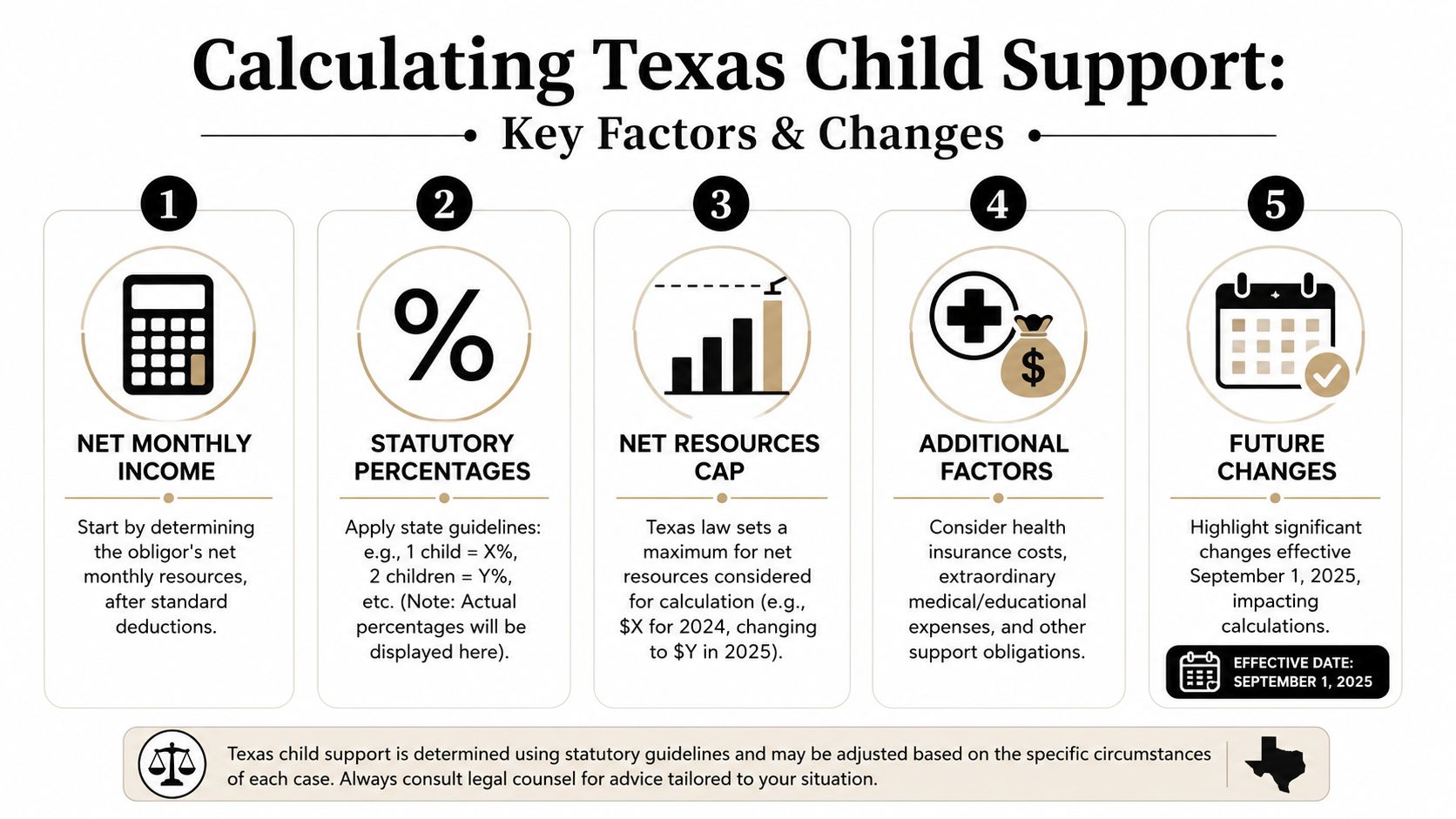
The court starts with the obligor's net monthly resources and applies the guideline percentages in Texas Family Code §154.125. For net resources at or below the cap, the presumptive rates are 20% for one child, 25% for two, 30% for three, 35% for four, and 40% for five children, with six or more children at not less than 40%, as outlined in Anderson Legal Group's summary of Texas Family Code §154.125.
Beginning September 1, 2025, the cap used in guideline calculations rises to $11,700 in net monthly resources. That matters most in higher-income modification cases, because it raises the guideline starting point before anyone argues about deviations or shared custody.
If you want the mechanics of the formula broken down further, see how to calculate child support in Texas.
What the new cap does to the math
If the paying parent's net monthly resources exceed both the old and new caps, the guideline maximums change like this:
| Number of children | Old cap at $9,200 | New cap at $11,700 |
|---|---|---|
| 1 child at 20% | $1,840 | $2,340 |
| 2 children at 25% | $2,300 | $2,925 |
| 3 children at 30% | $2,760 | $3,510 |
For four children, the guideline maximum rises from $3,220 to $4,095.
That is the new starting point. In many cases, it is also the pressure point in settlement talks. A parent asking for guideline support now has a larger number to work from. A parent asking the court to go below guideline needs better proof than before, especially in an upper-income case.
How 50/50 custody changes the strategy
Texas does not use a simple shared-custody worksheet like some states. Even in a true 50/50 arrangement, courts usually begin with the guideline framework and then examine whether a departure is appropriate under Texas Family Code §154.123.
That creates a practical tension. The new $11,700 cap pushes the presumptive number up, but a genuine equal-possession schedule may support a lower amount if both parents are paying substantial day-to-day expenses directly.
The argument has to be specific. Judges want to see who pays for housing, school costs, health insurance, activities, transportation, and the duplicated expenses that come with maintaining two functioning households for the child.
A 50/50 schedule, by itself, does not erase support.
Real calculation examples
Here are the examples I use with clients to frame the discussion early.
Example 1: One child, high-income case, standard possession
If the obligor's net monthly resources exceed the cap, the guideline starting point is 20% of $11,700, which equals $2,340 per month.
Example 2: Two children, high-income case, standard possession
The guideline starting point is 25% of $11,700, which equals $2,925 per month.
Example 3: One child, high-income case, true 50/50 schedule
The court may still start at $2,340 if the obligor is over the cap. Then the significant dispute begins. If both parents have similar incomes and both are covering substantial direct expenses during their own parenting time, the parent seeking a lower number has a strong deviation argument under §154.123. If one parent earns much more, pays fewer direct expenses, or the schedule is labeled 50/50 but operates unevenly in practice, the court may stay much closer to guideline.
That is the strategic point many articles skip. The 2025 cap raises the baseline in high-income cases. A true 50/50 schedule can still matter, but only if the facts are organized in a way the court can use.
The trade-off clients need to understand
Guideline math is usually fast. Proving why the guideline number should be adjusted is where modification cases get more expensive.
If you want the court to move off the presumptive amount, build the calculation in layers:
- start with verified net monthly resources
- apply the correct guideline percentage
- identify whether the new $11,700 cap controls
- show the actual possession schedule as it is lived, not just as it appears on paper
- document which parent pays which child-related expenses
- tie the requested number to the child's best interest under §154.123
That approach gives the judge a usable framework. It also gives your lawyer something stronger than a general fairness argument.
In practice, the best 50/50 modification presentations do not argue that support should disappear. They show why the guideline number should be adjusted, by how much, and based on which facts.
Gathering Essential Evidence and Documentation
A modification case usually turns on records, not speeches. If you want the court to reduce support after an income drop, or adjust the number in a true 50/50 schedule under the new $11,700 cap, your file has to show the judge exactly what changed, when it changed, and how that affects the calculation.

The court is comparing two points in time. It needs proof of the old baseline, proof of the current facts, and proof that your requested number is grounded in the Family Code. Clients often underestimate the last part. In higher income cases, the 2025 cap changes the starting guideline math. In shared custody cases, the paper file also needs to show who is paying day-to-day child expenses during each parent's time.
The core document set
Start with the records judges and associate judges expect to see:
- Recent pay records: Current pay stubs, year-to-date earnings, bonus information, and payroll deductions.
- Federal tax returns for at least two years: These help the court spot a temporary dip versus a real change in earnings.
- Employment records: Offer letters, termination notices, disability paperwork, or documentation showing reduced hours.
- Health insurance records: Premium statements, proof of who carries coverage, and any change in the child's medical or dental costs.
- Childcare and activity expense records: In 50/50 cases, these can matter when you are asking the court to look past the basic guideline figure.
- Business records if self-employed: Profit and loss statements, 1099s, bank statements, general ledgers, and documents showing business-paid personal expenses.
- Possession records: Calendars, school pickup logs, daycare sign-in records, travel confirmations, and message history showing the actual schedule.
For a fuller Texas-specific checklist, review evidence needed for a child support case in Texas.
What judges usually distrust
Judges see the same weak patterns over and over. A parent says income dropped, but deposits into the bank account suggest otherwise. A parent says the schedule is equal, but school records show one household handles most overnights. A parent says both sides split expenses, but cannot produce receipts, transfer records, or account statements.
That kind of gap matters.
If your argument is tied to a 50/50 schedule, do not stop with the possession order. Bring a clean calendar covering several months, then match it to neutral records where possible. If your argument is tied to the new cap, do not hand the court raw gross income and expect the judge to do the rest. Provide net resource documents and a worksheet that shows the cap-based guideline amount first, then the reason you believe a deviation is justified.
A late filing creates another problem. Support keeps accruing under the old order until the court signs a new one, and unpaid amounts can continue to build while the case is pending.
Here's a practical explainer that addresses common proof issues in family court:
Build the file for cross-examination
A good evidence packet should let the judge answer three questions in minutes, not after a long argument.
| Question | Best proof |
|---|---|
| What changed since the last order? | Payroll records, tax returns, medical records, business records, possession logs |
| When did it change? | Dated pay stubs, termination letters, insurance notices, school records, calendars |
| What should the new number be? | A support worksheet tied to current net resources, the $11,700 cap if applicable, and any documented deviation factors |
In practice, the strongest files do one more thing. They connect the documents to a precise ask. If you want support reduced to a guideline amount, show the math. If you want a lower-than-guideline number because the schedule is truly shared and both homes carry substantial expenses, organize the exhibits so the judge can follow that argument without guessing.
A clean file usually saves money. It also gives the other side fewer openings to argue that your numbers are incomplete, selective, or unreliable.
Tips for Negotiation Mediation and Court Hearings
A common mediation setup looks like this. One parent earns above the new $11,700 net resource cap. The parents are already exercising something close to 50/50. Both are paying for housing, food, school needs, and daily transportation. One side walks in demanding full guideline support based on the cap. The other walks in saying, "We split time equally, so support should be zero."
Neither position is usually the best negotiating position.
The stronger approach is to start with the guideline calculation under §154.125, then show why the facts support a deviation under §154.123. In high-income shared-possession cases, that sequence matters. Mediators and judges usually respond better to a parent who can show the baseline number, then explain precisely why that number should move up or down.
In mediation
Walk in with three numbers, not one:
- Your guideline number: Calculate support using current net resources, including the $11,700 cap if it applies.
- Your deviation number: Identify the amount you will request if the 50/50 schedule and actual child-related expenses justify a different figure.
- Your bottom line: Know the point where settlement still makes financial sense compared with paying for another hearing.
For 50/50 cases, bring a clear calendar and expense log to mediation. That visual proof often does more work than broad statements about "equal time." If you want a deviation, show the actual overnights, exchange pattern, and which parent is paying for recurring items such as health insurance, school costs, activities, and after-school care.
A simple example helps. If guideline support reaches the cap-based amount, but the other parent has the child half the time and is also covering substantial direct expenses, the negotiation should not stop at the capped number. The key question is whether applying the cap without adjustment would be unjust or inappropriate under the facts of your case. That is the argument to prepare.
Good mediation prep usually includes:
- A clean support worksheet: Show the guideline amount first, then the proposed deviation and the reason for it.
- A possession calendar: Use a format the mediator can read in seconds.
- An expense summary: Focus on child-related expenses both households pay.
- A realistic settlement range: Ask for a result a judge could sign without rewriting the whole deal.

In the courtroom
Judges want a short path from facts to numbers.
If your case involves the new cap and a true shared schedule, present it in that order. First, establish current net resources. Second, show the guideline amount under the capped calculation. Third, explain why the possession schedule and duplicated household costs justify a different result. That keeps the hearing grounded in the statute instead of turning into a fairness debate.
Be careful with 50/50 claims. Many parents say "equal custody" when the actual calendar is closer to expanded standard possession or an informal arrangement that changes month to month. If the schedule is not consistent, a deviation request gets harder to win. Courts care about what is really happening, not the label attached to it.
When you testify, answer directly. If the judge asks when the schedule changed, give the date or the best documented time period. If the judge asks who pays for the child's insurance or tutoring, answer that question and stop. Clear answers build credibility. Speeches do not.
What helps your credibility
Credibility often turns on discipline.
- Use the same numbers everywhere: Your worksheet, affidavit, testimony, and proposed order should match.
- Acknowledge shared costs: If both parents carry substantial expenses, say so.
- Separate parenting complaints from support issues: A judge may care about both, but not in the same hearing and not in the same way.
- Offer a practical order: Judges are more receptive to an amount they can trace to evidence and statutory factors.
Texas Child Support Law Office of Bryan Fagan is one example of a firm that handles modification cases involving high-income support, 50/50 custody calculations, and deviation arguments under §154.123.
Answers to Your Most Pressing Modification Questions
Can we just agree between ourselves to change support
No. An informal agreement doesn't replace a court order.
If you want the new amount to be enforceable, you need a signed modified order. Until then, the existing order controls.
If I file to modify, can I start paying the lower amount right away
Usually, that's where parents get into trouble. A common mistake is reducing payments based on an informal agreement. Courts only award retroactive reduction if the change occurred before the filing date and is proven, and many arrears cases come from parents who stop paying after filing without understanding that the original obligation remains in place until a judge rules, as explained in Lady Justice Legal's guide to Texas child support modifications.
Filing a case is not the same as winning it. Until the judge signs a new order, the old one is still enforceable.
Can a support change be made retroactive
Sometimes, but parents often misunderstand how limited that relief is. The court may consider retroactive adjustment tied to the proper legal timeline and proof, but you should never assume the court will erase unpaid support solely because you filed a modification.
The practical lesson is simple. File promptly when the facts change, and keep paying as ordered unless and until the court signs something different.
What if my order predates the September 1 2025 cap increase
It does not update automatically. If the old order was based on the prior cap and your case now meets the legal standard for modification, the updated $11,700 cap may become part of the recalculation. The court still needs a filed case, current financial proof, and a proper legal basis under §156.401.
Does 50 50 custody automatically eliminate child support
No. A shared schedule can be important, but it doesn't automatically erase support. In many cases it supports a deviation analysis under §154.123, especially when both parents are carrying substantial direct expenses. Whether that changes the final number depends on the facts, the quality of the evidence, and how the judge views the child's best interest.
What if the court denies my request
Then the old order remains in effect. That's why preparation matters. A weak case doesn't just fail to change support. It can leave you with continuing obligations, ongoing stress, and in some situations accumulated arrears if you acted too early on assumptions rather than a signed order.
How long does the process usually take
Timing depends on whether the case settles or requires a contested hearing. Courts move faster when both parents exchange records quickly and negotiate realistically. Cases slow down when documents are incomplete, service is delayed, or one side treats mediation as a pointless obstacle instead of a real settlement opportunity.
If your child support order no longer matches your income, your parenting schedule, or your child's current needs, Texas Child Support Law Office of Bryan Fagan offers information and legal guidance focused on establishing, modifying, enforcing, and defending Texas child support orders under the Texas Family Code.