You ran the calculator. You got a number. It may have looked clean and official, but it didn't feel right.
That reaction is common in Texas child support cases. A formula can produce a presumptive amount, yet your real life may include therapy bills, unusual travel for possession, another support obligation, or a child whose needs don't fit a standard worksheet. That's where deviation comes in.
If you want to understand how judges calculate child support deviations in Texas, start with this: judges don't begin by asking whether a number feels fair. They begin by calculating the guideline amount under Texas Family Code §154.125. Then they ask whether applying that amount would be unjust or inappropriate under Texas Family Code §154.123. The parent asking for something different has to prove why.
Most deviation requests fail for one simple reason. The parent brings a position instead of evidence. “This is too much.” “I already pay for everything.” “The other parent has money.” Those are arguments. Judges decide deviations based on records, testimony, and child-focused proof.
A strong deviation case is usually straightforward in structure, even when the family facts are complicated. You identify the guideline baseline, tie your request to a specific statutory factor, and support it with credible documents. That's the lens a Texas judge uses.
Challenging the Standard Child Support Formula
A deviation is the legal request to move above or below the standard guideline amount. Texas law allows that because not every child support case fits a one-size-fits-all result.
Under Texas Family Code §154.125, the guideline amount is presumed to be in the child's best interest. That presumption matters. It means the default number comes into court with built-in credibility. If you want a different number, you have to overcome that starting point with facts.
What parents usually get wrong
Parents often think the court will adjust support because the guideline amount feels disconnected from daily life. That's not enough.
Judges don't deviate because one parent is frustrated. They deviate when the evidence shows the guideline amount would be unjust or inappropriate under §154.123. That's a legal standard, not a fairness slogan.
Common weak approaches include:
- General complaints: “Everything costs more now” won't carry much weight without child-specific proof.
- Lifestyle arguments: Complaining about the other parent's spending usually distracts from the issue unless it ties directly to resources the court can properly consider.
- Punishment framing: Support isn't a tool to reward one parent or punish the other.
Practical rule: If your argument doesn't connect directly to the child's actual needs or a recognized financial circumstance under the Family Code, the judge is unlikely to move off the guideline amount.
What a real deviation request looks like
A serious request has a narrow theory. For example, the child has recurring uninsured treatment expenses. Or the obligor has unusual access-related travel costs. Or the obligor's resources exceed the guideline cap and the child's proven needs justify support above it.
That difference matters in court. Narrow theories are easier to prove. They also give the judge a workable reason to make findings in the order.
When clients ask whether it's worth challenging the formula, the answer depends less on emotion and more on documentation. If you can show the judge exactly why the guideline number misses the mark, you may have a deviation case. If you're relying on broad claims of unfairness, you probably don't.
The Starting Point Texas Guideline Child Support
A judge cannot decide whether to deviate until the court has a clean guideline number in front of it. In Texas, that starting number comes from Texas Family Code §§ 154.061, 154.062, and 154.125.
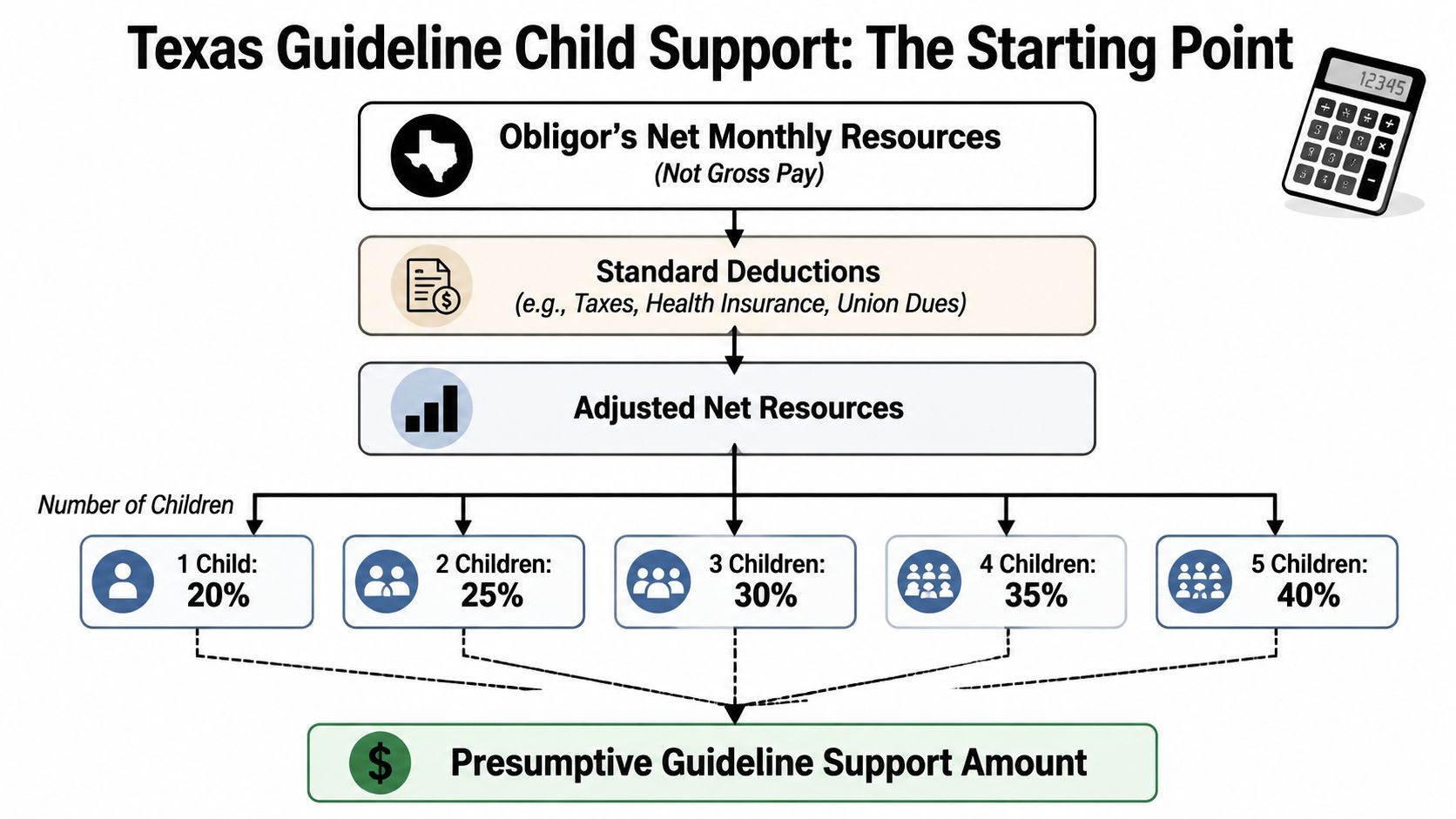
The baseline is built on monthly net resources, not gross pay. That point trips up parents all the time. A salary figure on a pay stub does not answer the support question. The court has to determine what income counts, what deductions apply under the statute, and then apply the guideline percentage to that net figure.
For cases filed under the current cap, the guideline calculation applies to the first $11,700 in monthly net resources. The standard percentages remain 20% for one child, 25% for two, 30% for three, 35% for four, and 40% for five or more children before the court.
Why net resources matter more than gross pay
Judges look at net resources because that is the number the Family Code tells them to use. If the math on net resources is wrong, the rest of the case starts crooked.
That matters in deviation cases more than clients expect. I often see parents focus on why the guideline result feels too high or too low before anyone has pinned down the actual resource figure. A judge is usually less interested in broad complaints than in whether the baseline calculation is supported by pay records, tax returns, profit and loss statements, or other reliable financial documents.
If you want a practical walkthrough of the same process courts use, this guide on how Texas child support is calculated is a good starting point. For a narrower look at income categories, What Counts as Net Resources for Child Support addresses which income sources are included when calculating Texas child support.
The judge's baseline calculation
In court, the sequence is usually straightforward:
- Identify all income that counts as resources. Wages, salary, commissions, self-employment income, bonuses, rental income, and other sources may be included depending on the facts.
- Apply the statutory net-resource framework. The court moves from gross income to monthly net resources under § 154.062.
- Use the percentage tied to the number of children before the court.
- Address the cap. If the obligor's monthly net resources are above $11,700, the guideline amount is calculated only to that level unless someone proves the child's proven needs support more.
Here is the standard chart:
| Children before the court | Guideline percentage |
|---|---|
| 1 child | 20% |
| 2 children | 25% |
| 3 children | 30% |
| 4 children | 35% |
| 5 or more children | 40% |
Why this step controls the deviation fight
This baseline does more than produce a number. It frames the judge's thinking.
If the presumptive amount is, for example, 20% of net resources up to the cap, the parent asking for a different result has to show why that amount is unjust or inappropriate in this case. Judges tend to view that request with more discipline when the baseline math is reliable and documented. They tend to view it with skepticism when the numbers are vague, incomplete, or built on estimates.
The same point applies in higher-income cases. Once net resources exceed $11,700 per month, the court does not automatically increase support just because the obligor earns more. The party seeking more than the capped guideline amount needs evidence of the child's proven needs, not just evidence of the parent's high income. That is often where deviation requests get won or lost.
The Legal Basis for Deviation Under Texas Family Code §154.123
The authority to depart from guideline support comes from Texas Family Code §154.123. That statute lets the court order an amount other than the guideline number when applying the guidelines would be unjust or inappropriate under the circumstances.
Many parents expect a checklist. Judges don't usually treat it that way. They tend to sort the statutory factors into practical categories and ask whether the proof justifies a different result in the child's best interest.
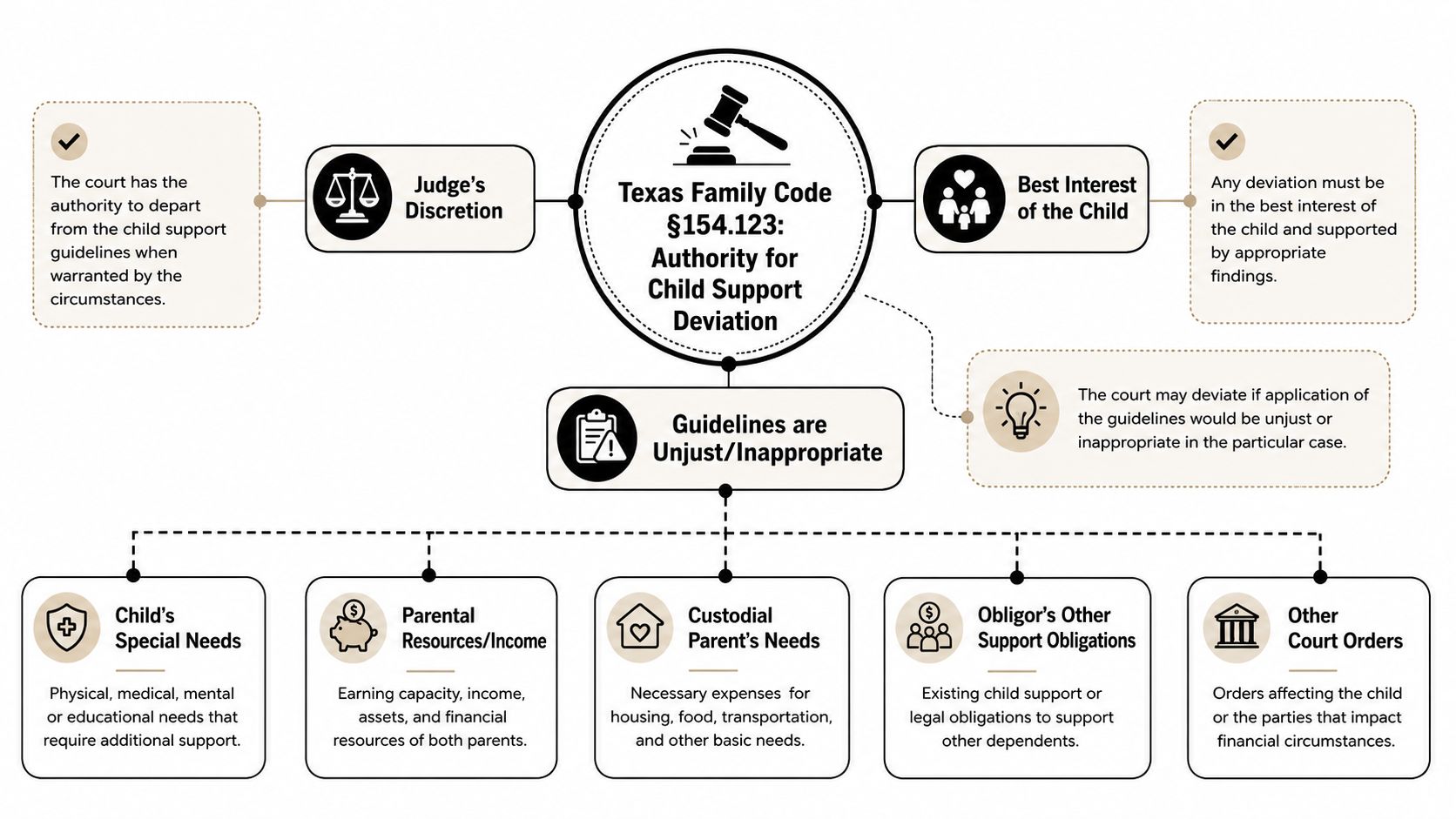
A deviation under Texas Family Code §154.123 is not automatic and must be supported by evidence. Judges typically look for facts that make the guideline result unjust or inappropriate, such as extraordinary medical or educational expenses, unusual fixed obligations, other support duties, or proven disparities in household resources, as discussed in this analysis of Texas child support deviation factors.
The categories judges usually care about
Most deviation issues fall into four practical buckets.
Child-specific needs
This is often the strongest category. If a child has unusual medical, therapeutic, educational, or developmental needs, the court wants detail. Not estimates. Not assumptions. Detail.
A judge will ask questions like these:
- What is the expense?
- Is it ongoing or temporary?
- Is it necessary?
- What portion is uninsured or otherwise unpaid?
- How does it relate to this child, specifically?
Parent resources and financial reality
The court can look beyond a simple paycheck comparison. The judge may evaluate the obligor's actual ability to pay and whether the households have materially different resources in a way that matters to the child.
This doesn't mean every income gap creates a deviation. It means a parent asking for one has to show why that gap makes the guideline result unjust in this family.
Other support duties and fixed obligations
Judges pay attention when a parent has other support obligations or unusual fixed expenses that are real, proven, and not self-created for litigation. The key is whether those obligations affect ability to pay in a way the court finds legitimate and relevant.
Possession and access circumstances
Parenting time can matter, especially when access creates unusual costs or when both parents shoulder substantial direct expenses for the child. But possession alone doesn't automatically rewrite support.
The best deviation arguments are specific enough that a judge can explain them in a written order without improvising.
What §154.123 does not do
It does not guarantee customization because a case is emotional or financially stressful. Almost every family law case is.
It also doesn't let a judge throw out the guideline framework. The court still has to anchor the ruling to the statutory baseline, then state why the guideline amount is unjust or inappropriate. That requirement is one reason evidence wins and broad rhetoric loses.
How a Judge Evaluates a Deviation Request
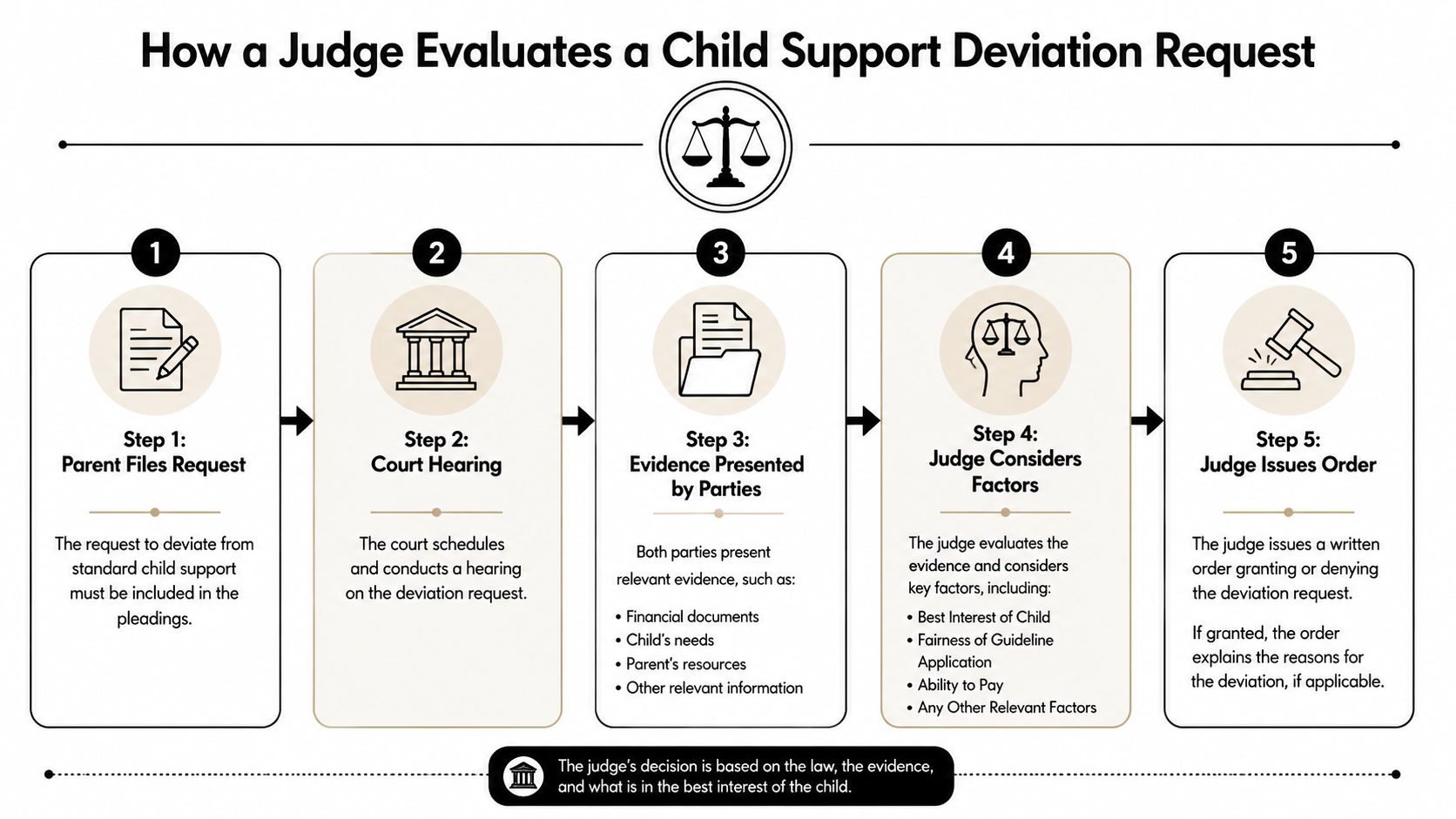
A deviation request is both procedural and evidentiary. If you want the court to order something other than the guideline amount, you need to ask for it in your pleadings and prove it at hearing or trial.
The procedural path
A typical case moves through these stages:
- Filing. A parent files an original SAPCR, divorce, or modification and includes a request for child support that may differ from guideline support.
- Service. The other parent must be formally served unless service is waived in a legally valid way.
- Financial exchange and discovery. The parties gather income records, expense proof, and child-related documents.
- Hearing or trial. The judge receives testimony and exhibits.
- Order. If the court deviates, the order should reflect the reason the guideline amount was not appropriate.
The judge's internal sequence
From the bench, the thinking is usually more structured than parents expect.
First, the judge determines the guideline baseline. That happens whether you like the formula or not. For practical help with the income side of that issue, this resource on how Texas courts calculate net resources lines up with the question courts focus on early in the case.
Then the judge listens for a legally valid reason to depart from the baseline. Not every fact matters equally. The court wants the facts that connect directly to the child's needs, the parties' actual finances, and the statutory deviation factors.
A short overview can help frame the process before a hearing:
What judges are really deciding
The legal question is not “Would another number also be reasonable?” The legal question is “Has the party asking for a deviation shown that the guideline amount is unjust or inappropriate here?”
That's a higher bar than many people expect.
Consider the contrast:
| Weak presentation | Strong presentation |
|---|---|
| “My child has extra expenses.” | Itemized bills, provider records, payment history, and testimony linking the expense to the child |
| “I can't afford this.” | Income records, fixed obligations, and a credible explanation of actual ability to pay |
| “We split time equally.” | A possession structure plus proof of the child-related costs each parent actually carries |
Courtroom reality: Judges usually trust organized proof more than dramatic testimony. A calm witness with good exhibits often outperforms a frustrated witness with strong feelings.
When the evidence doesn't carry the burden, the guideline number stands. When it does, the judge has room to set a different amount and explain why.
Practical Examples of Child Support Deviation Calculations
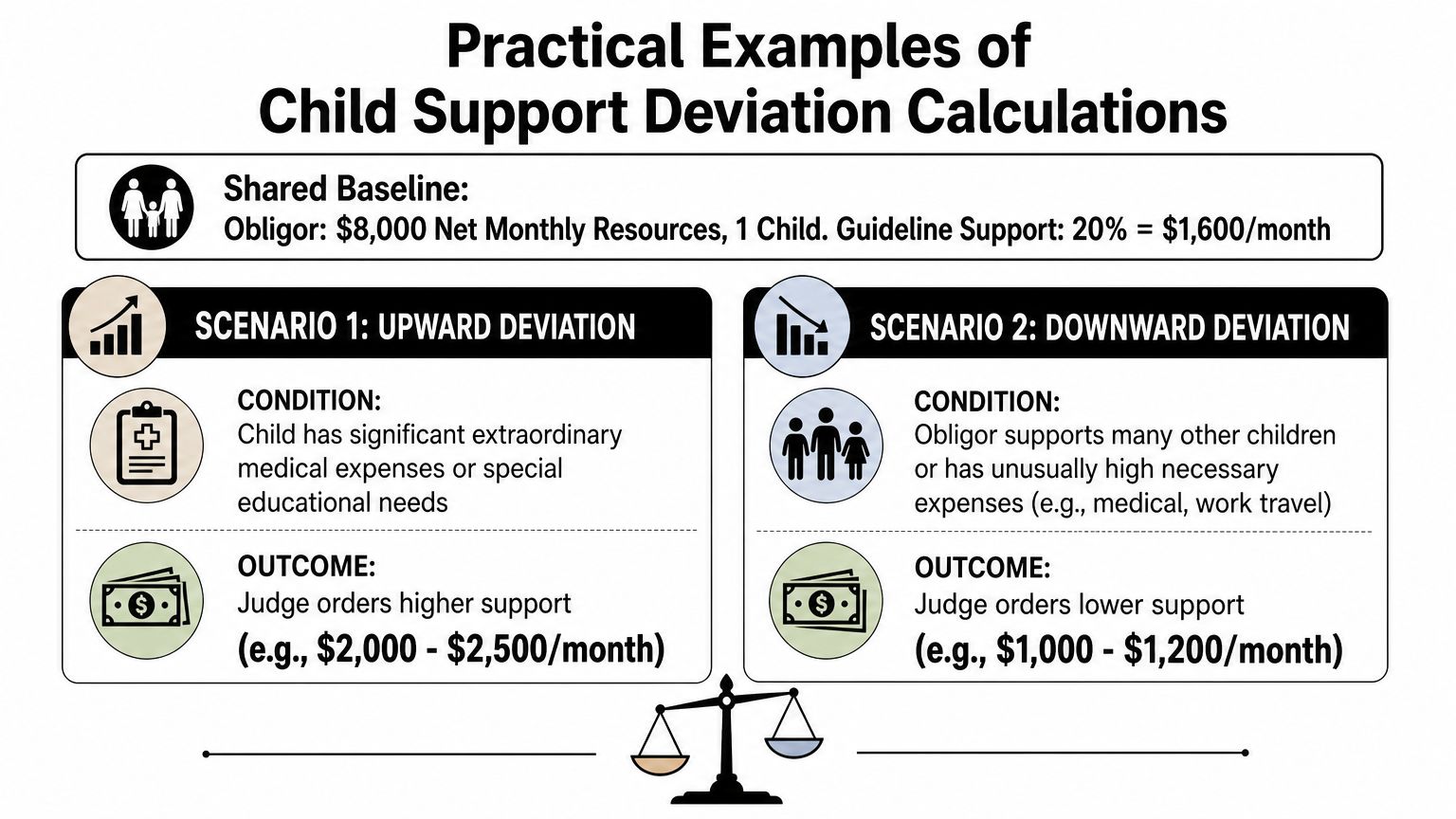
A judge usually sees the same pattern. One parent argues the guideline number is unfair. The other says the formula already covers the case. The parent who wins the deviation issue is usually the one who can turn that argument into a clean calculation backed by records.
Example one with one child and medical therapy
Assume the obligor has $8,000 in monthly net resources and there is one child before the court. Under the guideline percentages, the starting point is 20%, so the baseline support amount is $1,600.
Now add a child with recurring therapy expenses that insurance does not cover. The parent asking for more support brings therapy invoices, proof of what insurance denied, payment records for several months, and testimony from a provider or parent explaining why the treatment is ongoing.
That is the difference between a complaint and a deviation case.
Under Texas Family Code §154.123(b), the court may consider the child's proven needs, any special or extraordinary health care expenses, and the parents' financial resources. In a hearing like this, the judge is usually not looking for a perfect formula. The judge is deciding whether the standard amount leaves a shortfall tied to the child's actual needs. If the proof is organized and credible, the court may order the guideline amount plus a specific added amount or may allocate the uncovered expense between the parents in a way the judge considers fair.
Example two with unusual access costs
Use the same $8,000 net-resources figure and the same $1,600 guideline amount. This time, the obligor lives far enough away that exercising possession requires regular airfare, hotel stays, or long-distance driving costs.
Some parents lose this argument because they show only that travel is expensive. Judges usually want more. They want receipts, a possession history showing the parent spends the time, and proof that the expense is necessary to maintain the parent-child relationship rather than a self-created problem.
Section 154.123(b)(3) allows the court to consider travel costs for possession. In practice, the judge often weighs two competing facts at once. The child still needs support in the primary home. The paying parent also should not be priced out of seeing the child if the costs are substantial and legitimate. A modest downward deviation can happen here, but only if the court believes the travel is real, recurring, and connected to consistent parenting time.
Example three when resources exceed the cap
Now assume the obligor's monthly net resources are above the current $11,700 cap. The court still begins with the cap, not the full income. For one child, the guideline starting point is 20% of $11,700, which is $2,340 per month.
That number is the baseline, not the automatic final order.
If the parent seeking more support wants an amount above the cap, Texas Family Code §154.126 controls the analysis. The judge may order additional support only if the child has proven needs beyond the capped guideline amount. In court, that usually means evidence of actual expenses tied to the child, such as specialized educational support, unreimbursed medical care, therapy, disability-related costs, or other demonstrated needs. A high income by itself does not usually carry this issue.
I often see parties misunderstand this point. They focus on the obligor's earnings, lifestyle, or bonus history. Judges usually return to the same question: what does this child need, and what documents prove it? If the answer is vague, the request above the cap usually fails.
A realistic way judges do the math
Judges do not all calculate deviations the same way, but the reasoning usually follows a similar path:
- Set the guideline amount.
- Identify the specific fact that allegedly makes that amount unjust or inappropriate.
- Test whether the claimed expense or hardship is supported by reliable evidence.
- Decide whether the adjustment should be temporary, ongoing, or denied.
That last step matters. A short-term medical expense may justify a different result than a permanent therapy schedule. A judge who is not willing to change the monthly support amount may instead order reimbursement terms, split uninsured costs differently, or limit the deviation to a defined period.
Parents preparing these calculations should build them from records, not estimates. A Texas child support evidence checklist for support hearings is often more useful than another abstract explanation of the statute.
What these examples show
Deviation cases are won in the space between the guideline number and the proof.
The formula gives the judge a lawful starting point. The exhibits and testimony decide whether the court has a reason, under §154.123 or §154.126, to move away from it.
Evidence and Arguments That Win or Lose Deviation Cases
A deviation hearing is usually decided before the parent finishes testifying. The judge is asking a simple question: do I have reliable proof that the guideline amount would be unjust or inappropriate in this child's situation under Texas Family Code §154.123?
That mindset matters. Judges hear plenty of sincere arguments. What changes the result is proof that is specific, organized, and tied to a statutory factor the court can put in written findings.
What winning proof looks like in court
The strongest deviation cases give the judge something concrete to rely on. That usually means records that answer four practical questions:
- What is the guideline amount? Start with credible net-resource proof, such as pay stubs, tax returns, business records, or other documents the court can trust.
- What fact justifies a different result? Show the particular expense, hardship, or parenting arrangement that makes the guideline number unfair in this case.
- Is the amount real and ongoing? Use invoices, account statements, provider records, school documents, insurance records, or travel receipts.
- Can the judge measure the adjustment? Give the court numbers it can use, not broad complaints.
A parent asking for an upward deviation based on therapy costs, for example, should bring the treatment plan, billing records, proof of insurance coverage limits, and testimony showing the therapy is necessary for the child. A parent asking for a downward deviation based on high possession travel costs should bring flight confirmations, mileage logs, lodging receipts, and a clear summary showing how often those costs occur.
For hearing prep, a focused evidence checklist for a Texas child support case can help you match each argument to an exhibit before you get to court.
What loses credibility fast
Weak deviation cases usually fail for predictable reasons.
- The request is too vague. “I can't afford this” is not evidence. Judges want documents and testimony that explain why.
- The expense is not tied to the child. If the cost looks like a parent's lifestyle choice rather than a child-related need, the request usually stalls.
- The numbers shift under pressure. If a party gives one figure in a financial statement, another in testimony, and a third in argument, the court may distrust the whole presentation.
- The proof is thin for a major request. A large deviation request supported by estimates or screenshots often goes nowhere.
- The case is really about fairness between parents. Child support is about the child's best interest, not evening the score between households.
Credibility is often the deciding factor in close cases. A judge may forgive an incomplete exhibit binder. Judges are less forgiving when they think a parent padded expenses, minimized income, or left out records that would tell the full story.
The arguments judges tend to accept
Good arguments are narrow. They stay tied to the statute, the child, and the math.
These points tend to carry weight:
- The guideline amount does not cover a proven child-specific need.
- The requested adjustment is supported by records, not estimates.
- The parent has a clear way to calculate the amount.
- The request fits the child's best interest, not just the parent's preference.
Here is the trade-off judges often weigh. If the evidence shows a real need but the numbers are not stable enough to justify changing monthly support, the court may deny a full deviation and address the issue another way, such as allocating uninsured expenses, ordering reimbursement, or limiting relief to a set period. That is why the best presentations do more than argue for a different number. They give the judge a workable order.
A practical way to frame the case
Ask for the smallest deviation the evidence clearly supports.
That approach is often more persuasive than asking for an aggressive adjustment and hoping the court meets you in the middle. If the proof shows $400 in recurring monthly therapy and tutoring costs, a request built around those records is easier to grant than a broader claim that the child “needs more support to maintain the same standard of living.”
In court, the parent who wins is usually the parent who made the judge's job easier. Clear baseline. Clear reason for deviating. Clear exhibits. Clear calculation.
Your Next Steps and Common Questions About Deviations
If you believe the guideline amount doesn't fit your case, your first move isn't argument. It's preparation.
Gather income documents, child-expense records, insurance records, school records, travel records, and any prior orders that affect support. Then identify the one or two facts that matter under §154.123. Most strong cases are built around a few provable points, not a pile of grievances.
Immediate next steps before court
Use this short sequence:
- Review the pleadings: make sure the request for deviation is included.
- Organize the proof: group records by topic, such as medical, education, travel, or income.
- Build a clean summary: judges appreciate a concise explanation that matches the documents.
- Prepare for cross-examination: assume the other side will challenge necessity, amount, and credibility.
- Think modification if needed: if circumstances have changed since the current order, a modification case may be the proper vehicle.
Common questions clients ask
Can parents agree to a child support amount that deviates from the guidelines
Yes, parents can reach an agreement. But if you want an enforceable order, the judge still has to approve it. The court will look at whether the agreed amount is appropriate and in the child's best interest.
Does a 50 50 possession schedule eliminate child support
Usually, no. A shared schedule can support a deviation argument, but it doesn't automatically erase support. Judges still examine the parties' resources, the child's needs, and the actual cost structure in each home.
Can a deviated order be changed later
Yes. A child support order can be modified if there has been a material and substantial change in circumstances. When that happens, the court reexamines support through the same basic framework: baseline first, deviation proof second.
What if the other parent is asking for a deviation and I disagree
Then your job is to test the proof. Ask whether the expense is documented, recurring, necessary, and tied to the child. Many deviation requests look stronger in conversation than they do under oath with exhibits attached.
What is the biggest mistake parents make
They treat the hearing like a fairness debate instead of an evidence hearing. That mistake costs people support they should receive and forces others to pay support the evidence may not justify.
A deviation case is won by the parent who can show the judge, with disciplined proof, why the guideline amount doesn't fit this child and this family under Texas law.
If you're preparing for a child support hearing, a modification, or a dispute over whether the guideline amount should change, Texas Child Support Law Office of Bryan Fagan provides representation focused on Texas child support issues, including net resource disputes, deviation requests under §154.123, high-income cases, enforcement, and modification proceedings across Texas.