You may be staring at a child support balance that no longer looks real. A missed payment turned into several. Then interest kept adding up. Then a license problem, an enforcement notice, or a court date made it clear this debt isn't going away on its own.
That's where many parents start searching for child support arrears forgiveness in Texas. The hard truth is that Texas doesn't offer broad, automatic forgiveness. In most cases, once support becomes due, it becomes fixed debt. Still, “no general forgiveness” doesn't mean “no options.” It means the options are narrow, technical, and different depending on who is owed the money.
Facing Child Support Arrears in Texas
Most parents who call about arrears are not asking for a free pass. They want a way to stop the bleeding, avoid another enforcement hit, and get a balance under control. That's a practical goal. Texas law just doesn't label the solution as “forgiveness” in the broad way people hope.

What the word forgiveness usually gets wrong
In Texas, unpaid support is usually treated as accrued debt that already vested. That means you're not dealing with a flexible running account. You're dealing with amounts that became due under a court order and stayed due when they weren't paid.
If you're trying to understand how interest affects the balance, interest on child support arrears in Texas is often the first issue to review because the interest question changes how quickly a manageable problem turns into a long-term one.
Practical rule: Start by separating two issues. One is the debt you already owe. The other is whether your current order still matches your income. They require different legal tools.
What actually helps
Real relief usually comes from one of a few paths:
- A court-approved settlement of arrears owed directly to the other parent.
- A state incentive program for certain arrears owed to the government.
- An arrears offset claim in the unusual case where the child lived with the obligor for a significant period.
- A prompt modification of future support so the debt stops growing under an outdated order.
A common mistake is assuming a private promise fixes everything. It doesn't. In Texas, the details matter. Whether the arrears are owed to the other parent or assigned to the state changes nearly every strategic decision that follows.
Why Texas Courts Cannot Erase Child Support Debt
A common courtroom mistake starts the same way. A parent falls behind, loses work, gets back on their feet, and asks the judge to wipe out the old balance because the hardship was real. In Texas, that request usually fails.
Texas courts cannot retroactively reduce child support that already came due. Under Tex. Fam. Code § 154.012, once an installment matures, the court does not have authority to go back and erase it. Texas courts treat those unpaid amounts as fixed debt, which is why judges spend far more time deciding enforcement terms than canceling arrears.
That distinction matters because people often ask the wrong question. The issue is usually not, “Will the judge forgive this?” The better question is, “What part of this balance is legally negotiable, and with whom?” A general overview of how these balances build and get enforced appears in Child Support Arrears and Back Payments in Texas.
Why judges are so limited
Hardship can matter. It can affect contempt exposure, payment schedules, and whether future support should be modified. It does not usually give the court power to erase vested arrears.
That is the harsh part of Texas law. Once support becomes due and goes unpaid, the case shifts from setting support to collecting debt.
Interest makes the problem worse. Under Texas Family Code § 157.265(a), child support arrears accrue simple interest, and the applicable rate can differ depending on when the arrears arose under current law. In older cases, that timing issue can change the actual payoff number enough to affect settlement strategy, enforcement risk, and whether a lump-sum offer makes sense.
Practical rule: Do not walk into court asking for “forgiveness” of matured arrears. Ask whether there is a valid credit, a settlement path for privately owed debt, or a modification needed to stop new arrears from accruing.
The narrow exception people miss
There is one area where people sometimes confuse a valid legal credit with informal side payments. An arrears offset may apply in a limited set of cases, such as when the obligee voluntarily relinquished possession of the child for a significant period and the obligor can prove actual care, custody, and control. Even then, the credit must be adjudicated and approved by the court.
Buying groceries, covering rent, or paying school expenses directly usually does not erase court-ordered support. Judges want proof that fits the statute, not a stack of receipts and a fairness argument.
For support standards generally, Texas courts still begin with the guideline framework in § 154.125, and deviations may be argued under § 154.123 when the facts support them. Those provisions govern setting and modifying support. They do not authorize wiping out matured arrears. That is also why private deals become dangerous when any part of the balance is owed to the state. A parent may agree to forgive family-owed arrears, but no private agreement can cancel state-assigned debt without proper approval.
The Critical Difference Between State and Family Debt
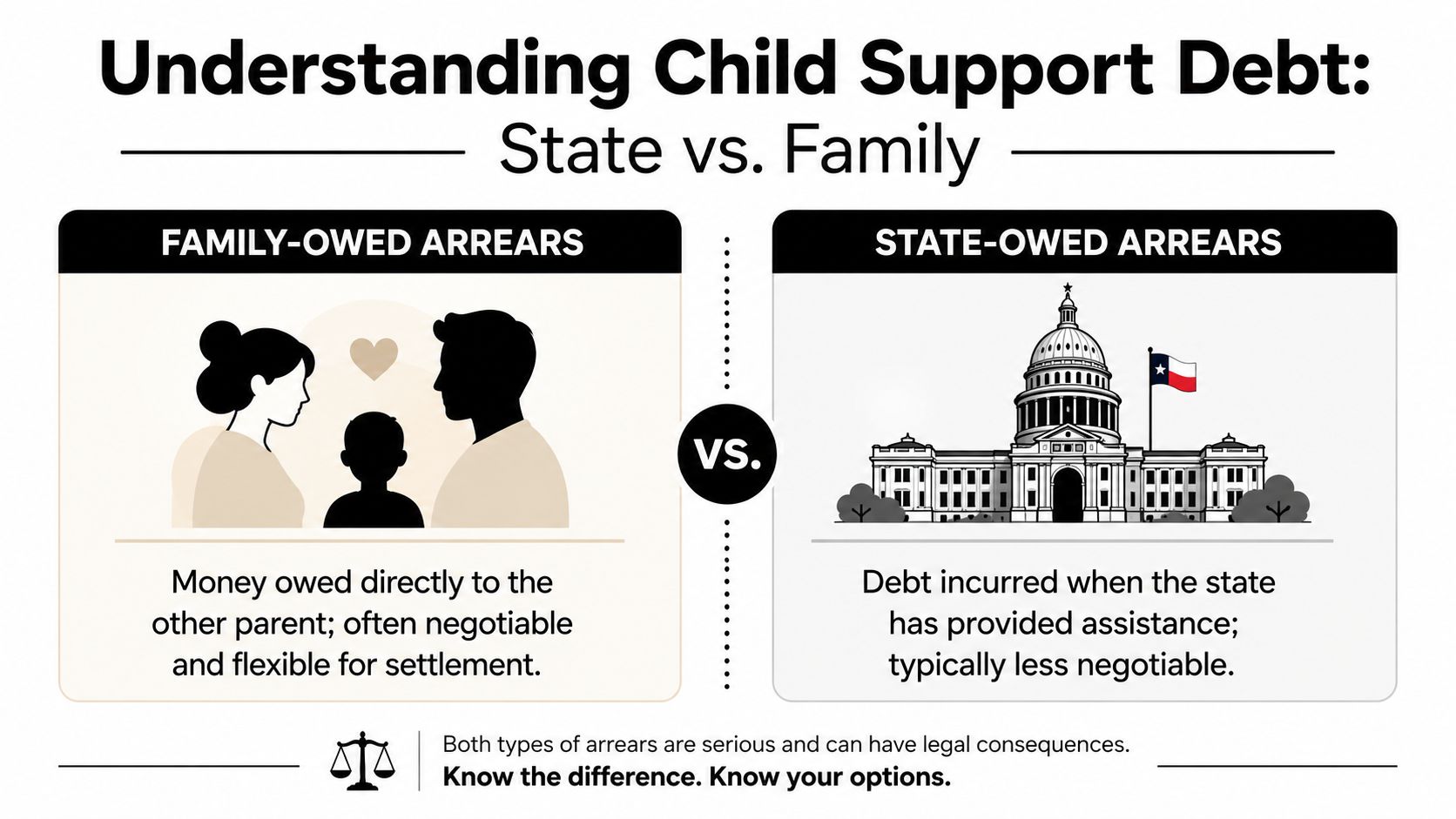
This is the part many people get wrong, and it causes expensive mistakes. Not all arrears are the same debt. In Texas, some arrears are owed directly to the other parent, and some are owed to the state because public assistance created an assignment of support rights.
Why this distinction changes everything
If arrears are family-owed, the receiving parent may agree to compromise that debt. If arrears are state-owed, a private side deal doesn't clear the state's claim.
The clearest statement of that rule appears in this discussion of pardoning arrears when the custodial parent agrees, which explains that parents can agree to forgive family-owned arrears, but that is legally impossible for state-owed arrears assigned through TANF or Medicaid without explicit approval from the Office of the Attorney General. A private agreement is void as to that portion, and the state portion remains enforceable with interest and survives bankruptcy.
State-Owed vs. Family-Owed Arrears Breakdown
| Attribute | Family-Owed Arrears | State-Owed Arrears |
|---|---|---|
| Who is owed | The custodial parent or obligee | The government because support rights were assigned through public assistance |
| Can parents settle it privately | Sometimes, if reduced to a proper court order | No, not without explicit state approval |
| Will a side agreement work by itself | No, it still needs court approval to be enforceable | No, and it is ineffective for the state portion |
| Main strategy | Negotiate compromise and obtain signed order | Use approved state process, usually through the OAG framework |
| Big risk | Thinking an oral deal is enough | Thinking the other parent can release debt they do not own |
A common real-world problem
A parent pays money directly, gets a text saying “I forgive the back support,” and assumes the case is over. Then the Attorney General still shows an arrears balance because part of the debt was assigned to the state. At that point, the parent hasn't bought peace. The parent has just spent money without resolving the legal status of the debt.
Before you negotiate anything, get a payment record and identify what portion is family-owed and what portion is state-owed. Strategy comes second. Classification comes first.
If your case involves mixed arrears, don't treat it as one settlement problem. It is usually two separate problems living in the same file.
How to Legally Settle Privately Owed Arrears
A common mistake looks like this. One parent pays a lump sum directly to the other parent, gets a text saying the back support is forgiven, and assumes the problem is over. Then enforcement continues because nothing was filed, nothing was signed by the court, and part of the balance may not have belonged to the other parent to release in the first place.
That is why private settlement works only in a narrow lane. It can resolve family-owed arrears if the numbers are verified, the terms are drafted correctly, and the court signs an order that matches the deal.
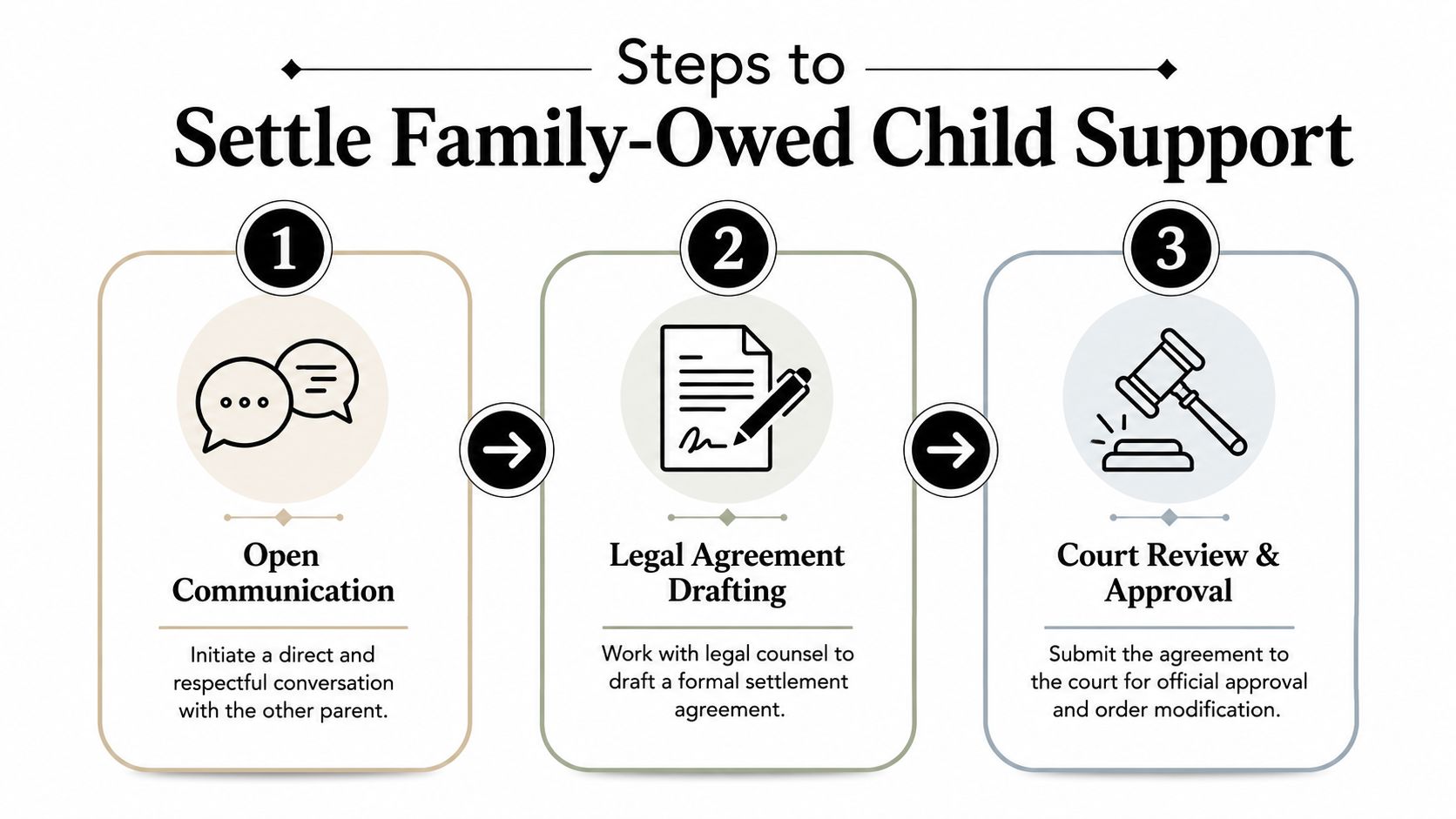
Step one is negotiation based on the actual balance
Start with the payment record, not assumptions. Confirm the arrears balance, confirm whether interest is included, and confirm that the amount you plan to settle is family-owed. If the file has any assigned arrears, a private deal will not clear that state portion, no matter what the other parent agrees to accept.
A workable settlement usually needs specific answers to five questions:
- How much will be paid
- When it will be paid
- Whether it will be one payment or several
- Exactly which family-owed arrears and interest will be released
- What order will be submitted to the court
Paying first is risky. It weakens your position, creates room for disputes about what the payment meant, and often leaves the arrears ledger untouched until a judge signs something.
If you are on the receiving side of the case, how to collect back child support gives useful context on enforcement pressure and collection timing.
Step two is drafting terms the court can enforce
The agreement has to say more than “paid in full.” Good drafting identifies the amount being compromised, states whether interest is included or reserved, sets default terms if installment payments are missed, and matches the relief the court has authority to grant.
Many private deals often fail. The parents may agree in principle, but the paperwork is vague about what survives, what is released, and whether future enforcement stops. Sloppy language creates a second lawsuit after the supposed settlement.
The following video gives a practical overview before drafting starts:
Step three is getting a signed court order
Until the court signs an order, you do not have a completed settlement. You have a private agreement with limited protection.
The usual process includes filing in the court with continuing jurisdiction, serving any required papers, setting a hearing if the court wants proof or if any issue remains contested, and submitting a proposed order that states the balance being resolved. In some cases, the judge will want the arrears amount stated with precision and the release tied to actual receipt of funds.
If future support is also being addressed, the court still applies the Texas Family Code standards for current support. That includes the guideline framework under § 154.125, the net-resources definition under § 154.062, and any deviation request under § 154.123.
Texas Child Support Law Office of Bryan Fagan handles child support establishment, modification, enforcement, and defense under the Texas Family Code.
Options for State-Owed Child Support Debt
State-owed arrears are much harder to reduce. You are not negotiating only with the other parent because the debt belongs to the government for the assigned portion. That's why the question is not “Will the other parent forgive it?” Rather, the question is “What state-approved process applies?”

The primary tool is the incentive program
Texas operates the Arrears Payment Incentive Program, also known as NCP Choices in the provided material. It offers a dollar-for-dollar credit for qualifying payments made toward state-owed arrears, as described in this explanation of child support arrears forgiveness in Texas.
That matters because it is not broad cancellation. It is a structured credit mechanism tied to voluntary payments and program eligibility.
What works and what usually doesn't
For state debt, the practical options are narrow:
- Apply through the official process. Review eligibility requirements on the Texas Attorney General's website and submit the required application to the Child Support Division.
- Pay through the proper channel. The program requires payments through the Texas Child Support Disbursement Unit.
- Keep the payment history clean. Consistency matters because the credit is earned through qualifying payments.
What usually doesn't work is trying to negotiate around the state with a private agreement, sending direct side payments, or assuming bankruptcy will clear the assigned balance. For state-owed arrears, those moves usually waste time and create false confidence.
If your debt is state-owed, focus on approved channels, documented payments, and formal program compliance. Informal workarounds don't solve formal debt.
In many cases, the best realistic outcome is not “forgiveness” in the ordinary sense. It is reducing state-owed arrears through matching credit while also stabilizing the current support obligation so new debt doesn't keep building.
Understanding Enforcement and Modifying Future Support
A common mistake shows up right after arrears start piling up. A parent spends months trying to cut a side deal on old debt, especially with the other parent, while the current order keeps running every month. By the time enforcement hits, the case is larger, harder to fix, and often mixed between family-owed arrears and state-owed arrears. That distinction matters here too, because a private agreement does nothing to stop enforcement on the state's share.
Texas has strong enforcement tools, and they are built to create pressure fast. Income withholding is the usual starting point. Cases can also involve bank account seizure, tax refund interception, license suspension, passport denial, and court enforcement actions. For a practical summary of those pressure points, see Texas child support enforcement remedies and procedures.
Contempt is the part many parents underestimate. If the court finds willful nonpayment, the judge can order fines, attorney's fees, and jail time. Hardship can matter, but only if it is documented and presented correctly. Walking into enforcement court with excuses and no records is how people make a bad file worse.
The better strategy is often to attack the problem from two directions at once. Deal with enforcement exposure, and file to change the future amount if the facts support it. Texas courts generally cannot erase matured support, but they can modify future support under Tex. Fam. Code § 156.401 when there has been a material and substantial change in circumstances.
That usually means a real change, not frustration with the existing number. Job loss, a major income drop, disability, or a substantial shift in the child's living arrangements may support modification. The court with continuing jurisdiction must receive a proper petition, the other side must be served unless service is waived, and the evidence has to be organized. Pay stubs, tax returns, medical records, termination paperwork, and proof of current expenses often matter more than the story a parent wants to tell.
Guideline support still starts with net resources under § 154.062 and the percentages in § 154.125, unless the court finds a reason to deviate under § 154.123. In higher-income cases, the cap on monthly net resources used for guideline support increased to $11,700 effective September 1, 2025, for new and modified orders. That does not change old arrears. It can change the number going forward in a new modification order.
Timing matters. If income dropped six months ago and no modification was filed, the old amount usually kept accruing the whole time. Courts do not usually reach back and correct that delay. On the other side, if the receiving parent files after the obligor's income rises, the same rules can increase future support.
The practical point is simple. Do not confuse arrears relief with support modification. One deals with debt that already exists. The other controls what happens next. In many cases, the only way to stop an arrears problem from getting worse is to file for modification quickly, keep every payment documented, and avoid private arrangements that ignore whether the debt is owed to the family, the state, or both.
Frequently Asked Questions About Arrears Forgiveness
Can a Texas judge forgive my child support arrears because I fell behind during a hard time
Usually no. Under § 154.012, matured support is generally not subject to retroactive modification. Financial hardship may matter in enforcement, payment plans, or future modification, but it usually does not erase accrued debt.
If my ex agrees to waive arrears, is that enough
Not by itself. If the arrears are family-owed, the agreement still needs to be properly documented and reduced to a court order. If any part of the debt is state-owed, the other parent cannot privately release that portion.
Does arrears debt stop when my child turns 18 or graduates
The current support obligation may end under the order, but the arrears balance does not disappear just because the child has aged out. The unpaid amount remains collectible until resolved through payment, approved credit, offset, or court-recognized settlement where legally allowed.
Can bankruptcy wipe out child support arrears
No. Child support arrears generally survive bankruptcy. That is one reason parents need a Texas family law strategy rather than a general debt-relief strategy.
Can I go to jail for unpaid child support
Jail is not automatic, but contempt is a real risk in enforcement court. If the court finds willful nonpayment, incarceration can become part of the enforcement outcome. That's one reason documentation of your finances, payment efforts, and modification history matters.
What should I bring to court if I want to address arrears or modify support
Bring records, not explanations alone. Useful documents usually include payment history, the current order, proof of income, tax records if relevant, medical documentation if health affected earning capacity, and any written settlement communications. If you're arguing for a guideline recalculation, the court will want evidence tied to § 154.062, § 154.123, and § 154.125.
What is the first strategic step if I have mixed arrears
Find out how much is owed to the other parent and how much is owed to the state. That classification determines whether you should negotiate a court-approved settlement, apply for the incentive program, litigate an offset issue, or pursue multiple tracks at once.
If you need a legal plan for arrears, enforcement, or modification, Texas Child Support Law Office of Bryan Fagan provides counsel on establishing, modifying, enforcing, and defending child support orders under the Texas Family Code across Texas.