Yes, child support can be retroactive in Texas. But it isn't automatic, and a judge usually won't go back forever because Texas law puts strict limits on how far back a claim can reach.
If you've been paying for everything on your own, rent, groceries, school costs, doctor visits, and the other parent hasn't been contributing, your question is probably simple: can the court make them pay for the past too? In many Texas cases, yes. The hard part isn't whether retroactive support exists. The hard part is knowing the filing rules, service rules, and calculation rules that decide how much you can recover.
A lot of parents confuse retroactive child support with arrears. They're not the same. Retroactive support is support for a time before a court entered a child support order. Arrears are unpaid amounts due after an order already existed. That distinction matters in court, and it changes both the evidence you need and the arguments the judge will hear.
Understanding Retroactive Child Support in Texas
Texas courts can order retroactive child support when one parent should have been supporting the child before any formal support order was signed. This usually comes up after a breakup, after a paternity case, or after one parent waited too long to file while carrying the full financial load alone.
The practical question isn't just “is child support retroactive.” The practical question is whether your facts fit the statute, whether you filed correctly, and whether you can prove what happened during the earlier period.
What retroactive support actually means
Retroactive support deals with a pre-order period. No order existed yet, but the child still needed support. A judge can look backward and assign a financial obligation for that earlier time.
Arrears are different. If there was already a signed order and the paying parent missed payments, that's an enforcement problem, not a retroactive support problem.
Practical rule: If there was never a child support order, you may be dealing with retroactive support. If there was an order and payments were missed, you're dealing with arrears.
Why Texas courts allow it
Texas law recognizes a basic reality. A child's needs don't start on the day a petition gets filed. They existed before the courthouse got involved.
That doesn't mean the requesting parent gets everything they ask for. Judges still look at timing, fairness, and the paying parent's conduct. If you waited to file, that matters. If the other parent avoided responsibility, that matters too.
Where many parents get it wrong
Parents often assume one of two bad rules. First, they assume retroactive support is guaranteed. It isn't. Second, they assume the other parent is safe because no order existed yet. That's also wrong.
If you're preparing for court, think in terms of proof:
- Your timeline matters. When did the child live primarily with you, and when did support stop or never begin?
- Your filing date matters. Texas courts anchor retroactive claims to procedure, not emotion.
- Your records matter. Old income records, paternity documents, and proof of direct support can drive the outcome.
That's how judges handle these cases. Not by sympathy alone, but by statute and evidence.
How Far Back Can Retroactive Support Go
Texas doesn't give courts unlimited power to reach into the past. Under Texas Family Code Chapter 154, §154.009 creates a rebuttable presumption that a court may order retroactive child support for up to four years before the petition was filed. A court can shorten that period if the requesting parent unreasonably delayed filing, and it can go longer if the paying parent actively evaded service.
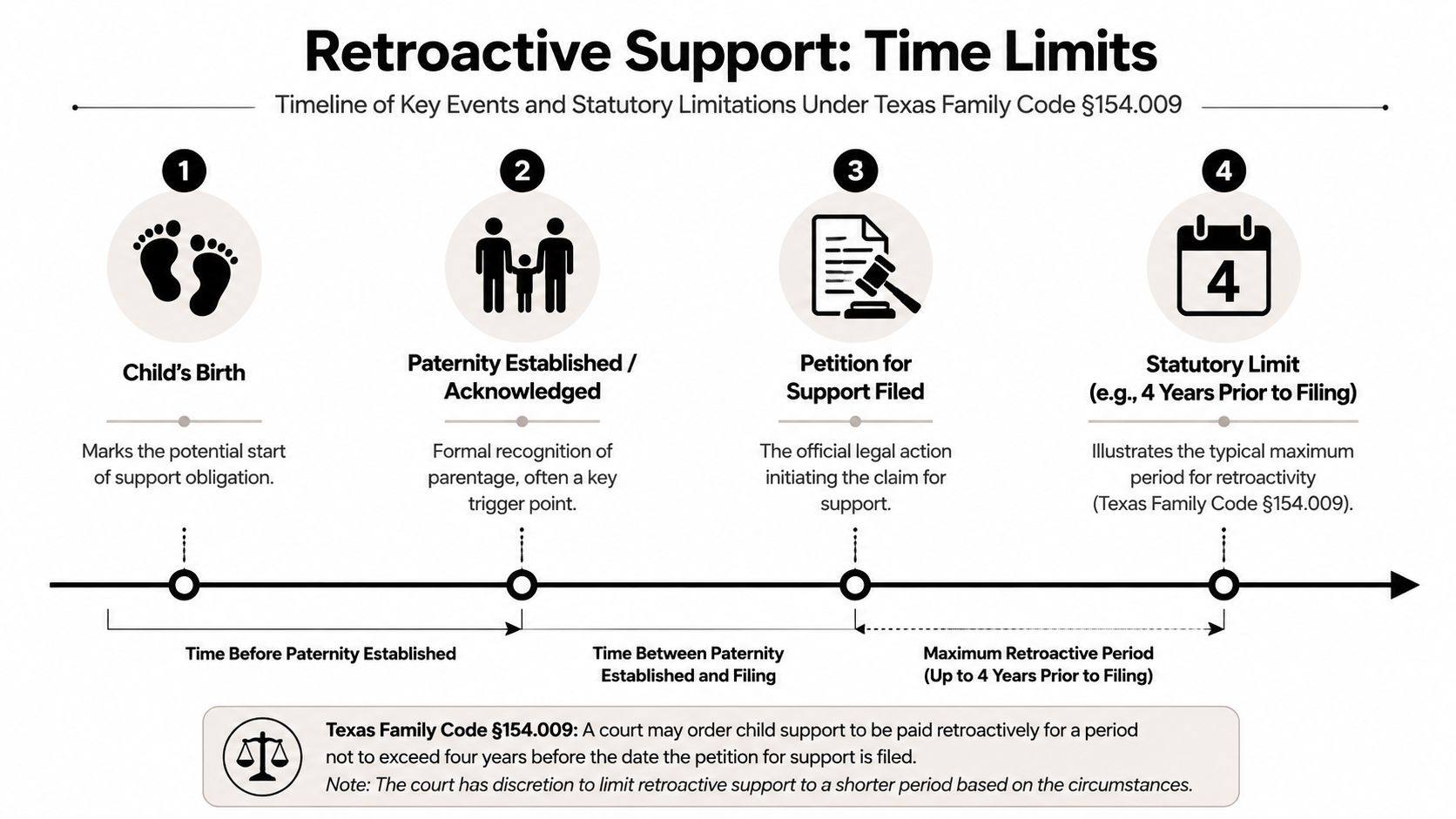
That four-year rule is the number most parents need to know. It's the starting point in Texas. Not birth in every case. Not separation in every case. Not “as far back as feels fair.”
The four-year lookback is a presumption, not a guarantee
A rebuttable presumption means the court starts there, but it doesn't have to stay there. Judges can adjust the period based on the facts.
Here's how that usually plays out in real courtrooms:
- Shorter period: The requesting parent knew where the other parent was, could have filed earlier, and waited without a good reason.
- Longer period: The paying parent hid, dodged service, or otherwise evaded the process.
- Standard period: The case fits the ordinary pattern, so the court looks back up to four years from filing.
That's why timing strategy matters. Filing late can cost you support. Evading service can cost the other parent more.
A courtroom-ready example
Assume a parent files in early 2026 and asks for retroactive support. The court will usually measure backward from the filing date and decide whether the facts support the presumptive four-year period. If the evidence shows the other parent had avoided service, the court may consider a longer period. If the requesting parent sat on their rights without a strong reason, the court may cut the period down.
The child's right to support exists from birth. But the court's enforcement window for retroactive reimbursement is generally narrower. That's the balance Texas law strikes.
For a deeper look at the enforcement timeline, see how far back child support can be enforced in Texas. If you also need the guideline formula itself, How Child Support Is Calculated in Texas explains how net resources drive the support amount.
The biggest mistake I see is delay. Parents wait because they hope the other parent will “step up.” Courts don't reward that kind of waiting.
How Retroactive Child Support Is Calculated
The amount isn't guessed. It isn't based on what feels fair in hindsight either. Under Texas Family Code §154.131, the court uses the child support guidelines to calculate retroactive support, and that calculation is based on the obligor's net resources during the past period. For guideline calculations, the statutory net monthly resource cap increases to $11,700 effective September 1, 2025.
That one point changes a lot of cases. The judge is supposed to look at what the paying parent earned during the period when support should have been paid, not just what they earn now.
Past income controls the calculation
If the obligor had one income level in an earlier year and a different one now, the court can calculate retroactive support using the earlier income. That means old pay stubs, tax returns, payroll records, and bank records matter.
For one child, Texas guideline support often starts with 20% of net resources. If the obligor's net monthly resources fall under the cap, the guideline calculation is straightforward. If income goes above the cap, the court can consider additional support based on the child's needs and other relevant factors under §154.123.
Sample Retroactive Child Support Calculation
| Time Period | Obligor's Net Monthly Resources | Guideline % (1 Child) | Monthly Support Owed | Total for Period |
|---|---|---|---|---|
| Past period example under the cap | $5,000 | 20% | $1,000 | depends on the number of months ordered |
| High-income example at the cap | $11,700 | 20% | $2,340 | depends on the number of months ordered |
That table shows the method. The court then multiplies the monthly amount by the approved retroactive period.
How the cap works in a high-income case
Texas Family Code §154.125 sets the guideline framework, and the updated cap matters in high-income cases. If an obligor has net resources of $20,000 per month, the court calculates the base support using 20% of the first $11,700, which equals $2,340, then considers additional support on the remaining $8,300 based on the child's needs and the factors the court may weigh under §154.123.
Many people often misunderstand this point. The cap is not a free pass on income above that amount. It limits the standard guideline calculation on the first layer of income. It does not prevent the court from ordering more when the law allows it.
When judges deviate from the guideline amount
Texas Family Code §154.123 gives courts room to deviate when the guideline amount would be unjust or inappropriate. For example:
- Special needs of the child: If a child has severe medical conditions requiring $1,500 per month in additional care, a court may raise support to 25% up to the cap, producing $2,925 instead of $2,340.
- Hardship on the obligor: If the obligor's income is limited to $5,000 per month because of disability, a court might reduce the obligation to 15%, or $750.
The court must explain the deviation in a written order. If you're building or defending a retroactive claim, bring the financial records that prove the actual historical picture. For a fuller breakdown of the math, see how to calculate child support in Texas.
The Legal Process for Filing Your Claim
Winning a retroactive support case starts with procedure. If you miss the filing or service rules, you can lose support that would otherwise have been recoverable.

Under Texas Family Code §154.012, a parent must properly file a petition and serve the other parent. If service is delayed beyond 90 days after filing without good cause, the court may limit the retroactive period to the date of service instead of the filing date. That can cost the requesting parent real money in a serious case, even though the same statute is discussed more fully earlier in the article.
Step one is filing the right case
Most parents start by filing a Suit Affecting the Parent-Child Relationship, often called a SAPCR, or by filing the appropriate pleading within an existing parentage or custody matter. If paternity hasn't been legally established, that issue has to be addressed too.
Don't treat filing like paperwork trivia. The filing date can become the anchor point for the retroactive period. If you wait, you weaken your position before the hearing even starts.
Service is not optional
A filed petition sitting in the clerk's office doesn't move your case forward by itself. The other parent must be properly served.
That's where many self-represented parents make avoidable mistakes:
- They file but never complete service.
- They rely on informal notice instead of formal service.
- They let months pass and then expect the original filing date to save them.
It may not.
File promptly, then push service immediately. Delay after filing can shrink the retroactive window.
What to gather before the hearing
Judges decide retroactive support cases on documents, timelines, and credibility. Bring proof that lines up with the statutory issues.
- Parentage records: Birth certificate, acknowledgment of paternity, or paternity orders.
- Income evidence: Old pay stubs, tax returns, W-2s, bank records, business records, and employment history for the relevant period.
- Support history: Proof of any direct payments, transfers, or periods with no support.
- Child-related records: School records, residence history, and medical records if they help establish who carried the day-to-day burden.
If you want a basic overview of first-order procedure, Establishing a Child Support Order in Texas is a useful starting point.
A short overview of how child support cases move through court can also help before your hearing:
What the hearing usually turns on
At the hearing, the judge usually wants answers to a short list of practical questions:
- When should support have started?
- How far back should the court go?
- What did the obligor earn during that time?
- Was any support already provided?
- Did either parent create delay or prejudice the other side?
If you're handling a complicated income case, especially a self-employment dispute or a high-income matter, one option is working with the Texas Child Support Law Office of Bryan Fagan, which focuses on establishing, modifying, enforcing, and defending child support orders under the Texas Family Code.
Common Defenses and Disputes in Retroactive Cases
Retroactive support claims aren't one-sided. A paying parent can challenge the amount, the time period, or the fairness of the request. Some defenses are weak. Some are legitimate. Good lawyering means knowing the difference.
Texas Family Code §154.123 allows a court to deviate from the standard guidelines when applying them would be unjust or inappropriate. In real cases, that's where many defenses land.
Defenses judges actually take seriously
Some arguments show up constantly, but only a few tend to carry weight when backed by evidence:
- Support was already provided in another form. The obligor may show they paid housing costs, bought food and clothing, or covered other direct child expenses.
- The requesting parent delayed unreasonably. If one parent waited too long and that delay prejudiced the other side, the court may reduce the claim.
- Past income is disputed. This happens often with cash work, self-employment, commissions, or inconsistent records.
- Hardship supports a lower amount. If the obligor's financial condition during the retroactive period was limited, the court may consider that in a deviation analysis.
A practical example of a deviation argument
Suppose the obligor didn't make formal child support payments, but did provide regular housing and paid specific child-related bills during the period at issue. That doesn't erase the claim automatically. But it can support an argument that the full guideline amount would be unjust or inappropriate under §154.123.
Or take a parent with a documented medical condition that sharply reduced earning capacity during the relevant period. A retroactive calculation based on an inflated income figure won't hold up well if the records prove otherwise.
Judges care less about broad complaints and more about records. If you claim hardship, show the records. If you claim you paid support directly, show the records.
The disputes that usually decide the case
Most retroactive cases turn on one of these fights:
| Dispute | Why it matters |
|---|---|
| Historical income | It sets the guideline amount for the past period |
| Length of lookback | It determines how many months are included |
| Prior direct support | It may reduce what the court orders |
| Delay and notice | It can shape fairness arguments and rebut presumptions |
If you're defending against a retroactive claim, don't show up with general objections. Show up with bank statements, tax returns, receipts, and a clean timeline.
Enforcing a Retroactive Child Support Order
Once the judge signs the order, the retroactive amount usually becomes a judgment or an enforceable support obligation. At that point, the fight changes. You're no longer arguing about whether support should be awarded. You're dealing with collection.
Some parents assume that once they “win,” the money just arrives. It doesn't work that way. The order has to be enforced like any other court-ordered support debt.
How courts structure payment
The judge may require payment in a lump sum or as part of an ongoing payment schedule added to current support. The exact structure depends on the order and the facts of the case.
If the obligated parent doesn't pay, the receiving parent can pursue enforcement remedies recognized in Texas child support practice, including wage withholding and other collection tools. In practical terms, the order has force because the court can compel compliance.
What nonpayment leads to
When the obligor ignores a signed order, the consequences can escalate fast:
- Wage withholding
- Liens against property
- License suspension
- Enforcement proceedings in court
That's why retroactive support isn't symbolic. It creates a real debt with real enforcement consequences.
For parents trying to recover what the court already ordered, how to collect back child support gives a practical overview of collection options.
If you have an order, use it. Don't let a signed judgment sit untouched while the balance remains unpaid.
A realistic warning for both sides
If you're asking for retroactive support, get a clear written order that states the amount and payment terms. If you're the parent ordered to pay, comply quickly or ask the court for lawful relief if a real problem exists. Ignoring the order is the worst option.
Judges are usually far more receptive to a parent who addresses payment directly than one who disappears after the hearing.
Frequently Asked Questions About Retroactive Support
Can parents agree to waive retroactive child support
They can try to resolve retroactive support in settlement, but the court still has to approve the final order. If the proposed agreement doesn't adequately address the child's interests, the judge can question it. Don't assume a side agreement is enough.
What if the paying parent's past income can't be proven cleanly
Then the case becomes an evidence fight. The court still has to make a support decision based on the best available proof. That's why old tax returns, payroll documents, bank statements, and business records matter so much.
Does retroactive support use the same guideline system as current support
Yes. As reflected in Texas Family Code §154.125, courts apply the same guideline percentages retroactively to the obligor's past income, up to the $11,700 net monthly resource cap effective September 1, 2025, as discussed earlier in the article.
Are medical expenses treated the same way as regular retroactive child support
Not always. Medical and related birth-related expenses can be handled differently from standard cash child support. Parents often leave money on the table by treating every past expense as if it falls under the same rule.
Can retroactive support be ordered if the child is already over 18
It can depend on the procedural posture of the case and when the claim was brought. Don't assume the claim disappears just because the child is older now. The filing history and the type of relief requested matter.
What should I do first if I think I have a retroactive support claim
File promptly, serve correctly, and gather old income records immediately. In these cases, delay usually hurts the parent asking for support more than anyone else.
If you're dealing with a retroactive child support claim, don't guess about dates, service, or income proof. The Texas Child Support Law Office of Bryan Fagan handles cases involving establishment, enforcement, retroactive support, high-income calculations, and disputes under the Texas Family Code, and a focused case review can help you decide what to file, what to prove, and what to expect in court.