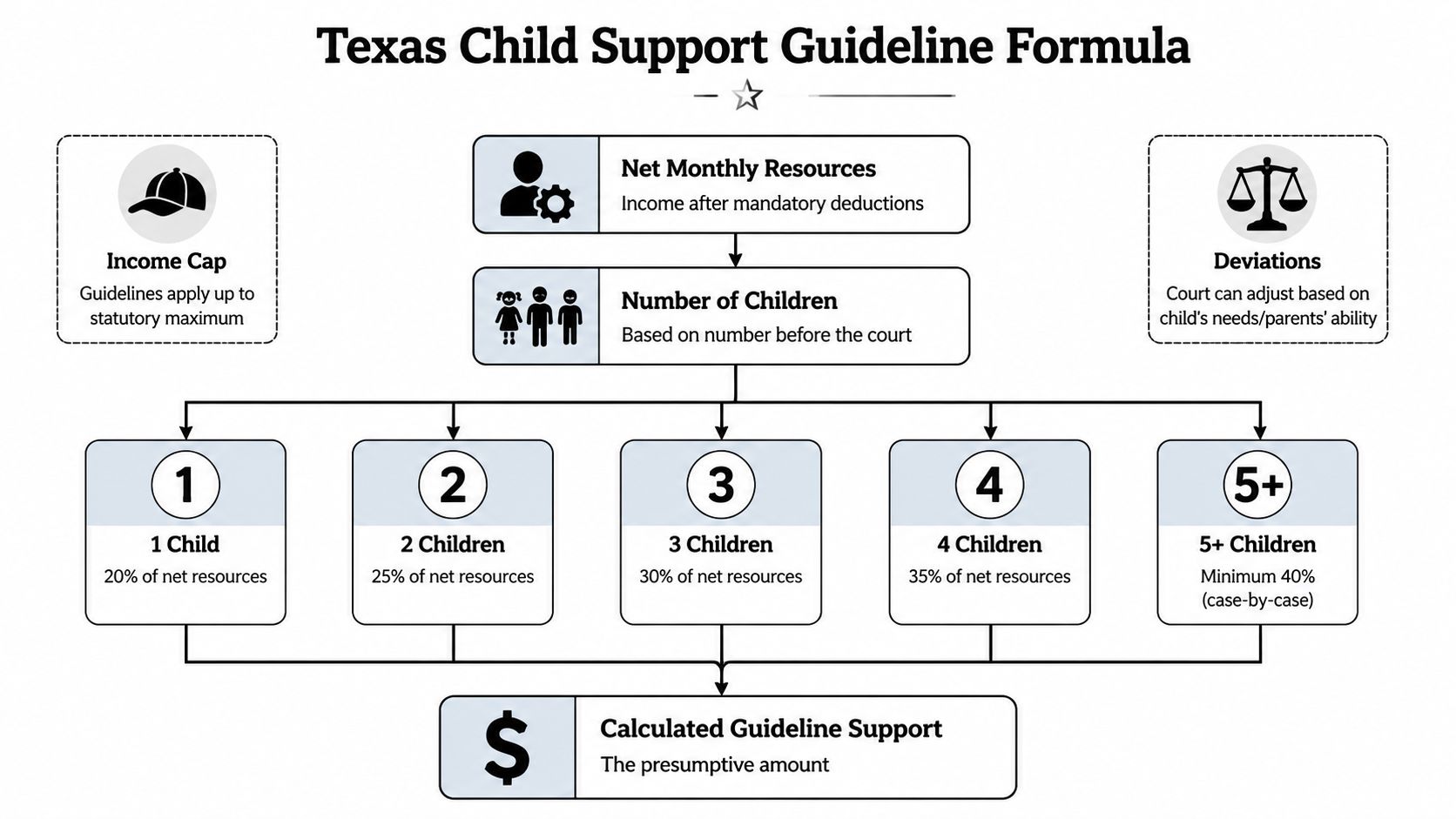
Yes, child support can be negotiated in Texas, but the agreement must be approved by a judge to be enforceable. Texas courts still use the guideline formula based on net resources, including 20% for one child, 25% for two, 30% for three, 35% for four, and 40% for five or more, unless a valid reason supports a different result.
That matters because most parents asking whether they can negotiate child support in Texas are already in the middle of a practical problem. One parent wants predictability. The other wants flexibility. Both want to avoid a bad courtroom fight. The answer is not just “yes” or “no.” The actual answer is that Texas gives parents room to negotiate, but it puts firm guardrails around that negotiation.
Those guardrails exist for one reason: the child's best interest. Texas judges don't treat child support as a private contract the way they would a business debt. They treat it as support owed for a child, and that changes everything about what works, what doesn't, and what a court will sign.
The Foundation of Every Order The Texas Guideline Formula
Before anyone can negotiate intelligently, you need the baseline number a Texas court will start from. In Texas, child support is built around net monthly resources, not gross pay. That point alone changes many negotiations, because parents often walk in arguing about salary when the legal fight is really about the income base and the allowed deductions.
Under Texas Family Code §154.125, the guideline percentages are tied to the number of children before the court. Texas Law Help states that the guideline percentages are 20% for one child, 25% for two, 30% for three, 35% for four, and 40% for five or more, and that for cases filed on or after September 1, 2021, a lower-income schedule applies when the obligor has $1,000 or less in monthly net resources, using 15% for one child, 20% for two, 25% for three, 30% for four, and 35% for five (Texas Law Help on child support and lower incomes).
Start with the number that actually matters
The legal question isn't “What do you earn?” It's “What are your net monthly resources for guideline purposes?”
That's why support negotiations often turn into document cases. Pay stubs, tax records, benefits records, and proof of who pays health insurance can matter more than broad arguments about fairness. If the parties don't agree on the income base, they aren't really negotiating support yet. They're still negotiating the math.
For a fuller discussion of the formula itself, see this overview of Texas child support guidelines explained. A related breakdown in How Child Support Is Calculated in Texas is also useful if you're trying to understand how net resources drive the final amount.
A practical way courts approach the calculation
In court, the sequence usually looks like this:
- Identify net monthly resources.
- Determine how many children are before the court.
- Apply the correct percentage under §154.125.
- Check whether the low-income schedule applies.
- Ask whether a deviation is justified under Texas Family Code §154.123.
Here's the practical lesson: the guideline amount is the presumptive amount. It is the starting point judges trust unless someone gives the court a legally sound reason to move away from it.
Practical rule: If you can't explain your proposed number by reference to net resources and the statutory chart, you're not negotiating from a position a Texas judge is likely to respect.
What usually goes wrong
Parents often make three mistakes early.
- They negotiate from gross income. That isn't the formula Texas uses.
- They skip the low-income analysis. If the obligor has $1,000 or less in monthly net resources, the lower schedule may control under the Texas Law Help guidance already cited.
- They argue fairness before proving the numbers. Courts want the calculation first, the deviation argument second.
If you're asking can child support be negotiated in Texas, the correct answer starts here. Yes, but the guideline formula is the anchor. Most good settlements don't ignore that anchor. They build from it.
Why a Handshake Deal Is Not Enough The Role of Court Approval
Parents make informal deals all the time. One pays the mortgage. The other covers school costs. Someone agrees to skip monthly support because possession time feels roughly equal. Those arrangements may feel practical, but without a court order, they are unstable.
Texas law allows parents to make written agreements that vary from the guidelines, but they become enforceable only after a judge reviews them, decides they are in the child's best interest, and puts them into a formal order. A private deal has no legal standing, as explained in this discussion of negotiated child support agreements in Texas.

Why judges review these agreements at all
Under Texas Family Code §153.007 and §154.001, a court still has to examine the agreement. The judge is not there just to notarize what the parents want. The judge is there to decide whether the child is adequately protected.
That is why the “best interest of the child” standard controls. A parent can give away many personal claims in litigation. A parent cannot bargain away a child's right to support and expect the court to rubber-stamp it.
If your agreement would make sense only because both adults are tired of fighting, that's usually not enough. The court wants to know whether the child is actually protected.
What works and what fails
A negotiated order tends to work when it does these things:
- Uses the guideline amount as a benchmark. Even if the final number differs, the order should show the court the baseline.
- Explains the trade-offs clearly. If one parent is paying school tuition, medical expenses, or other child-related costs in place of some monthly support, the order needs to say so precisely.
- Reduces everything to writing. Verbal side deals are a future enforcement problem.
These arrangements usually fail when they do the opposite:
| Situation | Likely court concern |
|---|---|
| Parents agree privately and never file it | No enforceable order |
| One parent pays expenses informally instead of support | Those payments may not count the way the parent expects |
| Support is set artificially low with no explanation | Child's best interest is not shown |
For parents trying to settle without trial, a practical reference point is this guide to agreed child support orders in Texas.
The core point is simple. You can negotiate. You cannot self-authorize. In Texas, the agreement becomes real only when the judge signs it.
Justifying a Negotiated Amount How to Deviate from the Guidelines
A different number is not enough by itself. Under Texas Family Code §154.123, the court may deviate from the guidelines, but the judge needs a reason grounded in the child's circumstances, the parents' situation, or both. Many negotiated cases are often won or lost based on these considerations.
The strongest deviation arguments are specific. The weakest are emotional. “We both think this is fair” carries far less weight than “Here are the child's documented expenses, here is the possession structure, and here is why the guideline amount does not fit this case.”
What judges are actually looking for
In practice, courts tend to focus on whether the proposed deviation is tied to real child-related needs and whether the order remains workable over time.
A judge is more likely to approve a deviation when the record shows things like:
- Documented child expenses. School costs, medical needs, therapy, or other recurring expenses are easier to defend when they are concrete and traceable.
- A possession schedule that changes the financial reality. If one parent is covering substantial day-to-day costs because of the schedule, that may affect the support analysis.
- A clear allocation of responsibility. Vague promises create conflict. Specific obligations create enforceable orders.
Build the evidence before the hearing
If you want a guideline deviation approved, prepare it like a proof problem.
Bring organized records. Show the court how the proposed amount was reached. Identify who pays which expenses and when. If the agreement shifts support into direct payment of certain costs, make sure the language is specific enough to enforce.
Courts approve well-documented deviations far more readily than vague “we worked it out” proposals.
A practical presentation to the court often includes:
- The guideline calculation first.
- The reason the guideline amount doesn't fit.
- The documents supporting the alternative.
- The exact order language needed to make it enforceable.
What not to do
The most common strategic error is treating deviation like a free-form negotiation. It isn't. Texas permits flexibility, but only inside a legal structure.
Avoid these approaches:
- Trading support for goodwill. A promise to “help out more later” means nothing in an enforcement case.
- Using round numbers with no support. Judges notice when the number appears arbitrary.
- Trying to enrich a parent instead of meeting a child's needs. Courts are alert to that distinction.
If your case involves unusual expenses, a nonstandard schedule, or a parent whose financial picture doesn't fit the typical pattern, deviation can be the right tool. But the court will want the “why,” not just the agreement.
Negotiation Strategies for High-Income and 50/50 Custody Cases
High-income cases and shared possession cases are where simplistic advice falls apart. Clients often hear the worst myths in these circumstances, including “the court will just use a percentage of all income” or “50/50 means no child support.” Neither statement is reliable.
For high-income matters, one date matters a great deal. Effective September 1, 2025, Texas will raise the net monthly resources cap from $9,200 to $11,700. The guideline formula then applies only up to $11,700, and support above that level generally depends on the child's proven needs rather than a straight percentage of excess income, as summarized in this discussion of the Texas child support cap change.

High-income cases after the cap change
That upcoming cap matters because it changes the negotiating position. The guideline base expands by $2,500 per month, and that can materially affect settlement positions in higher-income cases under the same source above. For one child, the guideline amount at the cap is about 20% of $11,700, or $2,340 per month. For five or more children, it is about 40% of $11,700, or $4,680 per month under that same source.
In practical terms, negotiation above the cap becomes an evidence question. If the paying parent's net resources exceed $11,700, the argument is no longer “apply the percentage to all income.” The argument becomes “what proven needs of this child justify support above the cap?”
That usually means the parent requesting more support should come prepared with a disciplined expense presentation. Private school, specialized medical care, therapy, or recurring activity expenses are easier to discuss when they are documented and child-specific. Broad lifestyle arguments usually perform poorly.
For more detail on that niche issue, this page on high-income child support in Texas is a useful reference.
Why 50/50 cases still produce support orders
Equal possession does not automatically erase support. Texas courts still look at income, child-related expenses, and whether a deviation from the guideline amount is justified. In a true 50/50 arrangement, the negotiation usually shifts from “who is primary” to “who is carrying which financial burdens, and is the proposed allocation fair to the child?”
That's why many 50/50 cases are negotiated around practical realities such as:
- Income disparity between the parents
- Which parent covers health-related costs
- Who pays recurring school and activity expenses
- Whether the proposed arrangement can be enforced cleanly
In shared custody cases, the strongest proposal is usually the one that matches money to actual responsibility, not the one that makes the adults feel even.
What actually works in these cases
Parents often get better results in complex cases by narrowing the dispute.
Instead of fighting over slogans, focus on the specific issue that matters most:
| Case type | Productive negotiation focus |
|---|---|
| High-income case | Child's proven needs above the cap |
| 50/50 possession case | Allocation of recurring child expenses |
| Mixed issue case | Guideline baseline plus documented deviations |
When a case requires a structured review of income, net resources, deviations, or post-cap strategy, one available option is the Texas Child Support Law Office of Bryan Fagan, which handles establishment, modification, enforcement, and high-income support disputes under the Texas Family Code.
The Modification Process Renegotiating an Existing Court Order
Once a child support order is signed, the parents can't change it by text message, side agreement, or a temporary compromise that never reaches the court. To change the legal obligation, one parent has to seek a modification and obtain a new signed order.
Texas requires proof of a material and substantial change in circumstances since the last order. The State Law Library of Texas notes that a common benchmark, though not a rigid rule, is a change in the obligor's income that would produce a 20% or $100 difference in the monthly support obligation, as described in the Texas child support modification guide.

The court process in plain terms
A modification usually moves through a sequence like this:
- File the modification case. The pleading is commonly a petition to modify the parent-child relationship.
- Serve the other parent. Proper service matters unless service is formally waived.
- Exchange financial information. If income is disputed, records become central.
- Negotiate or mediate. Many cases resolve here if the numbers are clear.
- Attend a hearing if needed. The judge decides whether the legal standard is met and what the new amount should be.
- Obtain a signed order. Until then, the old order remains in effect.
This short video gives a useful visual overview of the process:
What clients should do before filing
Good modification cases are built before filing, not after.
Gather your current financial records. Compare the existing order to the current facts. Identify whether the change is about income, custody, medical needs, or another substantial issue. If you're trying to settle before hearing, draft terms that could be placed in a new order.
A modified arrangement is enforceable only after the court signs it. Until then, paying a different amount informally can create arrears under the existing order.
What usually stalls a modification
Three problems show up repeatedly:
- The parent can describe a hardship but can't prove a legal change.
- The parties reach a new deal but never reduce it to a signed order.
- One side assumes income growth alone guarantees a new number. The court still needs evidence and a proper request.
If you're asking whether child support can be renegotiated in Texas after divorce, the answer is yes. But the procedure matters just as much as the merits.
Common Questions About Negotiating Texas Child Support
Can we agree to waive child support completely in Texas
You can ask the court to approve an agreement that sets support unusually low or even at zero, but that doesn't mean the judge will sign it. The court's job is to protect the child's best interest, not merely to ratify what the parents prefer.
In practice, zero-support agreements face heavy scrutiny. If one parent is assuming nearly all direct child-related costs, or the overall structure clearly provides for the child another way, the proposal may have a better chance. But if the arrangement shifts support away from one parent without a solid explanation, courts may reject it.
The practical question is not “Do both parents agree?” The practical question is “Can the judge see how this child is being adequately supported?”
What if we want to trade monthly support for school tuition or other expenses
This is common, and sometimes it can be structured well. Parents may prefer an arrangement where one parent directly pays school costs, medical expenses, or activity expenses instead of making a standard cash payment at the guideline level.
That can work, but only if the order says exactly who pays what, when payment is due, how reimbursement works, and whether those payments satisfy some portion of support. If the written order is vague, those payments may later be treated as voluntary payments rather than court-ordered support.
The safest approach is to make the order do the accounting. If one parent is supposed to receive credit for paying a defined expense, the signed order should say so plainly.
Can parents negotiate child support during mediation
Yes. Mediation is often where significant negotiation occurs. But the result still has to be reduced to written terms and presented to the court for approval.
Mediation is useful because it lets parents solve several connected issues at once. Support, health-care allocation, expense reimbursement, and possession details often affect each other. A strong mediated settlement addresses those moving parts together rather than pretending support exists in isolation.
Does 50/50 custody mean nobody pays support
No. Shared possession changes the discussion, but it doesn't erase the court's authority to order support. The better question is whether the facts justify a deviation from the baseline and how the recurring costs are divided between the parents.
When one parent earns substantially more or carries fewer direct day-to-day expenses, support may still be appropriate even with equal time. The court will look at the whole arrangement, not just the label “50/50.”
Can high earners negotiate lower support than the guideline amount
Sometimes, but not just because the obligor earns a high income. In higher-income cases, the analysis often turns on the cap and on whether support above the cap is justified by the child's proven needs.
That means a high earner isn't automatically entitled to a lower result, and the receiving parent isn't automatically entitled to a percentage of all income. The stronger case is the one built around documented child-related needs and a legally coherent proposal.
Can we make a private agreement and follow it without going to court
You can do it in a practical sense, but it is risky. A private agreement has no legal standing unless it becomes part of a signed court order. If there is already an order in place, the old order remains enforceable until modified.
That creates a serious danger. A parent may believe he or she is complying with the family's real agreement while still accumulating enforceable arrears under the actual court order.
What if the other parent's income changed after the order was signed
Then modification may be possible, but proof matters. You need evidence of the change and a request for a new order. A court won't revise support just because one parent says circumstances are different now.
Current pay information, tax records, and proof of changed child-related expenses often become central. If the income issue is contested, the case may require formal discovery before settlement is realistic.
Can we negotiate retroactive child support
Parents can negotiate resolution of claims involving past support issues, including how an amount will be paid or resolved, but the court still has to approve the final result if it is going to be enforceable. In practice, retroactive issues require careful drafting because payment timing, credits, and any existing arrears record all matter.
The biggest mistake in retroactive disputes is assuming informal payments will automatically receive legal credit. If there is going to be a negotiated resolution, it should be specific and incorporated into an enforceable order.
What is the smartest way to approach negotiation
Start with the guideline framework. Gather the income records. Identify any child-specific expenses that might justify a different amount. Then negotiate from a draft order, not from memory.
That last point saves people a lot of grief. If the terms can't be written clearly, they usually can't be enforced cleanly.
If you need help evaluating whether a proposed agreement will hold up in court, Texas Child Support Law Office of Bryan Fagan handles Texas child support cases involving establishment, modification, enforcement, high-income disputes, 50/50 custody questions, and net resource calculations under the Texas Family Code. A focused review of your income documents, existing order, and proposed settlement terms can tell you quickly whether you have a workable agreement or a future enforcement problem.