You married into the day-to-day life of a child, helped with homework, paid for groceries, maybe even sat in court once for the other parent. Then a support notice shows up, and suddenly you're asking the question nobody answered cleanly before, can a step parent child support obligation Texas court bind you to pay? In Texas, the answer usually starts with a hard no, then changes fast if adoption, a specific court order, or an unusual parent-like fact pattern changes your legal status.
The rule in Texas is simple on its face, but the details matter. Biological and adoptive parents carry the support duty, not a stepparent who has not adopted the child, and Texas guideline percentages apply only to the person with the legal duty under the Family Code, not the spouse standing beside them. The practical problem is that many families stop at that headline and miss the traps, especially after adoption, remarriage, or a parent arguing for a deviation based on household finances.
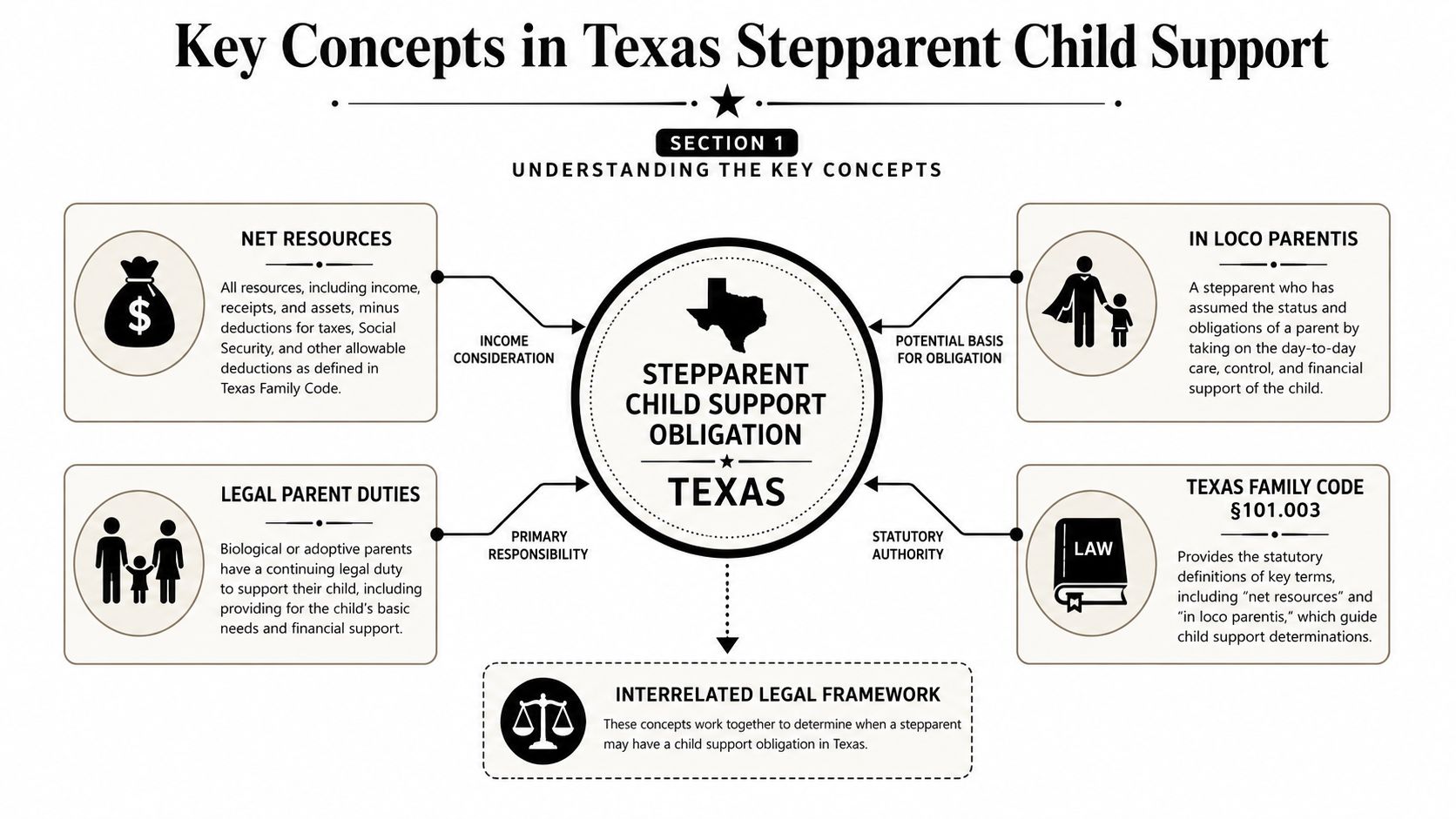
Understanding the Key Concepts
A Texas support case turns on status first, then money. The court asks who has the legal duty to support the child, what counts as net resources, and whether anyone is trying to stretch the law beyond that status line. Under Texas Family Code definitions, the key point is that the support order tracks the legal parent, not the person who merely married into the family.
Net resources and legal duty
Net resources are the starting point for guideline support under Texas law, and the court uses them only for the obligor, the parent with the legal duty to pay. In plain English, the stepparent's paycheck does not become the child support number just because the household is blended.
That distinction matters in every Texas support calculation. The guideline percentages are tied to the legal parent's net resources, with 20% for one child, 25% for two, 30% for three, 35% for four, and 40% for five or more children under the Texas framework cited in the briefing. The stepparent is usually outside that calculation unless legal parentage changed through adoption.
If you want a clean, practical overview of the formula, How Child Support Is Calculated in Texas tracks the same basic rule, the support amount follows net resources and the guideline percentage, not marital status.
Practical rule: If the person paying support is not the child's legal parent, stop treating the case like a normal guideline calculation. The threshold question is status, not sympathy.
In loco parentis
In loco parentis means acting in the place of a parent. Texas families use that phrase a lot because many stepparents do real parenting, but Texas courts still distinguish between emotional parenting and legal parenthood.
That distinction is why a stepparent who coaches soccer, attends school events, and pays household bills usually still has no automatic support duty. The law cares about who adopted the child, who is named in an express order, and whether a court finds a legally meaningful basis to treat that adult like a parent. For a plain-language overview of support calculations, the state's family law rules point back to the same backbone, legal duty plus net resources, and not the stepparent's wages.
Key Statutes and Case Law
Texas family law does not leave this issue to guesswork. The core rules sit in §154.125, which sets the guideline percentages, and §154.123, which lets a judge deviate when the facts justify it. Those provisions matter because Texas does not start from the idea that a household should share child support equally, it starts from the idea that the legal parent pays according to net resources unless the court has a reason to go off-guideline.
The support scheme also intersects with adoption statutes and standing rules. Once a child is legally adopted, the adoptive parent steps into the same support position as any other legal parent. For broader Family Code reference material, the firm's Texas Family Code child support overview is available at Texas Family Code Child Support, which is useful when you're drafting or reading a petition.
What the statutes actually do
§154.125 is the guideline engine. It tells the court how to calculate support using the obligor's net resources and the child-count percentage structure. That's the section you cite when you want the court to follow the standard formula.
§154.123 is where parents fight about fairness. If remarriage, shared housing, or unusual expenses change the obligor's real financial picture, that section is where a party argues for a deviation. It does not create stepparent liability by itself. It gives the judge discretion to adjust the number when the evidence supports it.
§102.004 matters because adoption and parentage issues change who belongs in the case at all. Once legal parentage changes, so do support duties. If you're preparing a filing, don't talk loosely about “the stepdad” or “the stepmom” when the actual issue is whether that person became a legal parent through adoption.
A Texas judge is far more interested in the legal relationship than in the family story. If the status changed, the support analysis changed with it.
Why courts focus on legal status
Texas courts apply the support laws to the person who has the duty to support. That's why step-parent income is not used in the obligor's guideline calculation under Texas Family Code rules, and why a spouse's earnings usually matter only indirectly, if at all. The legal question is not who helped raise the child, it's who owes the support obligation under the Family Code.
That distinction helps in court, because it narrows the evidence. You do not need a scrapbook of family affection. You need adoption papers, orders, income records, and a clean explanation of who the legal parent is under Texas law.
Establishing When Obligation Arises
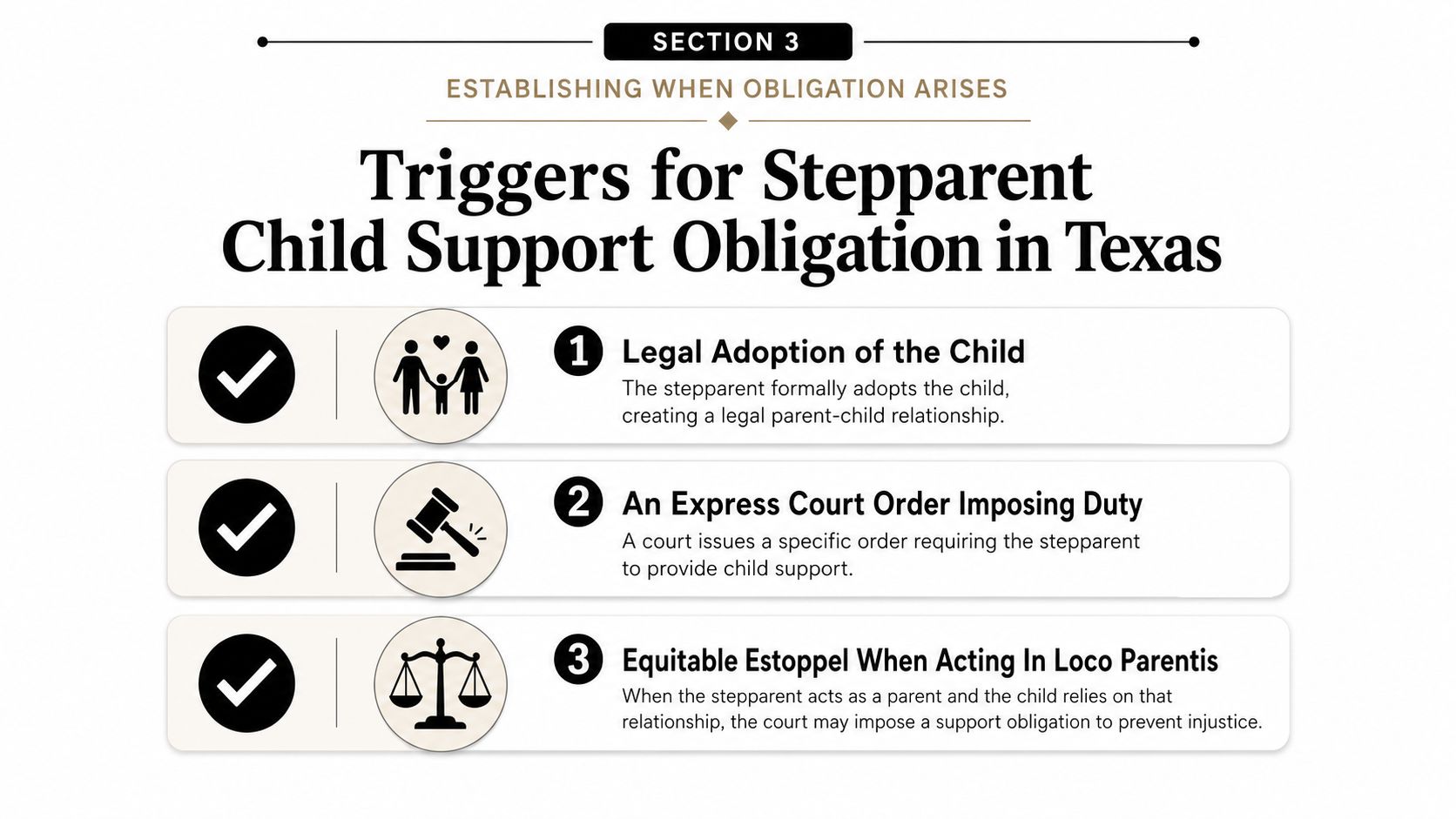
A stepparent support duty does not appear out of nowhere. It arises when the legal relationship changes, or when a court has a lawful basis to treat the stepparent as more than a spouse to the parent. The strongest trigger is adoption, because adoption converts a non-parent spouse into a legal parent with the same support obligations as a biological parent.
The three triggers that matter
Legal adoption of the child. Once adoption is finalized, the stepparent is no longer just a spouse in the home. The person becomes a legal parent, and the support obligation follows that status.
An express court order imposing duty. If a court specifically orders support, that order controls. In practice, the petition has to identify the legal basis for the request and the judge has to have authority to enter that order. A vague request that someone “help support the child” is not enough.
Equitable estoppel when acting in loco parentis. This is the hard, fact-specific edge case. Some Texas-focused commentary notes that equitable doctrines can create liability when a stepparent has acted in a parent role and the facts justify it. That argument is not the ordinary rule, and it is not something to assume. It is a litigation issue that depends on conduct, reliance, and fairness.
What adoption changes
Adoption is the bright-line line in the sand. A stepparent who adopts has the same obligations as any other parent, and the marriage ending later does not erase that duty. That is the legal shift many overlook when they search only for “step parent child support obligation Texas” and stop at the no-duty headline.
The practical consequence is obvious in court. If adoption exists, the support case looks like any other parent-to-parent support dispute. If adoption does not exist, the opposing side has a much harder job explaining why a stepparent should owe guideline support.
What to prove or attack
If you're asking the court to impose support, gather the documents that show legal parentage, the exact language of any order, and the facts supporting any reliance theory. If you're defending, attack the missing trigger first. No adoption, no express order, and no clean basis for estoppel means the case should be treated as a normal Texas child support case against the actual parent, not the stepparent.
The Texas acknowledgement of paternity process is worth separating from stepparent issues, because parentage documents and support duty often get mixed together in bad petitions.
Calculating Support and Enforcement
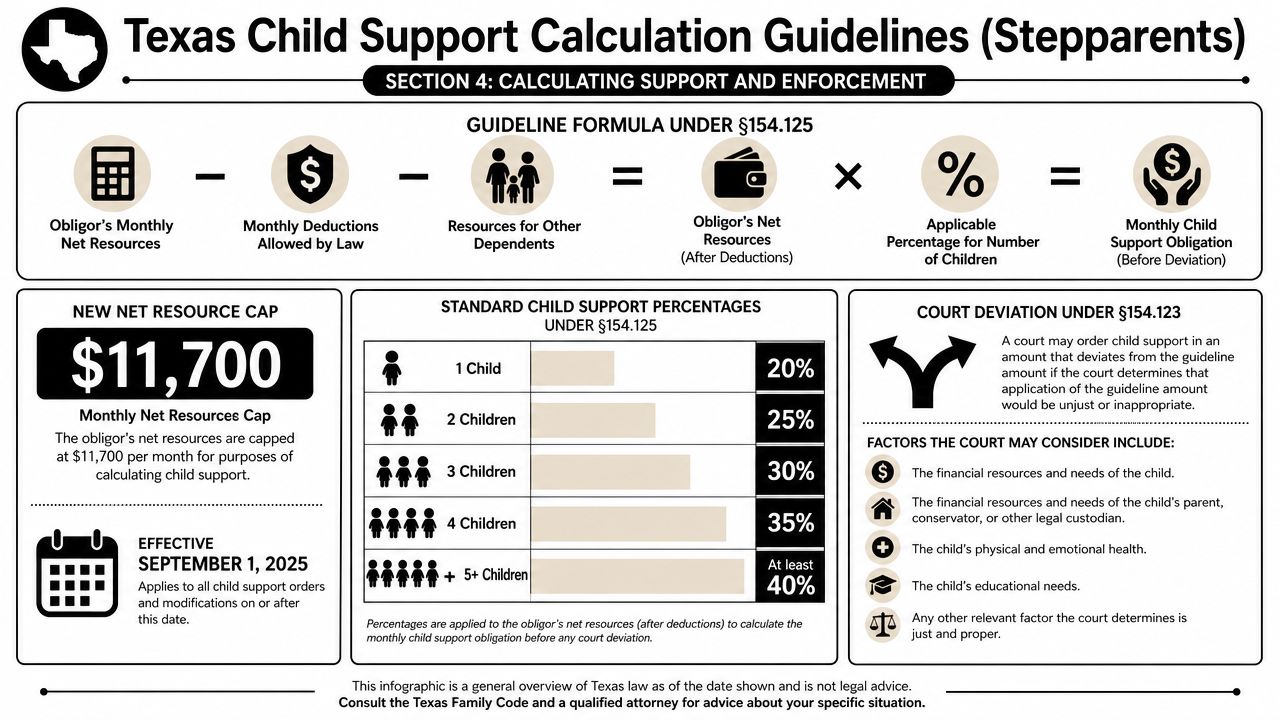
Texas guideline support starts with the obligor's net resources, then applies the percentage tied to the number of children. The recent statewide cap change matters because the law now uses a higher ceiling on those net resources, $11,700 effective September 1, 2025, up from $9,200. That change can push guideline numbers higher in high-income cases, and the Texas legal summary in the briefing estimated the difference could mean roughly $500 to $1,000 more per month depending on income and number of children, because the court applies the percentage to a higher capped amount. See the update at Texas Child Support in Texas.
How the math works
For one child, the guideline percentage is 20%. For two children, it is 25%. For three, 30%. For four, 35%. For five or more, 40%. Those percentages apply to the legal obligor's net resources, not the stepparent's income.
A simple example makes this easier. If a legal parent's net resources are high enough to hit the cap, the court does not keep climbing forever. It applies the guideline percentage to the capped amount unless there is a valid deviation. That is why the 2025 cap increase matters most in cases where income already sits above the old ceiling.
For a one-child case, the guideline outcome after the cap increase can be materially higher than before, because the court now runs 20% against a larger ceiling. For multi-child cases, the same principle applies. The percent changes by child count, but the cap change is what lifts the top end of the calculation.
When courts deviate
§154.123 lets a judge move away from the guideline amount when the evidence supports it. That is where remarriage, household sharing, special needs, and unusual financial circumstances get argued. The court does not need to accept every deviation request, but it does have the authority to consider them.
Remarriage does not make the stepparent a payor, but it can affect the obligor's real-world budget. Shared housing, lower overhead, and different tax treatment can all make the obligor's disposable income look different from the paper number alone. That's the angle Texas lawyers litigate.
Enforcement is not optional
Once support is ordered, Texas courts enforce it through tools like wage garnishment and contempt proceedings. A support order is not a suggestion, and the court will not treat arrears casually just because the obligor remarried or the household changed.
If the order is wrong, challenge it early. If the order is right, pay it on time. Waiting only turns a calculation dispute into an enforcement problem.
For parents preparing papers, bring pay stubs, tax returns, proof of bonuses, and anything showing the full net-resource picture. In high-income cases, that evidence matters more after the 2025 cap increase, because the court has more room to run the percentage against a higher ceiling.
Defending and Avoiding Stepparent Support Orders
The defense starts with status. If there's no adoption, no express order, and no strong equitable argument, the stepparent should not be treated as the support obligor. That is the cleanest and strongest position in a Texas case.
Remarriage can still matter indirectly, because a new spouse's income may affect the household picture even when it is excluded from guideline math. A party may try to use §154.123 to argue that shared living expenses changed the obligor's actual ability to pay. That does not turn the stepparent into the obligor, but it can affect the number the court reaches for the legal parent.
If you need a broader family-law context on remarriage, Child Support and Remarriage in Texas is the right related topic, because the practical fight is usually indirect impact, not direct liability.
The best defense is clean paperwork. Keep finances separate, document who pays what, and preserve anything showing that the stepparent never adopted the child and never entered an order creating support duty. If the other side is trying to prove estoppel, force them to prove reliance, legal status, and a real basis for imposing support.
Practical Steps for Texas Litigants
A support dispute gets won or lost on preparation. If you are filing, contesting, or trying to modify an order, build the record before you walk into court. Texas judges want documents, not stories.

File the right pleading
Start with the correct petition or response. If you're asking for support, say exactly who the legal parent is and why the stepparent should or should not be treated as obligated. If you're defending, make status the first issue in your answer, not the last.
Serve notice correctly
A filing is useless if the other side isn't served. Use proper service, keep proof of service, and make sure every person with a legal interest in the case gets notice the way Texas procedure requires. A missed service issue can derail an otherwise strong case.
Prepare for the hearing
Gather the core evidence early. Pay stubs, tax returns, bank records, adoption decrees, prior orders, and texts or emails about who acted as parent all belong in the file. If you're arguing against a support order, highlight the absence of adoption and the absence of any express duty.
Modify only with statutory grounds
A later change in the cap does not automatically rewrite an old order. Texas guidance in the briefing is clear, a parent has to file for modification and satisfy the statutory standard. Treat modification as a real lawsuit, not a form update.
For parents who want help organizing a case, the Texas Child Support Law Office of Bryan Fagan handles establishment, modification, enforcement, and defense of support orders under the Texas Family Code. That kind of representation matters most in high-income, adoption, and step-parent disputes where the paperwork has to be precise.
The court process is simple only if your facts are simple. Once adoption, remarriage, or indirect income issues show up, get the documents in order and be ready to prove the exact legal relationship.
Conclusion and FAQs
Texas does not make a stepparent pay child support just because they lived in the home, helped raise the child, or acted like a parent. The duty attaches when legal status changes, most often through adoption, or when a court has a legitimate basis to impose or adjust support under the Family Code. If you are the stepparent, your first job is to prove you are not the legal obligor. If you are the parent seeking support, your first job is to prove the legal trigger.
FAQ
Can a past informal parent role trigger retroactive support? Usually not by itself. Texas families may argue estoppel or reliance, but the cleanest support duty comes from legal parentage, not from memories of day-to-day parenting.
How often can a support order be modified? Not on a whim. A party has to file a modification and satisfy the statutory standard, and a change in the guideline cap alone does not automatically reopen an old order.
Does shared 50/50 custody affect a stepparent? Not directly if the stepparent is not the legal parent. Custody arrangements matter to the legal parents' support analysis, but they do not create a support duty for a non-adoptive stepparent.
What should high-income earners do differently? They should document net resources carefully, because the $11,700 cap effective September 1, 2025 can change the numbers in a meaningful way, and deviation arguments under §154.123 become more important when the income sits above the cap.
If your family has adoption papers, a pending modification, or a support notice that names the wrong person, act now and get the record straight before the hearing date gets close. Contact Texas Child Support Law Office of Bryan Fagan to review the order, confirm the legal duty, and build the documents you'll need in court.