You may be dealing with this question right now. You got a bonus. You sold stock. A relative left you money. You closed out an account, rolled over retirement funds, or received a lump sum from a business transaction. Then the next thought hits fast: Will Texas count this for child support?
That concern is justified. In Texas, child support isn't based on every dollar that passes through your hands. It's based on net resources under the Texas Family Code, and that phrase has a specific legal meaning. Some money is counted. Some money is deducted. Some money is excluded from the calculation altogether. And some money lands in the gray area where the judge decides whether it is really income or just looks like income.
If you're searching for what income is excluded from child support Texas, the answer starts with the statute, but it doesn't end there. The list of exclusions matters. So does the proof. So does the way the money was received, documented, deposited, and explained to the court.
Parents lose these arguments when they assume the court will accept labels like “one-time,” “gift,” or “not really income.” Courts want records, tracing, and a coherent explanation that fits Chapter 154 of the Texas Family Code. That's what decides whether a payment stays outside the child support base or gets pulled into it.
The High Stakes of Defining Income in Texas Child Support
A parent walks into court thinking the dispute is simple. “My paycheck is my income. Everything else was unusual.” The other side says the opposite. “That bonus counts. That sale counts. That transfer counts.” By the time the hearing starts, the fight isn't about broad fairness. It's about classification.
That's why these cases turn on definitions. Under Texas law, the court doesn't begin with your view of what feels like income. The court begins with the Family Code and asks what qualifies as net resources, what must be subtracted, and what must be excluded.
Why this issue comes up so often
The pressure points are predictable:
- Employment changes: A raise, severance package, commission payment, or annual bonus can trigger a support review.
- Asset events: Selling property, liquidating an account, or receiving proceeds from a note often creates confusion about whether the money is principal or income.
- Family transitions: A remarriage may improve household finances, but that doesn't mean a new spouse's money belongs in the support calculation.
The court's job is to separate appearance from legal substance. A bank deposit can be large and still not be part of net resources. On the other hand, money called “one-time” can still be treated as available support income if the evidence shows it should be.
Practical rule: If you can't explain the source of the money and document why it fits inside or outside §154.062, the court may adopt the other side's version.
Why labels don't win hearings
Saying “it was a reimbursement,” “it was a rollover,” or “it was my spouse's contribution” doesn't carry much weight by itself. Judges want underlying documents. They want to know whether the payment reflects earnings, a return of principal, or something the statute explicitly excludes.
Parents often make expensive mistakes. They focus on the amount and ignore the category. Texas child support law focuses on the category first.
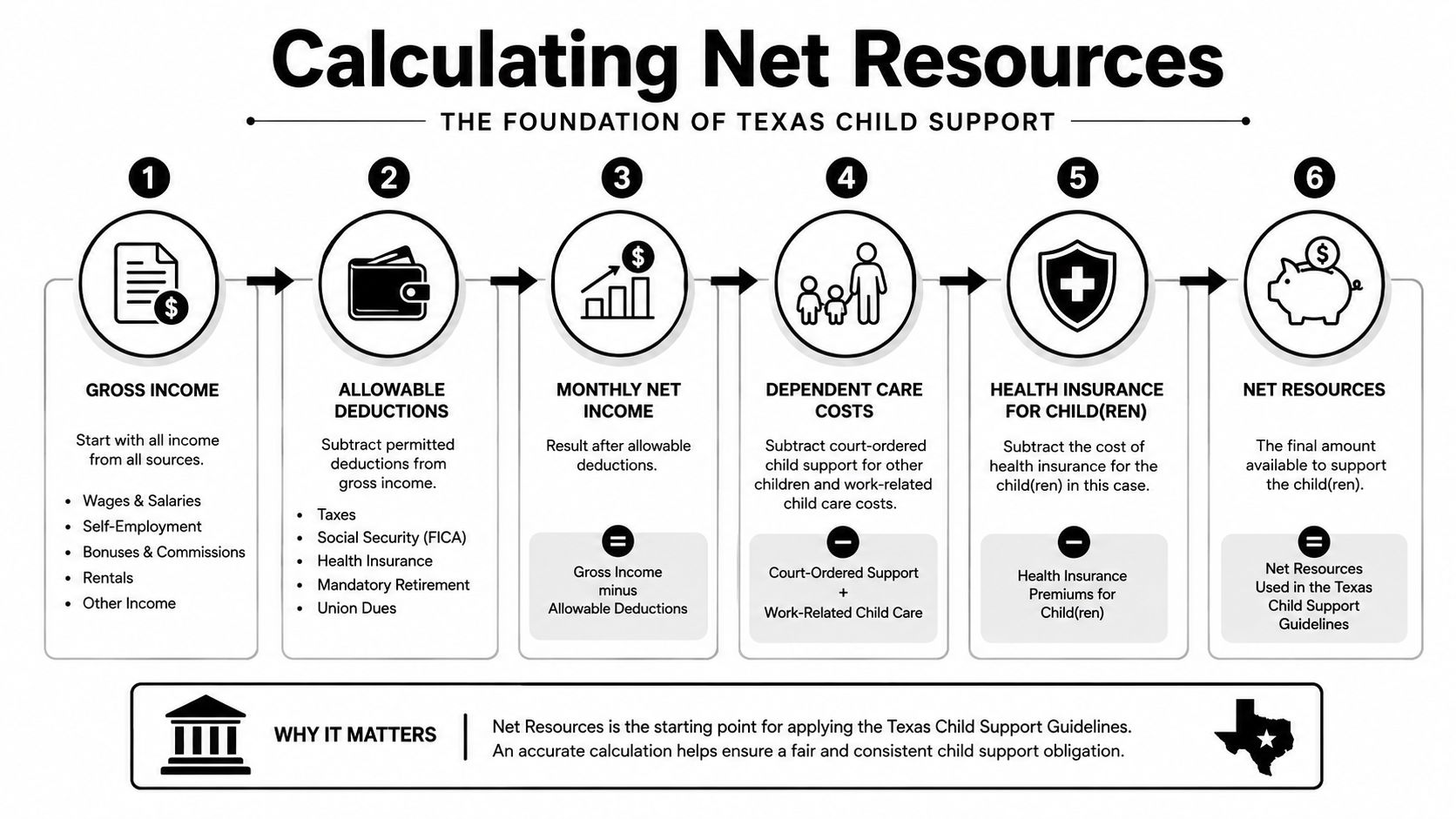
Calculating Net Resources The Foundation of Texas Child Support
Texas child support starts with net resources, not gross pay and not household income. The guideline percentages in Texas Family Code §154.125 are then applied to that number. The statewide structure currently uses percentages such as 20% for one child, 25% for two children, and 40% for five children, as noted in the discussion of excluded resources under Texas Family Code §154.062 and guideline percentages.
For a fuller breakdown of the formula courts use, review this guide on how Texas courts calculate net resources.
The calculation in working order
In a hearing, the process usually runs like this:
- Identify gross income sources under Texas Family Code §154.062.
- Separate out items that are excluded and never become part of net resources.
- Apply the allowed deductions required by the statute.
- Reach monthly net resources.
- Apply the guideline percentage under §154.125.
- Consider deviation factors under §154.123 if either side asks the court to move above or below the guideline amount.
That sequence matters. A parent who skips straight to a percentage usually gets the wrong number.
What lawyers and courts look for first
The court will usually examine the most reliable financial records first, including:
- Pay records: Regular wages, overtime patterns, commissions, and bonus history.
- Tax records: Returns can help show recurring income streams, business activity, and whether a claimed one-time payment was part of a pattern.
- Business documents: Profit-and-loss statements, ledgers, and account statements matter in self-employment cases.
Courts don't calculate support from assumptions. They calculate it from records, then test those records against the statute.
Why the distinction matters
Many parents use the word “income” casually. Texas law doesn't. It uses a narrower framework with defined inclusions, exclusions, and deductions. That's why two people can look at the same deposit and reach opposite conclusions.
A simple example shows the difference. If a parent receives money from a note, the court may ask whether that payment was interest or a return of principal. Interest may be treated one way. The principal or capital return may be excluded. The classification changes the support result.
Statutory Exclusions What Texas Law Explicitly Leaves Out
When clients ask what income is excluded from child support in Texas, I start with the statutory list. Texas Family Code §154.062 casts a broad net at the front end, but it also carves out specific items that aren't part of net resources. Under Texas Family Code §154.062, accounts receivable, payments for foster care, resources provided by a new spouse, and the principal or capital returns on a note are excluded from net resources.
The key point is simple. Excluded resources are not just deductions. They are items the court leaves out of the child support base.
Included vs. excluded resources for Texas child support
| Resource Type | Typically Included in Net Resources? | Governing Principle / Statute |
|---|---|---|
| Wages and salary | Yes | Texas Family Code §154.062 includes broad income categories |
| Bonuses and commissions | Often yes | Treated as income unless a valid exclusion applies |
| Accounts receivable | No | Excluded under Texas Family Code §154.062 |
| Foster care payments | No | Excluded under Texas Family Code §154.062 |
| New spouse's income or resources | No | Excluded under Texas Family Code §154.062 |
| Principal or capital return on a note | No | Excluded under Texas Family Code §154.062 |
| Gross business receipts | Not automatically | The court looks at net resources, not gross receipts |
The exclusions that matter most in practice
Some exclusions appear often in real disputes.
- Accounts receivable: A receivable isn't the same thing as spendable income. This matters in business-owner cases where one side points to unpaid invoices as proof of available money.
- Foster care payments: The statute excludes payments tied to foster care, which keeps those amounts from being folded into ordinary support calculations.
- New spouse resources: A remarriage may change your household budget, but the law does not make your new spouse responsible for your child support obligation.
- Principal on a note: If a payment is merely returning capital, Texas treats that differently from earnings generated by the asset.
What doesn't work
Parents often blur together three separate concepts:
- money that is excluded,
- money that is deducted, and
- money that is not proven.
Those are not the same argument. If you claim an exclusion, tie it directly to §154.062. If you claim a deduction, show where the Family Code allows it. If you lack records, the court may infer that the funds were available to you.
A hearing goes better when each disputed dollar has a legal label and a document attached to it.
Contested Income The Gray Areas Where Courts Decide
Three days before a child support hearing, a parent finally produces bank statements showing a six-figure deposit. The explanation is predictable. It was a one-time bonus, a family gift, a retirement rollover, a loan from the business, or proceeds from selling an asset. Those cases are where support fights are usually won or lost.

Texas Family Code §154.062 gives the framework, but it does not answer every dispute by itself. The central dispute is often classification. Is the payment income, excluded principal, reimbursement, debt, or a transfer that only looks temporary on paper? In court, labels carry very little weight unless the documents back them up.
That is why “non-recurring” is not a magic word. A single payment can still affect child support if the evidence shows it was available for living expenses, part of a pattern, or under the parent's control. If the dispute also involves a parent who is understating earnings or shifting money off the books, this discussion of imputing income in Texas child support cases often becomes part of the same hearing.
What judges usually examine
Judges in these cases tend to drill into the same practical questions:
- How often has this happened before? One bonus may be unusual. Three “one-time” bonuses in four years usually are not.
- Who controlled the money? If a parent could decide when to take a distribution, defer compensation, or move funds between accounts, the court may treat those funds as available resources.
- What exactly was deposited? Sale proceeds, retirement distributions, reimbursements, and loan advances each require different proof. The court will want to know whether the deposit included earnings, appreciation, or only a return of capital.
- Where did the money go? If the funds paid mortgage payments, credit cards, travel, or ordinary household bills, that use undercuts the claim that the money was unavailable for support.
- Does the paper trail match the story? Tax returns, K-1s, payroll records, bank statements, and business ledgers should line up. If they do not, credibility becomes the issue.
The hardest gray-area cases involve money that is technically irregular but functionally reliable.
The arguments that usually fail
Parents often walk into court with accounting terms instead of proof. “Owner draw” is not a legal answer. “Loan” is not enough by itself. “Reinvestment” does not end the inquiry if the same account is also paying personal expenses.
A judge will usually look past the label and ask a more direct question: was this money available to support the child?
That is the practical reason these disputes turn on tracing. If you claim a deposit was excluded principal, show the originating account, the amount invested, the sale documents, and the breakdown between basis and gain. If you claim a payment was a true loan, produce the note, repayment terms, payment history, and evidence that similar loans are treated the same way in the ordinary course. If the explanation changes halfway through testimony, the court will notice.
How close cases get decided
Close cases are decided by consistency. Courts compare this year's records to prior years, check whether tax treatment matches the position taken in court, and look for signs that income was deferred, redirected, or disguised as something else. Business-owner cases get especially difficult because personal and business funds are often commingled. Once that happens, the parent asking the court to exclude the money has a steeper climb.
I tell clients to prepare for the question behind every question. Why should the court accept your classification of this money? The winning answer is usually specific, documented, and easy to follow. The losing answer is usually broad, verbal, and full of exceptions.
Gray-area income disputes are rarely about one deposit alone. They are about whether the judge believes the full money story.
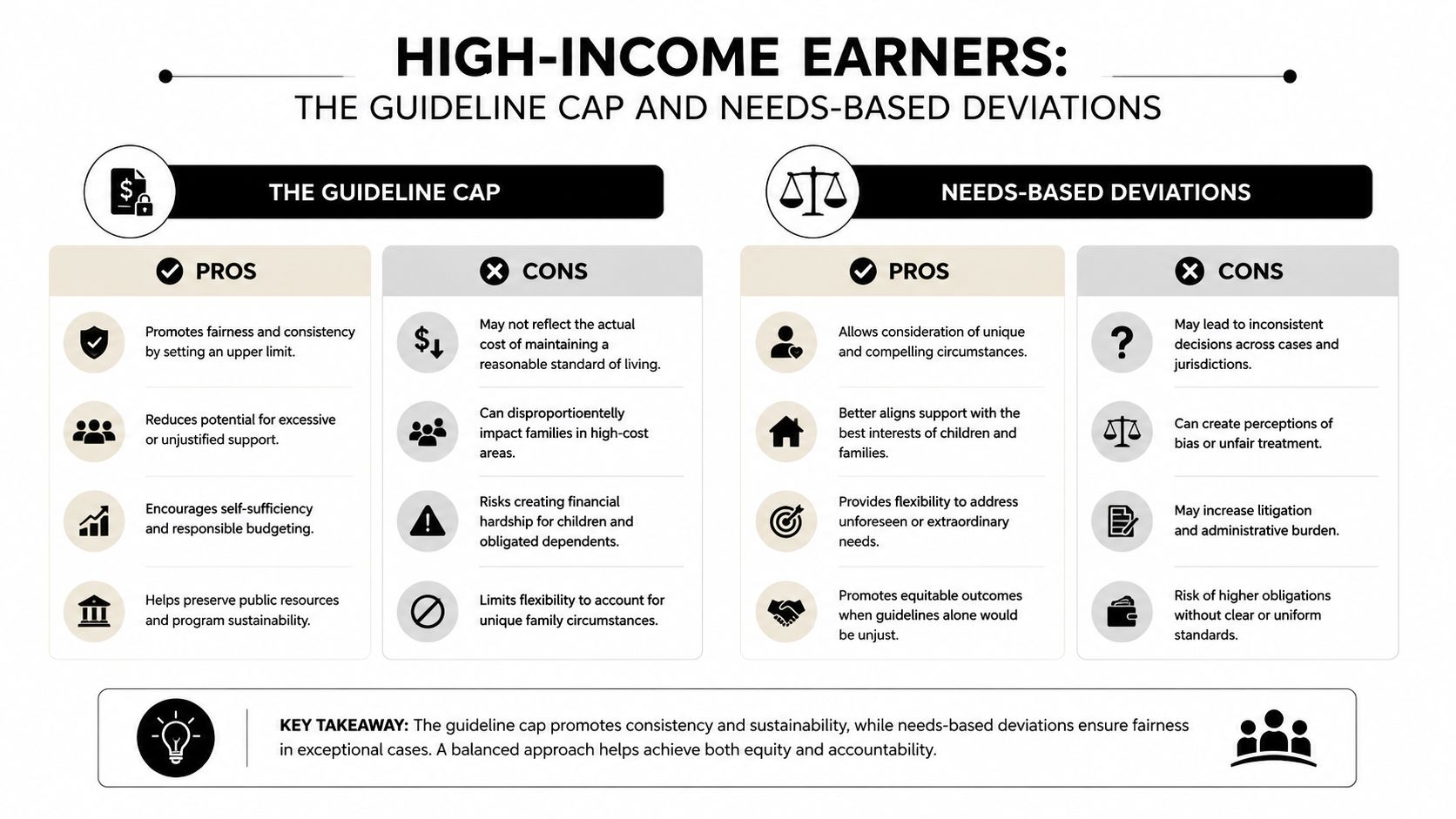
High-Income Earners The Guideline Cap and Needs-Based Deviations
A parent walks into court assuming the child support fight is over because the other parent earns far above the cap. Then the hearing turns to a different issue entirely: what does this child need, and can anyone prove it?
That shift matters in high-income cases. Texas Family Code §154.125 applies the guideline percentages only up to a statutory cap on monthly net resources. Effective September 1, 2025, that cap is $11,700 in net monthly resources. But §154.123 gives the court room to order a different amount when the evidence supports a deviation, including evidence of the child's proven needs.
The cap limits the formula, not the court's authority
Lawyers hear the same bad argument over and over: income above the cap does not matter. That is wrong in the way that loses hearings.
The cap limits the standard guideline calculation. It does not prevent a court from ordering support above that amount if the child has proven needs beyond the guideline figure. In practice, high-income cases cease being math problems and instead become evidence problems. The parent asking for more than the capped guideline amount must connect the requested support to the child's actual needs, not to the parents' wealth, resentment, or preferred lifestyle.
That distinction is where many cases are won or lost. Judges do not award above-cap support just because one parent can afford it. They want to see why the child needs it.
What courts usually want to see
A strong above-cap presentation is concrete and child-specific. It often includes:
- Medical records and treatment plans: recurring therapy, prescriptions, specialists, in-home care, or other documented health-related needs
- School records and evaluations: private services, academic interventions, tutoring, or specialized educational placements tied to an identified need
- Disability-related expenses: equipment, supervision, transportation, respite care, or home modifications
- Reliable cost proof: invoices, payment histories, insurance denials, provider statements, and organized summaries that match the underlying records
General testimony about a child being "used to a certain standard of living" usually does not carry much weight by itself. Texas courts focus on needs, and that word does real work in the statute. If the claimed expense benefits the household generally, rather than the child specifically, expect pushback.
Where the real courtroom fight happens
In ordinary support disputes, the main battle is often whether a payment counts as income. In high-income cases, the battle often changes shape. One side argues the obligor has reached the guideline cap, so the support number should stop there. The other side argues the child's circumstances justify more.
Both sides need to understand the trade-off. If you are seeking support above the cap, asking for too much without tight proof can hurt credibility. If you are opposing an above-cap request, relying on the cap alone leaves the court with an incomplete analysis if the child has documented medical, educational, or disability-related needs.
The better argument is usually narrower and better documented. Show which expenses are recurring, which are extraordinary, which are already covered by insurance or school services, and which are unmet. That is the level of detail judges use.
In high-income child support cases, the question is rarely just how much the parent earns. The harder question is whether the child's proven needs justify going past the capped guideline amount.
How to Prove Income Exclusions in Court
The hearing often turns on a simple moment. One parent points to a large deposit and calls it income. The other says it was an inheritance, a reimbursement, a return of capital, or a one-time transfer between accounts. The judge decides based on proof, not labels.
That is why income-exclusion cases are won with tracing, records, and clean testimony tied to the Texas Family Code. If you want a court to leave money out of net resources, show the court exactly what the payment was, why it fits outside §154.062, and why the other side's characterization is wrong. Hidden income arguments and non-recurring payment disputes usually rise or fall on that level of detail.

The Checklist That Matters
Start with source documents. Judges are far more persuaded by records created at the time of the transaction than by a spreadsheet prepared for court.
- Financial information sheet: Fill it out with care. If it conflicts with your bank records, tax returns, or testimony, the court will notice.
- Tax returns and pay records: These help show whether money was part of regular earnings or a one-off event.
- Bank statements: Use them to trace deposits, transfers, and whether funds were mixed with wages or business income.
- Business records: If you own a business, bring profit and loss statements, general ledgers, invoices, reimbursement records, and documents showing whether a payment was revenue, a receivable, a shareholder draw, or return of capital.
- Supporting transaction documents: Notes, closing statements, trust distributions, probate papers, settlement documents, and loan records often decide whether the court treats a payment as available income.
The court does not have to accept your description of a deposit. It will look for a paper trail that matches the timeline.
Tracing is what wins close cases
Tracing means connecting the dots with dates, amounts, and account records. If the issue is inheritance proceeds, note payments, insurance reimbursements, or money moved between accounts, the judge needs to see where the money started, how it moved, and why it should not be counted as net resources.
A strong presentation sounds like this: the funds came from this estate account, cleared on this date, were deposited here, and the attached records show the payment was principal rather than earnings. That is far more persuasive than broad testimony that the deposit was "not income."
This matters most in the gray areas. Opposing counsel will often argue that a supposedly excluded payment was really disguised compensation, recurring support from family, or business income routed through another account. Be ready for that attack before you walk into court.
Procedure affects proof
Good documents still have to get into evidence. That means using the right pleading posture, conducting discovery early, and preparing exhibits so the judge can follow them without guessing.
- File the correct case or motion. Establishment, modification, and enforcement cases raise different proof issues.
- Use discovery to test the other side's theory. Requests for production, interrogatories, subpoenas, and depositions are often how you expose whether a claimed "gift" is really recurring income.
- Prepare exhibit notebooks with labels and short descriptions. A judge should be able to find the key deposit in seconds.
- Match each exhibit to a statute or argument. In most hearings, that means tying the evidence to §154.062 on net resources, and in some cases to §154.123 or §154.125 if the dispute overlaps with guideline arguments.
- Prepare testimony that explains the records in plain language. A witness who can walk through a transaction clearly is harder to impeach.
One practical option for parents dealing with disputed support calculations is working with counsel focused on these cases, such as Texas Child Support Law Office of Bryan Fagan, which handles establishment, modification, enforcement, and contested net-resource disputes under the Texas Family Code.
Bring the judge an organized financial story supported by source records. That is how you prove an exclusion and defend against claims of hidden income.
Common Questions About Excluded Income
Is child support I receive counted as my income for tax purposes
No. Child support received is not taxable income under IRS treatment and does not have to be included in gross income for taxes. That tax rule is separate from how Texas calculates the payer's child support obligation.
Does my new spouse's salary count toward my child support obligation
Texas law excludes resources provided by a new spouse from net resources under §154.062. Your remarriage may affect your household, but your new spouse's income is not automatically part of your child support calculation.
If I receive money from a note, is all of it counted
Not necessarily. Texas distinguishes between earnings and a principal or capital return on a note. The principal return is excluded under §154.062, which is why tracing the payment matters.
Are one-time payments automatically excluded
No. Courts often examine whether a payment was non-recurring or whether it should still be treated as part of available resources. In close cases, the records and the surrounding facts usually decide the issue.
If the court got my income wrong, what do I do
You usually need to address it through the court process, often by filing for modification if circumstances and timing support that request, or by challenging the evidence and findings in the pending case. Informal side agreements rarely solve support problems. Court orders do.
If you need a clear answer about excluded income, irregular payments, or a support amount that doesn't match the facts, the Texas Child Support Law Office of Bryan Fagan works with parents across Texas on establishment, modification, enforcement, and contested net-resource issues. A focused case review can help identify what the court is likely to count, what may be excluded under the Family Code, and what documents you need before the hearing.