You're probably here because one of three things just happened. A judge signed a child support order and your employer started taking money from your check. You're the parent waiting on support and trying to figure out why payments are inconsistent. Or you're the employer that just received legal paperwork and needs to know what must happen next.
An income withholding order is where those interests collide. In Texas, it's not a side issue. It's the standard collection mechanism that turns a support order into actual money moving from payroll to the State Disbursement Unit. If you misunderstand it, you can lose time, money, and your effectiveness in court.
The smart approach is simple. Know who controls what, know the deadlines, and fix mistakes at the right level. If the problem is the amount of support, attack the support order. If the problem is payroll execution, attack the withholding order or the employer's handling of it. Clients waste months when they confuse those two issues.
What Is an Income Withholding Order
An Income Withholding Order, or IWO, is the legal document that directs an employer to withhold support from wages. It is not a punishment for a parent who fell behind. It is the default enforcement tool used to collect child support, medical support, and in some cases spousal support.
Federal law drives the framework. The order must use the approved form, and withholding must begin within the required timeframe after the employer receives the notice under the federal Income Withholding for Support form requirements. That same federal guidance states the form is effective through August 31, 2026, and the order is legally binding only when it rests on a separate court order.
The three people who matter
You need to know the roles clearly.
- Obligor: The parent ordered to pay support.
- Obligee: The person entitled to receive support for the child.
- Payor: Usually the employer. This is the party that withholds wages and sends the money out.
Each has a different job. The obligor must comply with the court's support order. The obligee must monitor whether payments are being received and credited correctly. The employer must follow the withholding instructions exactly.
Why Texas courts use IWOs so often
A court order without collection is just paper. An income withholding order makes the support obligation operational. It reduces missed payments, creates a payment record, and removes the monthly argument about whether the obligor “intended” to pay.
Practical rule: If support has been ordered, assume withholding is part of the case unless there's a valid alternative arrangement in writing and accepted under the law.
Texas clients often take an IWO personally. That's a mistake. Judges and agencies use wage withholding because it is predictable. Predictability matters more than excuses in child support court.
What an IWO does not do
It does not replace the underlying court order. It enforces it.
That distinction matters. If the withholding amount is wrong because the support amount is wrong, you don't solve that by arguing with payroll. You solve it by going back to court and addressing the underlying support order under the Texas Family Code. If payroll is withholding incorrectly from an otherwise valid order, that is an implementation problem, not a support-calculation problem.
How an IWO Is Issued and Served in Texas
Your support order is signed on Monday. By the time the next payroll cycle closes, the key question is no longer what the judge ordered. Instead, the focus turns to whether the employer has been served, whether payroll applied the right amount, and whether anyone caught an error before money started coming out of the wrong check.
The Texas sequence
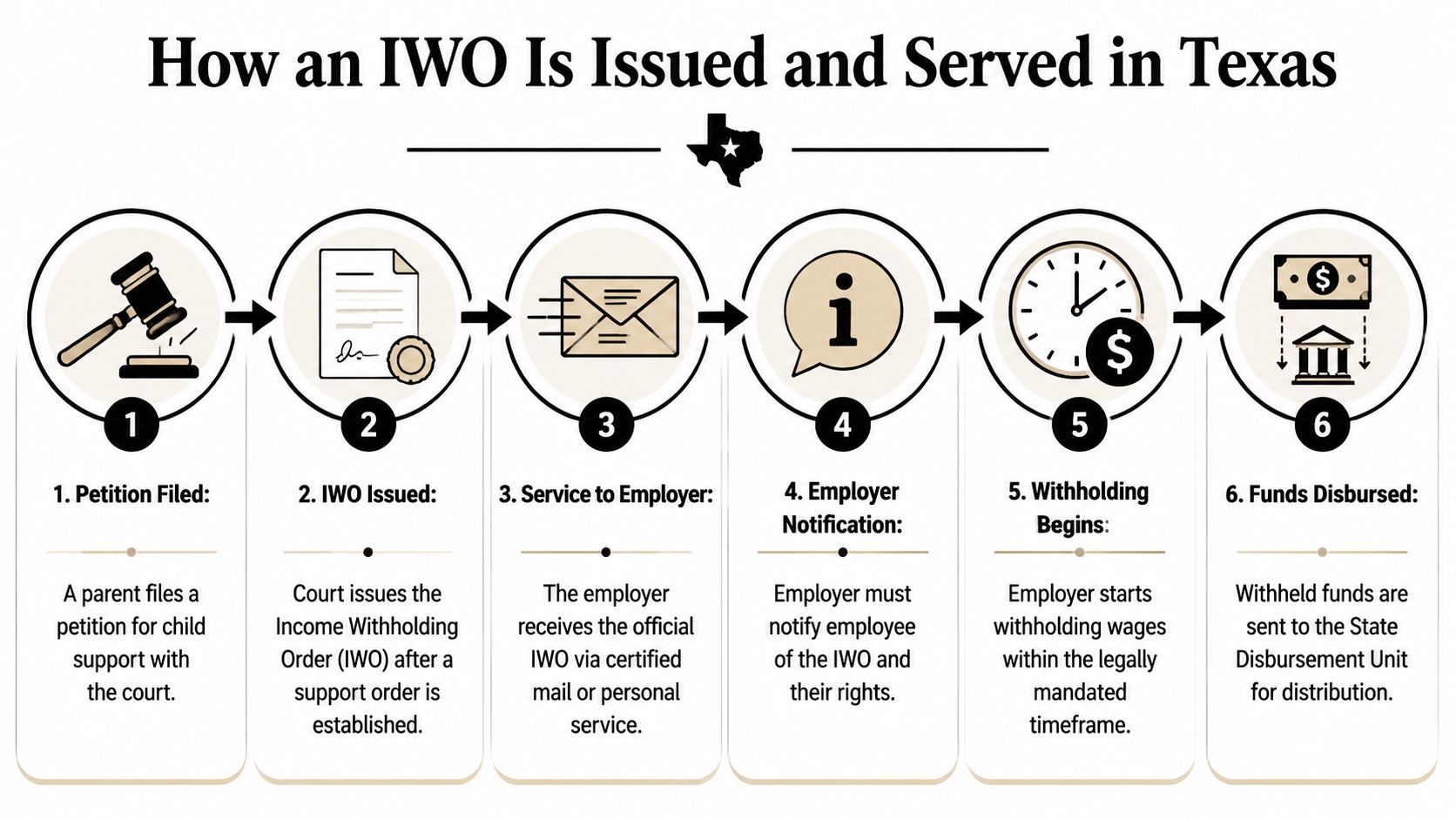
In a Texas child support case, the withholding process usually starts right after the support order is signed. That can happen in a divorce, SAPCR, paternity case, or modification. The order for support comes first. The income withholding order follows and is sent to the obligor's employer or other payor, which then starts deducting support and sending it to the Texas State Disbursement Unit.
That sequence sounds routine. It is not harmless.
For the obligor, a bad employer name, wrong Social Security number, or stale job information can delay proper withholding and create arrears on paper even if the underlying order is new. For the obligee, delay in service means delay in actual payment. For the employer, mishandling service can create direct liability fast. The strategy is simple. Verify the paperwork early, identify the correct payor, and track the service date immediately.
If you need a practical overview of the mechanics, Wage Withholding for Child Support in Texas explains how wage withholding is used to collect support.
The service deadline that matters
Under Texas Family Code §154.181, an income withholding order becomes effective when served on the employer, and the employer must begin withholding no later than the first pay period that occurs after the date of service in the time required by Texas Family Code Chapter 154. In practice, employers need to treat service as a live deadline, not paperwork to review whenever HR has time.
Here is the practical point. The clock runs from service on the employer, not from the date the parties finally notice the order in the court file, and not from the date the employee decides to mention it to payroll.
That distinction matters most in high-income cases. A delayed or mishandled IWO on a large salary can produce a large shortfall quickly, especially now that parties are paying closer attention to support levels tied to the 2025 cap. If the withholding amount looks too high or too low, do not argue with payroll first. Compare the IWO to the signed support order and fix the problem at the source.
Strategic advice for the obligor, obligee, and employer
Obligor: Read both documents. Compare the support order to the IWO line by line. Check the employer name, identifying information, amount to be withheld, and where payments are sent. If you changed jobs, say so immediately. If you are a high earner with bonuses, commissions, or multiple income streams, assume payroll confusion is more likely, not less.
Obligee: Do not assume a signed order means money is already on the way. Confirm that the correct employer was served. Then watch the first expected disbursement. If nothing hits on time, find out whether the delay came from service, payroll processing, or an incorrect order. Those are different problems, and each one has a different fix.
Employer: Log the date of service the same day the IWO arrives. Match the employee carefully before withholding. If the order is unclear, address the issue fast through the proper channel, but do not ignore it or let it sit in a general inbox. Payroll errors in child support cases are expensive.
A well-issued IWO puts pressure on all three players at once. The obligor loses room for excuses, the obligee gets a more reliable payment stream, and the employer becomes the compliance gatekeeper. That is exactly why service and timing matter so much under Texas law.
Employer Duties and Withholding Limits
An employer gets served with an IWO on Monday. Payroll waits for the next cycle, the employee objects, and HR puts the order aside “until things are clarified.” That is how employers create liability fast. Under Texas law, the employer is not a bystander. The employer is the collection point, and mistakes usually hurt all three players at once: the obligor gets credited late or not at all, the obligee misses support, and the employer gets pulled into a problem it should have handled the first day.

What the employer must do first
Start with speed and accuracy. Confirm the order applies to the right employee, route it to payroll immediately, and withhold according to its terms. Do not wait for the employee's approval. Do not “work it out internally.” Do not guess.
The employer should also do four practical things right away:
- Record the service date: Deadlines run from when the employer was served.
- Match the employee carefully: Similar names, old employee numbers, and job changes cause expensive mistakes.
- Follow the order as written: Payroll's job is to implement the order, not edit it.
- Send payments to the correct place: Misrouted payments can create fake arrears on paper, which then become very real in enforcement.
For a practical overview of the payroll side, review this guide on wage garnishment for child support in Texas.
The strategic point is simple. Employers should stay out of the legal fight and focus on exact compliance. Obligees should confirm the employer is withholding and remitting. Obligors should check pay stubs immediately, especially if they earn commissions, bonuses, or irregular compensation that payroll may code inconsistently.
The federal withholding caps
Even a valid IWO has limits. The outside cap comes from federal garnishment law, not payroll preference and not the employee's complaint. The U.S. Department of Labor's garnishment fact sheet explains that child support withholding can reach between 50% and 65% of disposable earnings, depending on whether the employee supports another family and whether older arrears are owed.
| Situation | Maximum withholding |
|---|---|
| Supports a second family, no older arrears | 50% |
| Supports a second family, older arrears apply | 55% |
| Does not support a second family, no older arrears | 60% |
| Does not support a second family, older arrears apply | 65% |
Disposable earnings are the key number. They are not gross wages. Employers that withhold from gross pay create over-withholding problems, employee disputes, and possible reimbursement issues.
This matters even more in high-income cases. A large salary does not let payroll ignore the cap. It also does not mean the support amount in the order is wrong. In 2025, Texas guideline support and the statutory cap on net resources can become a major issue in setting the order, but payroll still works from the withholding order it received and the federal limits that apply to disposable earnings. That distinction matters. Courts set support. Employers execute withholding.
What employers, obligors, and obligees usually get wrong
The same mistakes show up again and again.
- Employers use gross pay instead of disposable earnings: That produces the wrong withholding amount.
- Payroll delays implementation: Delay creates missed payments and exposure for the employer.
- Obligors treat HR like an appeals court: Payroll cannot rewrite a signed order.
- Obligees assume silence means compliance: If payments do not arrive, verify that withholding started and that remittances went to the right place.
- Any party ignores variable compensation: Bonuses, commissions, severance, and other irregular pay often trigger the biggest errors.
Employer warning: The safest course is immediate compliance, careful employee matching, and fast review by counsel if the order conflicts with payroll records or appears directed to the wrong person.
If you are the obligor, watch your first two pay periods closely. If you are the obligee, track the first expected disbursement instead of assuming payroll got it right. If you are the employer, treat an IWO like a deadline-driven legal directive, because that is exactly what it is.
Calculating Child Support Withholding in Texas
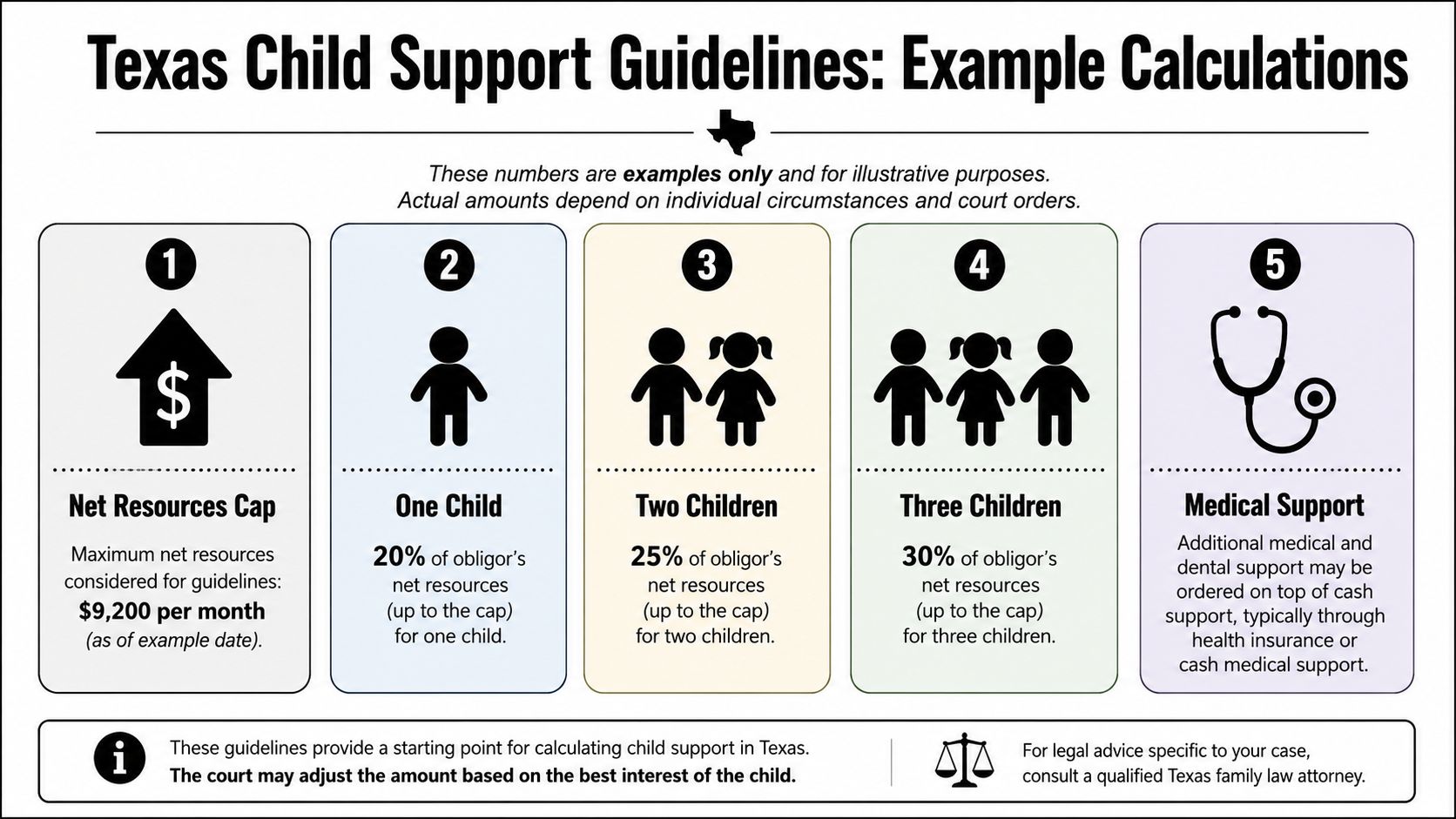
Texas doesn't calculate child support from thin air. The court starts with net monthly resources, then applies the guideline percentages in Texas Family Code §154.125. If you don't understand that phrase, you won't understand your withholding.
The basic rule for one child is straightforward. Under §154.125, support is generally 20% of the obligor's net monthly resources. The statute works off net resources, not gross salary.
Texas law defines net resources by taking gross income and subtracting allowed deductions such as taxes, Social Security, union dues, and certain other recognized deductions. The result is the number the court uses.
To see a visual summary of common guideline concepts, review this chart first.
A straightforward example under Section 154.125
Texas gives you a clean example of how the math works. Under Texas Family Code §154.125, if an obligor has $7,000 in net monthly resources, the guideline amount for one child is $1,400 monthly. If the obligor has $10,000 in net monthly resources, the guideline amount for one child is $2,000 monthly.
That matters because many parents walk into court arguing about gross pay, bonuses, or job titles. The court wants the net-resource number that fits the statute.
Here's the practical version:
| Net monthly resources | One child guideline amount |
|---|---|
| $7,000 | $1,400 |
| $10,000 | $2,000 |
Those examples are useful because they expose a common mistake. Parents assume payroll withholding should equal a flat percentage of the gross paycheck. That's not how the court order is built.
The 2025 cap changes high-income cases
For high earners, the analysis changes. Effective September 1, 2025, the guideline cap on net monthly resources is $11,700 under Texas Family Code §154.123 and §154.125. For one child, applying 20% to that cap produces $2,340 as the maximum guideline amount before the court considers anything above the cap.
The statute allows the court to go further when the child's proven needs justify more. That is the key point high-income obligors and obligees both miss. The cap is not an automatic ceiling on total support. It is the ceiling on the standard guideline calculation before the court evaluates additional support based on proven needs.
A useful background guide on the mechanics is how to calculate child support in Texas.
In a high-income case, don't walk into court saying, “The cap protects me.” The cap limits the baseline guideline calculation. It does not eliminate judicial discretion over proven needs under §154.123.
What proven needs usually means in court
If income exceeds the cap, the court looks at evidence, not assumptions. The parent asking for more support needs to prove the child's actual needs. That can include educational expenses, medical needs, and other legitimate child-related costs recognized by the court.
The parent resisting extra support should focus on two things:
- Demand proof of the child's needs: Not the other parent's lifestyle.
- Separate child expenses from household wish lists: Courts care about the child, not a parent's spending narrative.
- Document available insurance and direct payments: Those facts can matter when the court evaluates what is already being provided.
Here's where many cases swing. One side shows the child's actual needs with organized records. The other side shows broad claims and rough estimates. The organized side usually has the stronger position.
This video gives additional context for parents working through Texas support calculations.
How withholding connects to the support amount
The withholding amount follows the support order. It does not independently recalculate support each pay period. That means if the order says one amount and the employee's compensation structure changes, you may need a modification rather than a payroll argument.
Commission earners and bonus earners often get tripped up here. Irregular income doesn't cancel the order. It usually means the underlying case needs careful drafting, clear findings on net resources, and realistic evidence about earnings patterns.
Contesting Modifying or Terminating an IWO
Your paycheck drops, payroll says they are “just following the order,” and the other parent insists the amount is correct. Stop guessing. The first question is simple. Is the withholding wrong, or is the support order outdated? Those are different problems with different fixes.
Contesting the IWO
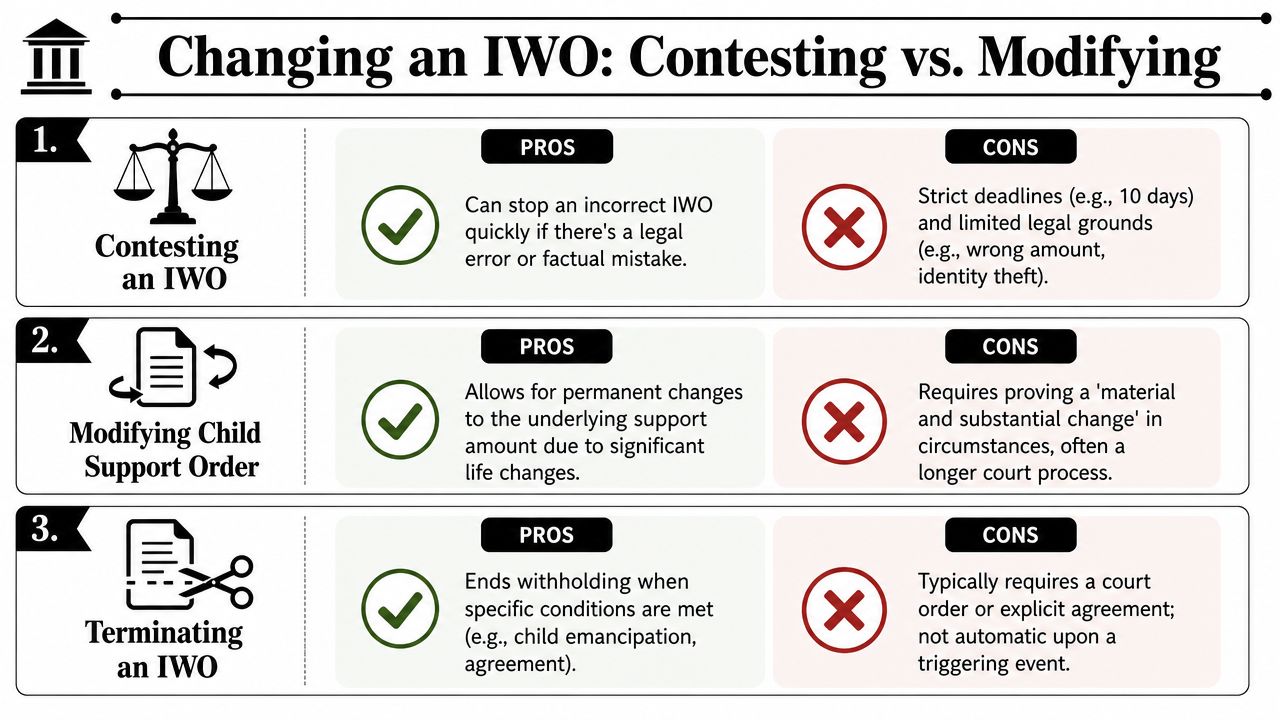
A contest usually targets an administrative or legal error in the withholding paperwork. Common examples include the wrong employee, the wrong employer, the wrong amount, duplicate withholding, or withholding that continues after a superseding order was signed.
For the obligor, this is a document comparison exercise. Put the signed support order, the IWO, and your pay stub next to each other. If the numbers or case identifiers do not match, raise the issue immediately with payroll and with the issuing court or agency. Delay creates arrears on paper, and paper problems become real problems fast.
For the obligee, do not oppose a correction just because money is coming in. If the withholding is legally wrong, it will be fixed eventually, and a sloppy record can complicate enforcement later.
For the employer, do not rewrite the order yourself. Verify the employee, the case information, and the amount. If the order appears defective or conflicts with another order, get clarification through the proper channel instead of making a payroll guess.
Modifying the support order
Modification is about the support amount itself. If the current order no longer fits the facts, payroll cannot solve that. Only a new court order can.
Under Texas Family Code §156.401, the court may modify child support when the circumstances of the child or a parent have materially and substantially changed, or when the statutory standard for timing and guideline variance is met under Texas Family Code Chapter 156.
Use that rule strategically.
If you are the obligor and your income dropped, changed from salary to commission, or became uneven, file to modify before arrears pile up. Judges do not retroactively clean up months of avoidable delay just because your compensation changed.
If you are the obligee and the child's needs increased, prove the child's actual expenses with records. In high-income cases, this matters even more. Once guideline support reaches the statutory ceiling, including the updated 2025 cap, the fight usually shifts to proven needs above the cap, not broad claims about rising costs.
If you are the employer, stay in your lane. A worker's complaint that support is “too high” does not authorize you to reduce withholding. Keep withholding under the order you received until a new one arrives.
The procedure that actually works
Clients waste time by arguing with payroll, arguing with the other parent, or arguing by text. File the right pleading instead.
The usual sequence is:
- Identify the right problem. Contest a defective IWO. Modify an outdated support order. Seek termination if the legal duty ended.
- File the petition or motion promptly with the correct court.
- Serve the other parent properly. Bad service delays everything.
- Prepare proof early. Pay records, tax returns, health insurance costs, childcare records, and evidence of the child's needs should be organized before the hearing.
- Get a signed order. Nothing changes in payroll without signed paperwork.
- Confirm employer processing. Do not assume the new order was implemented just because the hearing is over.
That last step gets missed all the time. The obligor assumes payroll will catch up. The obligee assumes the money will start or stop automatically. The employer may not even have the amended order yet.
A focused Texas practice such as Texas Child Support Law Office of Bryan Fagan can handle the filing, hearing, and order-drafting side of these cases. What matters to you is not the label on the lawyer. It is whether the lawyer knows how to tighten the evidence, get a clean order signed, and make sure payroll receives the right document.
Judges change support based on evidence and statutory standards. They do not change it because one parent is frustrated.
When termination becomes the issue
Termination is usually the cleanest issue legally and the messiest issue administratively. The withholding should end when the legal obligation ends or when the court signs a new order that changes it, but employers act on documents, not assumptions.
That matters to all three players.
The obligor should not assume withholding stops the week a child turns eighteen or graduates. Check the controlling order. If arrears remain, withholding may continue. If the obligation ended, get the proper terminating or amended order entered and confirm payroll received it.
The obligee should review whether any arrears are still owed before agreeing that withholding should stop. Current support may end while arrearage withholding continues.
The employer should stop or adjust withholding only after receiving valid legal direction. Ending deductions early can create liability. Continuing deductions after a clear termination order can also create problems.
The practical rule is simple. Fix paperwork fast, modify outdated orders early, and never expect payroll to sort out a family law dispute on its own.
Enforcement and Penalties for Nonpayment
An obligee usually learns the problem through silence. No deposit arrives. The payment record doesn't update. The other parent says payroll made a mistake. Payroll says they never got the right paperwork. Meanwhile, the child still needs support.
That delay is exactly why enforcement exists. If an employer receives a valid withholding order and fails to honor it, the employer can face liability for the unpaid amount. If the obligor avoids payment or works around the order, the obligee can pursue enforcement through the court or through the Office of the Attorney General.
Two common breakdowns
The first breakdown is employer noncompliance. The order arrives, but nobody in payroll acts on it. Weeks pass. Arrears grow. The employer then discovers that “we were reviewing it” doesn't erase liability.
The second breakdown is obligor evasion. A parent changes jobs, works irregularly, or stops cooperating while support remains due. In that situation, waiting politely usually makes the case worse.
If support isn't being paid, the practical next step is to review the available enforcement tools and build a record. The resource on what happens if child support is not paid outlines the types of consequences parents commonly face in Texas.
What I tell clients in this position
For the obligee, keep your records organized. Save payment histories, communications, and employment information. Enforcement gets stronger when your proof is clean.
For the obligor, don't assume partial payments or informal side agreements protect you. If the order says one thing and you're doing another, you're exposed.
For the employer, treat every valid IWO as time-sensitive legal process. Forwarding it slowly or calculating it casually is a costly habit.
Courts are far more patient with a parent who files to modify than with a parent who simply stops paying and hopes to explain it later.
Texas IWO Frequently Asked Questions
Can parents agree to skip an income withholding order
Sometimes parents want a private payment arrangement. That can work only if it is properly handled within the legal framework. If a court order requires withholding, a side agreement between parents doesn't automatically bind the employer or stop payroll.
What if the obligor is self-employed
A traditional wage-based IWO is less effective when there is no employer. That doesn't mean support disappears. It means collection and enforcement become more direct, and the court may need stronger evidence about actual income and cash flow.
What if income is based on commissions or fluctuating pay
Irregular pay does not excuse compliance. It means the underlying support order needs to be drafted and, when necessary, modified with a realistic view of earnings. If the current order no longer matches the parent's financial reality, file to modify instead of waiting for arrears to pile up.
Can an employer refuse because the employee objects
No. The employer's job is to follow a valid order. The employee's objection may matter in court, but it does not give payroll authority to ignore legal process.
What if the withholding amount looks wrong
Compare three documents immediately: the signed child support order, the IWO, and the pay stub. If the IWO doesn't match the order, challenge the withholding issue. If the IWO matches the order but the order itself is outdated or unfair, pursue modification.
Does withholding stop automatically when support should end
Don't count on automatic action. Employers stop withholding when they receive proper legal direction to stop or change it. If you believe the obligation ended, get the necessary court paperwork in place and confirm payroll received it.
Who should move fastest when there's a problem
All three parties should. The obligor should not ignore bad math. The obligee should not assume the system will self-correct. The employer should not delay a legal review of payroll instructions.
If you're dealing with an income withholding order in Texas, get the paperwork reviewed before a small payroll problem turns into arrears, enforcement, or a modification fight. Texas Child Support Law Office of Bryan Fagan handles child support establishment, modification, enforcement, and wage withholding issues under the Texas Family Code for parents across Texas.