If you're heading into a Texas child support hearing, you're probably asking the same question I hear from parents every week: What number is the judge going to use, and how do they get there? Many parents come in with a pay stub, a rough guess, and a lot of bad advice from friends who handled a different case under different facts.
Texas child support isn't random. It follows a statutory framework, mainly in Texas Family Code §154.125 for guideline support and §154.123 for departures from the guideline amount. But the statute is only the starting point. What matters in court is how the judge applies those rules to your income, your possession schedule, the child's actual needs, and any special facts that push the case outside the ordinary pattern.
Parents also run into trouble because they focus on the wrong number. The court usually doesn't start with take-home pay from your bank account, and it doesn't care much about many personal expenses people assume should reduce support. The case turns on net resources, allowable deductions, and whether guideline support fits the facts.
What follows is the practical answer to how child support is calculated in Texas. This is the courtroom version. It covers the standard formula, the $11,700 net monthly resource cap effective September 1, 2025, high-income cases, 50/50 custody disputes, retroactive support, and what to do if you need to modify or enforce an order.
Facing a Child Support Case in Texas
You may be preparing for a temporary orders hearing, responding to an Attorney General case, or negotiating support in a divorce. In every version of that problem, one issue controls the conversation fast: what the monthly child support number should be.
Texas courts usually begin with a straightforward framework. The judge identifies the paying parent's net monthly resources, applies the guideline percentage in Texas Family Code §154.125, and then decides whether there is a reason under §154.123 to move away from that number. That sounds simple. In practice, disputes usually center on income, deductions, other children, health insurance, and whether one parent is understating what they earn.
What works in court
A prepared parent walks in with organized financial records and a clear theory of the case. That means:
- Income proof: pay stubs, tax returns, business records, benefit statements, and anything else showing what money is coming in.
- Deductions proof: documents for the deductions Texas law allows, not a list of household bills the court won't treat as deductible.
- A support calculation: not just an opinion, but a calculation tied to the statute.
- A realistic position on custody: especially in expanded possession or 50/50 schedules, where many parents assume support disappears when it usually doesn't.
What usually fails
Two arguments rarely help. First, "I can't afford it because I have my own bills." Ordinary personal debt doesn't control the calculation. Second, "We have equal time, so nobody should pay." Texas courts don't treat equal possession as an automatic waiver of support.
Practical rule: If you want the judge to move off the guideline amount, you need facts, documents, and a legal reason under the Family Code. Frustration isn't evidence.
A good child support presentation is clear, not dramatic. The parent who explains the numbers cleanly usually has the advantage.
The Foundation Defining Net Resources
A child support case often turns on one question before anyone argues about percentages. What are the paying parent's net resources?
Texas does not calculate support from take-home pay on a paycheck or from whatever is left after a parent's monthly bills. The court starts with the statutory definition of resources and deductions. See Texas Family Code §§ 154.062 and 154.061. If the income number is inflated, support can be set too high. If income is hidden or reported too low, the child can be shorted for years.

For a practical breakdown of how judges and lawyers work through that math, see this guide on how Texas courts calculate net resources.
What income counts
Under § 154.062, gross resources reach much farther than salary. Courts look at wages, commissions, overtime, tips, bonuses, self-employment income, severance pay, retirement income, interest, dividends, rental income, royalties, trust income, unemployment benefits, and other income available to the parent.
That breadth matters in court. A parent with a modest base salary but large quarterly bonuses may owe support based on the full earnings picture, not the lower paycheck figure they prefer to use. The same problem comes up with business owners who run personal expenses through a company or report low taxable income while still paying their personal living costs from the business.
Common examples include:
- Employment pay: wages, salary, commissions, overtime, tips, and bonuses
- Business income: self-employment earnings and income from a closely held business
- Investment and property income: interest, dividends, royalties, and net rental income
- Replacement income: retirement benefits, unemployment, and some disability-related income
Some benefits are excluded. SSI is not treated the same way as SSDI, and that distinction can change the support analysis in a serious way.
For a focused explanation of included income sources, see What Counts as Net Resources for Child Support.
What gets deducted and what does not
Texas allows a short list of deductions from gross resources. The court generally subtracts Social Security taxes, federal income tax based on the tax rate for a single person claiming one personal exemption and the standard deduction, state income tax if applicable, union dues, and the cost of the child's health insurance or cash medical support. See § 154.062(d).
In some cases, retirement contributions also matter, particularly where Social Security is not being withheld. That issue comes up often with certain government employees.
What does not count is just as important. Judges do not reduce child support because a parent has a mortgage, car payment, credit card balances, private school tuition for another child without a court order, or expensive lifestyle habits. Those may be real expenses. They are usually irrelevant to the net-resources calculation.
| Common claimed expense | Usually deductible for support calculation |
|---|---|
| Car note | No |
| Rent or mortgage | No |
| Credit card debt | No |
| Personal utilities | No |
| Voluntary lifestyle spending | No |
Parents often make expensive mistakes when they walk into mediation or court with a stack of household bills, assuming those bills will drive the number down. Under the Family Code, they usually do not.
In practice, the fight is often over proof, not theory. For a W-2 employee, pay stubs and tax returns may be enough. For a business owner, I usually want bank statements, general ledgers, profit-and-loss statements, business tax returns, and any evidence showing the business is paying personal expenses. Clean records help. Incomplete records invite the court to make credibility calls, and those calls rarely favor the parent who controls the documents but does not produce them.
The Guideline Formula and Upcoming 2025 Cap
A parent walks into mediation convinced support should be based on full take-home pay, only to learn Texas applies a narrower formula. The court starts with net monthly resources, then applies the guideline percentages in Texas Family Code § 154.125 up to the statutory cap. If you want a plain-English reference alongside the statute, this guide on Texas child support guidelines explained tracks the basic framework.
Texas Child Support Guideline Percentages
| Number of Children | Percentage of Net Resources |
|---|---|
| 1 | 20% |
| 2 | 25% |
| 3 | 30% |
| 4 | 35% |
| 5 | 40% |
| 6 or more | At least 40% |
For many years, lawyers and judges worked from the existing net-resources cap. That changes September 1, 2025, when the cap rises from $9,200 to $11,700 per month. In practical terms, the maximum presumptive guideline support also rises. For one child, the guideline amount at the cap becomes $2,340. For two children, it becomes $2,925.
That change matters in settlement talks. A parent who would have been capped at the lower figure under current law may face a higher presumptive number once the new cap takes effect, especially if the order is set or modified after the effective date.
How the formula works in a real case
Assume there are two children before the court and the obligor's net monthly resources exceed the new cap after September 1, 2025. Under § 154.125, the court applies 25% to $11,700, which produces $2,925 in presumptive guideline support.
The next question is usually the one clients care about most. What happens to income above the cap?
Texas does not automatically keep applying the percentage to every additional dollar. Above the cap, the case stops being a simple math problem and becomes an evidence problem. A court may order more support if the child's proven needs justify it, but that requires proof tied to the child, not just proof that the paying parent earns a high income.
The cap also sharpens the actual disputes in a case:
- whether net resources were calculated correctly
- whether other children affect the percentage under the multiple-family rules
- whether a deviation is justified under Texas Family Code § 154.123
- whether the child has proven needs above the capped guideline amount
In court, fights over child support often turn less on the percentage and more on the income number the court accepts in the first place.
Lower-income cases use a different schedule
Texas also recognizes that the standard percentages can be too high in some lower-income cases. Under § 154.125(c) and the applicable guideline charts, a parent with very limited net resources may fall under the reduced schedule rather than the ordinary percentages.
That issue comes up often with hourly workers, parents between jobs, and parents with inconsistent earnings. It can materially change the monthly number, but only if the financial proof is accurate and current. Old pay stubs, partial records, and informal cash-income explanations usually create more problems than they solve.
Calculations for High-Income and 50/50 Custody Cases
A parent walks into mediation convinced the answer is obvious. "We split time 50/50, so nobody should pay child support." Or, "I make well above the cap, so support stops at the guideline number." Texas law does not work that way.
These are the cases where small mistakes get expensive. High-income support disputes turn on proof of the child's proven needs under Texas Family Code § 154.126. Equal-possession disputes turn on income, who pays recurring child-related costs, and whether a guideline result would be unjust or inappropriate under § 154.123. If you want a practical breakdown of high-income child support in Texas, start with the numbers, then build the evidence.

High-income cases above the cap
Once net resources exceed the statutory cap, the guideline amount is only the starting point. The court applies the guideline percentage to resources up to the cap under § 154.125. If a parent asks for more, the court can award additional child support only if the evidence shows the child has proven needs above that amount under § 154.126.
That distinction matters in court. Judges do not increase support just because one parent lives at a higher standard of living. They want evidence tied to the child: tuition being paid, unreimbursed medical expenses, therapy, tutoring, specialized care, transportation, or other concrete costs. In high-income cases, the strongest presentation is usually a clean exhibit trail, not broad testimony about what feels fair.
The 2025 cap change will matter here. As the cap rises, some cases that currently require a proven-needs fight may be resolved inside the guideline framework. For very high earners, though, the same strategic question remains. Is the request based on actual child-specific expenses, or is it an attempt to shift adult lifestyle costs into child support?
50/50 possession does not mean zero support
Texas has no automatic equal-time formula that cancels support. The Family Code still requires the court to identify an obligor and set support based on the facts of the case. In shared-possession cases, one parent often still pays because the incomes are uneven, one parent covers health insurance, or one household carries more of the child's fixed expenses.
I see this issue come up constantly in settlement talks. Parents focus on overnights, but courts and experienced lawyers focus on money flow. Who pays for insurance? Who pays after-school care? Who covers extracurricular fees, uniforms, school costs, and the child's day-to-day needs? Equal time does not mean equal financial burden.
A common settlement method is an offset calculation. Each side estimates what guideline support would look like if the other parent were the obligor, then the higher earner pays the difference or another negotiated amount. That is a negotiation tool, not a statutory formula. It works well in some cases and poorly in others, especially where one parent has variable compensation, receives substantial bonuses, or pays most of the child-related extras directly.
What usually drives the result
In a contested 50/50 or expanded-possession case, courts usually focus on a short list of practical questions:
- Which parent has higher net resources or stronger earning capacity
- Which parent pays the child's health and dental insurance under Texas Family Code § 154.181
- Which household pays more of the routine recurring expenses for the child
- Whether applying the guideline amount would be unjust or inappropriate under § 154.123
- Whether the requested amount reflects child-related costs, not an effort to equalize the parents' households
The best strategy depends on which side of the case you are on. If you are asking for support in a 50/50 schedule, show the actual imbalance in child-related costs. If you are resisting an inflated request, separate legitimate expenses from household overhead and push for findings tied to the statute. That is usually where these cases are won or lost.
Deviations Retroactive Support and Special Circumstances
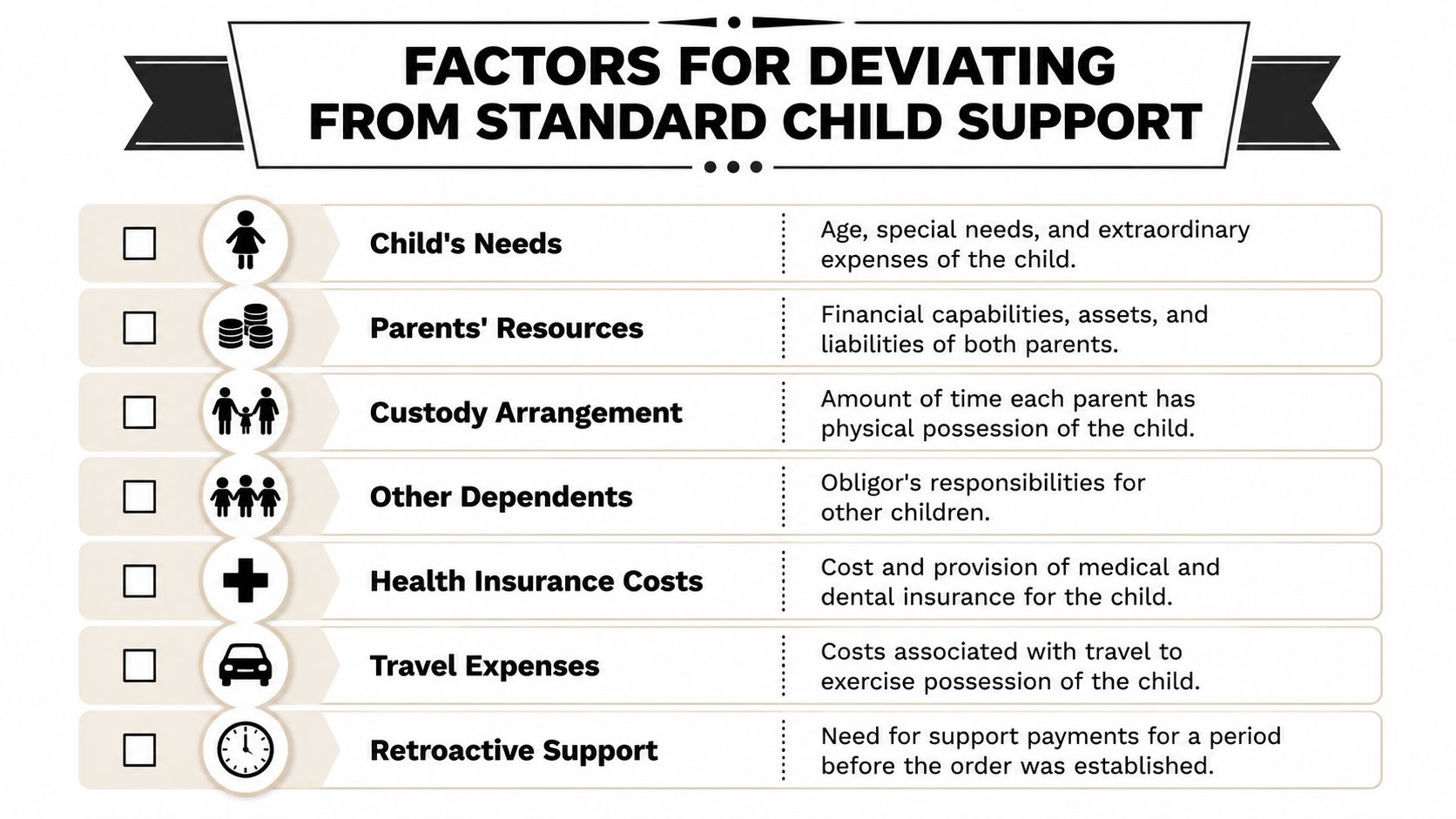
A parent can walk into court expecting the guideline number to control and leave with a different result. Texas law allows that. Under Texas Family Code § 154.123, a judge may order an amount above or below the guideline figure if applying the guidelines would be unjust or inappropriate in the specific case.
That discretion matters more in 2025 and after, especially in cases involving higher earners, unusual expense patterns, or parenting schedules that do not fit the standard model. The statute gives the court a framework, but the outcome usually turns on proof. Judges want records, invoices, testimony, and a clear explanation of why the guideline amount misses the mark.
When deviation arguments actually work
Strong deviation requests are specific. Weak ones rely on fairness language and broad complaints.
Under § 154.123(b), courts may consider factors such as:
- the age and needs of the child
- any special or extraordinary educational, health care, or other expenses
- the parents' ability to contribute to the child's support
- financial resources available for the support of the child
- possession of and access to the child
- travel costs tied to possession
- positive or negative cash flow from a business or assets
- support for other children the obligor has a duty to support
The practical question is simple. Can the judge connect the requested number to a statutory factor and to evidence in the file?
For example, a parent asking for more than guideline support in a high-income case should not stop at saying the child is used to a certain lifestyle. Courts usually want evidence of actual unmet needs. That may include private school tied to an established pattern, recurring therapy, tutoring, unreimbursed medical costs, or necessary travel expenses. On the other side, a parent opposing an upward deviation should separate true child-related needs from expenses that mainly benefit the receiving household.
The winning argument is usually the one that turns general claims into line-item proof.
Retroactive child support and the four-year presumption
Retroactive support is governed primarily by Texas Family Code §§ 154.009 and 154.131 through 154.133. The court can order a parent to pay support for a period before the case was filed, but the analysis is more structured than many parents expect.
The four-year rule is a presumption, not an absolute bar. In many cases, the court presumes that retroactive support should not go back more than four years before the date of service or appearance. That presumption can be rebutted. Two facts often matter most under § 154.131: whether the obligor knew or should have known he was the child's parent, and whether he sought to avoid establishing support.
That distinction changes case value fast. If you are seeking retroactive support beyond four years, prove knowledge, concealment, avoidance, or a history of providing little to no support. If you are defending that claim, focus on lack of notice, uncertainty about paternity, voluntary support already provided, and whether the request is financially oppressive under § 154.132.
Courts also look at fairness to both sides. Retroactive support is meant to address an unmet duty to support a child. It is not supposed to function as a punishment.
Unemployment, underemployment, and imputed income
A sudden drop in reported income does not end the inquiry. Under Texas Family Code § 154.066, if a parent is intentionally unemployed or underemployed, the court may apply the support guidelines to earning potential instead of actual earnings.
This issue comes up often with self-employed parents, cash-based businesses, commission earners, and parents who change jobs right before a hearing. The court may examine work history, education, licenses, past tax returns, bank records, business deductions, and whether the parent has chosen lower earnings for a reason that should affect the child.
Texas law also sets a floor. Under § 154.068, when actual income evidence is thin, the court may presume income based on a 40-hour workweek at federal minimum wage. In practice, that floor matters in entry-level cases, but it is rarely the end of the story if the evidence shows a higher earning capacity.
Other special circumstances that change the analysis
Some cases need a closer look because the standard monthly transfer payment does not tell the full story.
A few examples:
- A child has a disability requiring long-term care or extended support past age 18 under § 154.302
- One parent pays nearly all uninsured medical, therapy, or educational costs
- The child receives independent financial resources, such as trust income or government benefits
- The obligor has irregular compensation, including bonuses, equity compensation, or seasonal income
- A parent has remarried, and household expenses are being paid in a way that obscures true available resources
These are fact-heavy disputes. The legal standard comes from the code, but the result usually turns on documents and credibility. In court, the parent with organized proof usually has the stronger position.
Modifying and Enforcing Your Child Support Order
A child support order isn't self-updating. If income changes, possession changes, or the child's needs change, you need a new court order. Until that happens, the old order controls.
Start with the process map below.

How modification usually works
In practice, modification cases often arise after a job loss, a substantial increase in earnings, a major change in the child's expenses, or a shift in custody arrangements. The legal standard is whether there has been a material and substantial change in circumstances.
The procedure usually looks like this:
- File a petition to modify in the proper court.
- Serve the other parent unless service is waived in a valid way.
- Exchange financial information so the court can evaluate current resources.
- Attend mediation or a hearing depending on how the case progresses.
- Get a signed order. Without one, the old support amount remains enforceable.
The biggest mistake parents make is informal adjustment. They agree by text to pay less or accept less, then years later discover arrears still accrued under the old order.
Here is the video many parents find helpful when trying to understand the post-order process:
Enforcement is its own case
If support isn't being paid, enforcement can move quickly and aggressively. Courts may use wage withholding, liens, and other collection tools. The exact remedy depends on the amount owed, the payment history, and whether prior orders are clear enough to enforce as written.
If the dispute is substantial or fact-heavy, parents often need structured case review rather than a quick filing. The Texas Child Support Law Office of Bryan Fagan handles establishment, modification, enforcement, arrears, wage garnishment, and disputes over guideline calculations under the Texas Family Code.
Important: Don't wait for unpaid support to become a long arrearage problem, and don't wait for a job change to "average out." File for modification or enforcement while the proof is current.
Common Texas Child Support Questions
A parent walks into court with a tax return showing very little income, but bank statements show regular deposits, business-paid personal expenses, and a lifestyle the return does not explain. That is a common self-employment child support case in Texas. Courts do not stop at the tax return. They examine what the parent has available to support the child.
How do courts handle self-employment income
Self-employment cases turn on proof. Judges look at profit and loss statements, bank records, credit card statements, 1099s, QuickBooks entries, and whether claimed deductions are legitimate business expenses or personal spending. Under Texas Family Code Section 154.062, child support is based on net resources, and in a self-employment case the primary dispute is often what counts as income versus what is actually necessary to keep the business operating.
I tell clients to expect scrutiny if they write off vehicles, meals, travel, or housing through the business. Some deductions may be valid for tax purposes and still draw a challenge in a child support hearing. If the records are sloppy, the court may make reasonable inferences that do not favor the parent controlling the books.
Who pays for the child's health and dental insurance
Medical support and dental support are separate parts of the order, not side issues. Texas Family Code Sections 154.181 through 154.187 address medical support, and Sections 154.1815 through 154.1875 address dental support. One parent may be ordered to carry coverage if available at a reasonable cost, and the order usually also addresses uninsured expenses.
That matters in real dollars. A parent may focus on the monthly support number and miss the cost of premiums, copays, deductibles, and reimbursement terms. Read those provisions carefully before agreeing to final language.
Does support change if I have children with another parent
Yes. Texas applies an adjusted guideline chart when the obligor has a duty to support children in more than one household. The standard percentages in Texas Family Code Section 154.125 do not always apply the same way once other children are part of the calculation.
The court still focuses on the child before it. Later-born children do not erase the support obligation, but they can change the percentage applied to net resources. In practice, this issue is often mishandled because parents assume the court will automatically credit every child in the home. It usually takes clear evidence and a correct application of the multiple-family adjustment.
Can we make our own support agreement without going to court
Parents can agree to child support terms, but the agreement should be reduced to a written order and signed by the judge. Texas Family Code Section 154.124 allows parties to make an agreement, and courts often approve it if the terms are in the child's best interest.
An informal side deal creates predictable problems. One parent pays a lower amount for months, the other parent accepts it, and then the official payment record still shows a growing arrearage under the signed order. Text messages rarely fix that. Court orders do.
Can retroactive support go back more than four years
Yes, in some cases. Texas Family Code Section 154.131 creates a rebuttable presumption that retroactive child support should not exceed the four years before the filing date, but that presumption can be overcome. Courts look closely at whether the obligor knew or should have known of paternity and whether the obligor tried to avoid support.
Retroactive support also raises practical proof problems. Old pay records may be incomplete, cash income may be disputed, and the parties may remember the timeline very differently. The earlier the issue is addressed, the easier it usually is to prove.
How is child support calculated in a 50/50 schedule
A 50/50 possession schedule does not cancel child support in Texas. The Family Code does not use a simple formula that says equal time means no support. Courts still start with guideline support, and then they decide whether the facts justify a different result under Texas Family Code Section 154.123.
This is one of the most misunderstood issues I see. In a true equal-possession case, the court may consider each parent's net resources, who pays health insurance, who covers school and activity costs, and whether one home carries more day-to-day expenses. Some judges offset support. Some approve an agreed deviation. Some stay close to the guideline amount if the income gap is large.
What changes in 2025 for higher-income cases
The net-resource cap used for guideline child support is scheduled to increase on September 1, 2025. For many higher-income parents, that means a larger portion of income will fall within the guideline calculation before the court even considers whether proven needs justify more support above the cap under Texas Family Code Section 154.126.
That change matters in settlement strategy now. If a case will still be pending near the effective date, the timing of negotiation, mediation, temporary orders, and trial setting can affect the numbers. In high-income cases, small mistakes in defining net resources can produce large support differences over time.
If you're asking how child support is calculated in Texas, the legal framework is straightforward. The hard part is proving income, applying the right adjustments, and knowing when the facts support a deviation from the guideline.
If you're dealing with a support hearing, a modification request, a 50/50 custody dispute, or unpaid child support, the Texas Child Support Law Office of Bryan Fagan provides representation focused on establishing, modifying, enforcing, and defending child support orders under the Texas Family Code across Houston, Dallas, Austin, San Antonio, Fort Worth, and surrounding counties.