Your child had the ER visit, the X-ray, the cast, and the follow-up appointments. Insurance paid part of it, then the rest showed up as a stack of bills, an Explanation of Benefits, and a question the other parent suddenly wants to argue about: who pays what, and when? In Texas, that is not a side issue. Uninsured medical expenses are a parallel child-support obligation, and if your order is vague, the fight starts months later when reimbursement is already overdue.
What Counts as Uninsured Medical Expenses Under Texas Child Support
A broken arm is the easiest way to see how this works. The hospital bills the visit, insurance pays its share, and what's left is the unreimbursed amount, the part the parents still have to divide under the support order. Texas child-support orders usually require both parents to share uninsured or out-of-pocket medical expenses, and Texas law commonly treats the split as 50% each unless a court order assigns a different percentage based on the parents' incomes, as reflected in the Texas child support medical-support guidance from TexasLawHelp. That includes deductibles, copays, prescriptions, and other uncovered treatment, not just emergency care.

The charges that usually belong in the reimbursement bucket
Think in categories, not just invoices. Deductibles and copays are the obvious ones. So are prescriptions, therapy, orthodontic care, dental work, vision treatment, and durable medical equipment when the child needs it and insurance does not cover the full cost. Texas family-court practice treats these as part of the medical-support structure, separate from the monthly support check.
If the bill is for necessary care and insurance didn't fully cover it, don't assume it disappears into the basic child-support amount. It usually doesn't.
The clean way to handle this is simple. Separate the provider bill from the insurance payment, keep the EOB, and calculate the leftover amount before you ask the other parent for reimbursement. If you wait, the dispute becomes about paperwork instead of the child's expense.
What does not belong in the claim
Not every bill is reimbursable just because a child wore it, used it, or wanted it. Purely elective cosmetic treatment is the wrong fight for a child-support order. Over-the-counter items are also a poor fit when they were never prescribed and you have no documentation tying them to necessary treatment.
The order language matters because Texas child support uninsured medical expenses Texas disputes turn on proof, not emotion. If you want reimbursement, label the expense correctly the first time. Otherwise, the other parent will argue it was never an uninsured medical expense at all.
The Statutory Framework That Governs Medical Reimbursement
Texas does not treat medical reimbursement as a casual add-on. It is built into the Family Code. Under Texas Family Code §154.183(c), the court must allocate the child's reasonable and necessary unreimbursed health care costs, including deductibles and copays, between the parents according to their circumstances, and the law treats uninsured medical and dental expenses as additional child support. That is the governing standard, and it's the provision that should be in your pleadings when the order is being drafted or enforced. Texas Family Code child support discussion
What that means in practice is straightforward. The judge is not limited to the base guideline number. The court looks at the child's uncovered medical costs, the parents' financial positions, and the wording of the existing order, then assigns responsibility for the unreimbursed portion. The old habit of treating the medical clause like a footnote is a mistake.
The insurance obligation and the reimbursement obligation are different duties
Texas Family Code §154.188 matters when a parent ordered to provide health or dental insurance fails to do it. The statute says that parent can be held liable for the necessary medical or dental expenses, as well as the premiums or contributions that should have been paid for the child. That is not the same thing as reimbursement for a random bill. It is a statutory consequence for failing to carry the coverage the order required.
That distinction matters in a hearing. One issue is who had to maintain insurance. The other is who owes the uninsured balance after treatment happened. If you blur those together, you weaken the motion.
Practical rule: ask the court to separate insurance noncompliance from unreimbursed expense reimbursement. Judges understand the difference, and your paperwork should too.
The default split is often 50% each, but it is not automatic in every order. The percentage can change when the court assigns a different share based on the parents' incomes and circumstances. For Texas parents negotiating or litigating these clauses, the core question is not whether medical support exists. It is how precisely the order defines the reimbursement duty and the proof required before payment is due.
How Guideline Support and the 2025 Cap Interact With Medical Costs
Texas guideline support is set by percentage, not guesswork. TexasLawHelp states that the percentages applied to the obligor's net monthly resources are 20% for one child, 25% for two, 30% for three, 35% for four, 40% for five, and at least 40% for six or more children. It also states that the standard guideline cap applies to the first $11,700 per month in net resources, effective September 1, 2025, and that a court may order additional support above the guideline amount based on the parent's income and the child's needs. Texas child support calculation guidance
Here is the cleanest way to see the math. If an obligor has $10,000 in net monthly resources and two children, the ordinary guideline number is 25%, or $2,500 per month. That is the base support figure before you add separate medical obligations. The medical clause is not swallowed by that amount, it sits beside it.
A simple working example
If that same parent also has to carry health insurance for the child and reimburse unreimbursed medical costs, the monthly exposure is no longer just the base support check. It becomes a stack of obligations, base support plus insurance-related costs plus the child's uninsured bills. That is why medical support is not a minor detail in higher-cost families.
The mistake many parents make is treating the guideline amount as the whole case. In real court orders, it usually isn't.
The updated cap matters most in higher-income cases. Once the obligor's resources move above the cap, the court still has room to address the child's needs, and medical support can become part of the negotiation in settlement. That is especially true where the child has recurring therapy, orthodontia, or other ongoing care that insurance never fully absorbs.
| Texas Child Support Percentages of Net Monthly Resources | ||
|---|---|---|
| Number of Children | Percentage of Net Resources | Example on $10,000 |
| 1 | 20% | $2,000 |
| 2 | 25% | $2,500 |
| 3 | 30% | $3,000 |
| 4 | 35% | $3,500 |
| 5 | 40% | $4,000 |
| 6 or more | at least 40% | at least $4,000 |
That table only gives the base calculation. It does not include uninsured medical reimbursement, and that's the point. You should walk into mediation knowing both numbers, because the medical claim can change the overall cost of the order as much as the guideline payment itself.
Documentation and Billing Standards Courts Expect
If you want reimbursement, start acting like you're building a court exhibit the day the bill arrives. Judges do not want a loose text exchange and a blurry provider portal screenshot. They want a clean trail showing the child got treatment, insurance processed the claim, and the remaining amount is the one you're asking the other parent to pay. The earlier you organize this, the less likely the other side can claim confusion later.
The Explanation of Benefits matters more than the provider statement because it shows what insurance paid and what remained unreimbursed. If the bill is large or the coding is unclear, get an itemized invoice. For prescriptions, keep the pharmacy receipt and the labeling information that ties the cost to the child's treatment. For recurring expenses, keep a running ledger by date of service and amount paid.

What the reimbursement packet should include
Use a packet, not scattered messages. The packet should contain the bill, the EOB, the date of service, the provider name, proof of payment if you already paid it, and a written request for reimbursement under the order. If the issue is already headed toward court, that same file becomes your exhibit set. Evidence needed for a Texas child support case
Send copies to the other parent. Keep the originals. If you end up in court, that habit saves you from credibility fights.
Timing and notice matter
If you paid before notifying the other parent, don't hide that fact. Say when the service happened, what insurance covered, what remained, and when you first asked for payment. Courts care less about stylistic polish and more about whether the request was fair, specific, and documented.
The rule is procedural, not emotional. If the order requires sharing uninsured expenses, give the other parent the numbers and the backup. If you don't, you hand them an argument that the amount was never properly presented for reimbursement.
Enforcement and Modification of Medical Support Orders
If the other parent refuses to pay, you do not wait and hope they change their mind. You document the unpaid share, send a formal demand, and file a motion to enforce if the order is clear and the deadline has passed. Texas enforcement practice depends on the exact wording of the order, so the first question is always whether the clause gives you a clean reimbursement right or leaves room for argument. The more precise the order, the stronger the enforcement case.
A successful enforcement case usually needs three things. First, proof of the medical expense and the uninsured balance. Second, proof that the other parent was obligated to pay a defined share. Third, proof of nonpayment. Once you have those, the court can enter remedies tied to the unpaid amount, and in the right case, contempt may be on the table if the violation was willful and the order supports that relief.
Enforcement versus modification
Those are different fights. Enforcement says the order was violated. Modification says the existing order no longer fits the child's or parents' circumstances.
Texas Family Code §154.123 is the statute you use when asking the court to deviate from guideline support or revisit the structure because the numbers no longer make sense. A change in medical costs, a shift in income, or the impact of the $11,700 cap after September 1, 2025 can all matter in a high-income case where the medical obligation is now a serious part of total support exposure. How to modify child support in Texas
If the order is outdated, don't file enforcement first and hope it turns into a modification case. Pick the correct remedy from the start.
A court will look for a material change in circumstances, not just annoyance or buyer's remorse. That's where medical costs often become powerful evidence. Rising therapy costs, new specialist care, or repeated uninsured claims can show the order no longer reflects reality, especially where the base support figure already sits near the guideline ceiling.
The process is procedural and unforgiving. File the pleading, serve the other parent, prepare exhibits, and show the judge the numbers. That is how a medical-support dispute turns into an enforceable court result instead of another cycle of unpaid bills.
Sample Court Order Language and a Negotiation Walkthrough
Good order language removes room for games. A solid uninsured-expense clause says the parents will share reasonable and necessary unreimbursed medical and dental expenses, identifies the percentage split, requires exchange of the EOB and bill, and sets a deadline for payment after notice. It should also make clear that the obligation covers deductibles, copays, prescriptions, and other uncovered treatment, while excluding purely elective care unless the parties agree otherwise.
A clause like that gives the court a clean enforcement path later. If the order is vague, every reimbursement becomes a side argument about whether the cost was covered, necessary, timely presented, or even included at all. That is exactly how parents end up in hearings over bills that should have been resolved in writing months earlier.
A representative exchange is simple. One parent receives a $4,000 ER bill after insurance pays its share. The parent sends the bill, the EOB, and a written demand for the other parent's percentage under the order. The other parent says the bill is too high. The response is not a debate about feelings. The response is the document trail and the order language.
If the case started with a first order, Establishing a Child Support Order in Texas is the right procedural frame, because the medical clause belongs in the original order, not as an afterthought.
The negotiation should focus on the numbers in the order, not a fresh argument about who is the “better” parent.
In practice, the attorney's job is to translate the bill into the order's language. Who owes what share. What proof was exchanged. What deadline passed. That is how you turn a reimbursement dispute into a collectible amount instead of a recurring conflict.
The High-Income Reality Most Articles Miss
Most online guides treat uninsured medical expenses like a small add-on. That advice falls apart in higher-income Texas cases. Once the obligor is above the guideline cap, the base support figure and the medical obligations can operate as a combined burden that is materially larger than the monthly check people focus on first. That is why settlement leverage changes fast when the child has recurring care.
The total package is the pressure point. Insurance premiums, cash medical support, orthodontia, recurring therapy, and unreimbursed bills can stack up into a dispute that affects every negotiation choice. In those cases, attorneys use §154.123 deviation arguments to address whether the order should track the child's actual needs instead of stopping at the guideline number.
Why high earners fight these clauses harder
High-income parents care about precision because the math matters more. If the order leaves medical support loose, the reimbursement stream can become unpredictable. If it's too rigid, one parent ends up subsidizing care the other parent never properly reviewed. That is why a well-drafted order needs both a percentage split and a documentation rule.
Self-employed parents add another layer. Their income can be disputed, their net resources can be attacked, and the court may need to sort through business deductions before setting support. Once that happens, the medical clause becomes part of the larger fight over the fairness of the order, not just the child's treatment costs.
In a high-income case, the medical clause is not a footnote. It is part of the economics of the order.
The practical move is to model the whole exposure before you settle. Base support. Health insurance. Cash medical if ordered. Unreimbursed expenses. If those figures together are too high, the case needs either a different settlement structure or a targeted deviation request. That is the way to walk into court with a strategic advantage instead of surprises.
Action Checklist and Common Texas Child Support Questions
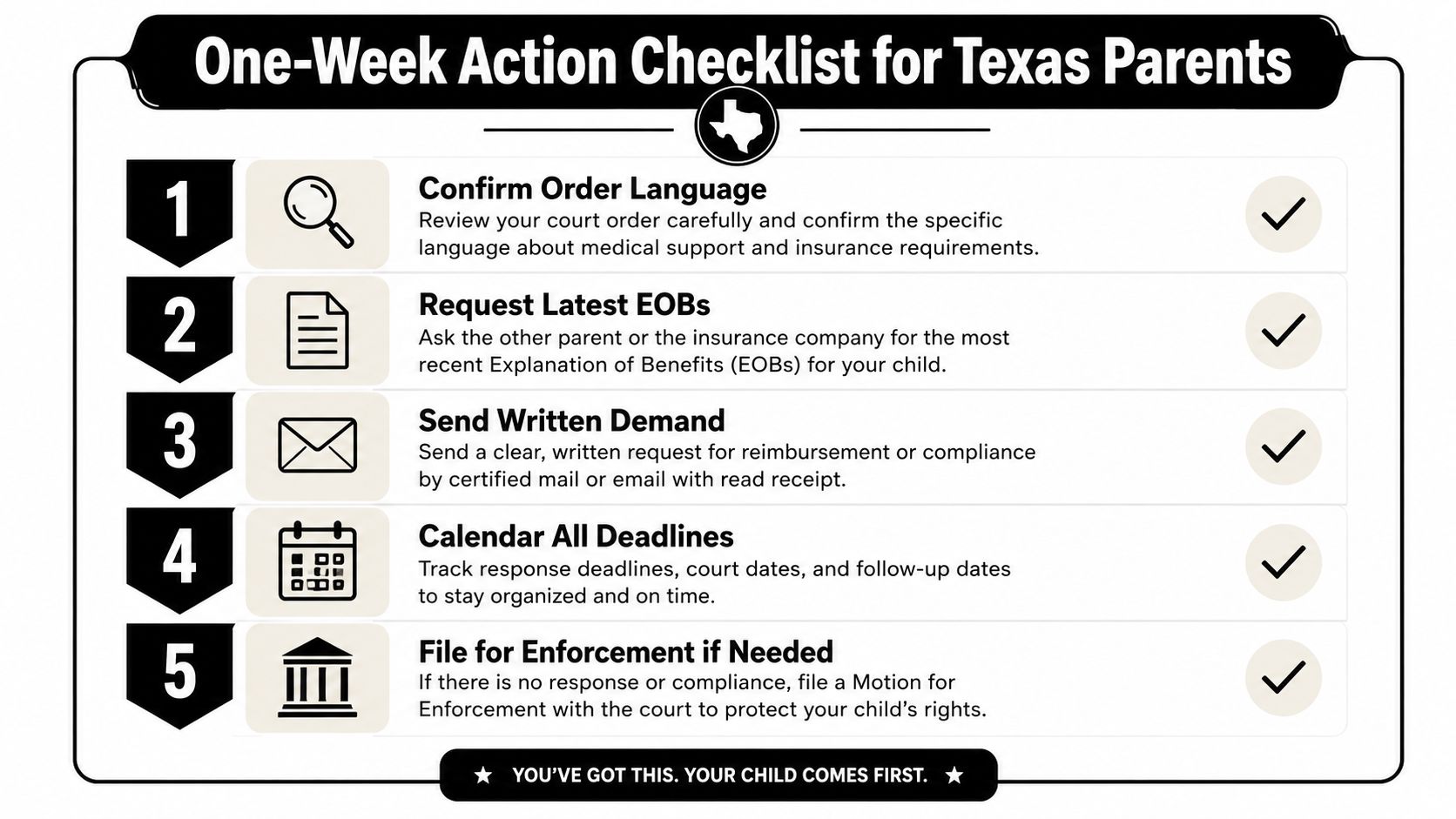
Start this week with five moves. Confirm the order language and look for the reimbursement clause, the percentage split, and the deadline. Request the latest EOBs for every unpaid treatment. Send a written demand with the bill, the EOB, and the exact amount owed. Calendar every deadline in the order. File for enforcement if the other parent ignores a clear obligation.
FAQ
Can a parent be ordered to pay cash medical if insurance is available? Yes. Texas courts can structure medical support separately from the base support obligation, and the court can allocate unreimbursed health care costs under Texas Family Code §154.183(c).
Is orthodontia treated as a necessary uninsured expense? It can be, if the treatment is reasonable and necessary and the order covers unreimbursed dental expenses under the medical-support language in the order and the Family Code.
Does 50/50 custody automatically change the split? No. Conservatorship arrangements do not erase medical-support duties. The percentage split still comes from the order and the parents' circumstances under §154.183(c), and the common default is 50% each unless the court assigns a different share.
If your order is vague, stale, or being ignored, do not wait for the next unpaid bill to become the next hearing. Get the reimbursement records together, then talk with Texas Child Support Law Office of Bryan Fagan about enforcing the order or revisiting the medical-support language before the dispute gets more expensive.