Child support in Texas usually ends when the child turns 18 or graduates from high school, whichever happens later. It does not end automatically, and payments usually keep coming out until a court signs an order stopping withholding.
That's the part most online advice gets wrong. Parents focus on the birthday or graduation date, but the date alone doesn't stop payroll deductions, State Disbursement Unit processing, or enforcement activity. In practice, when does child support end in Texas is partly a calendar question and partly a procedure question.
Clients are often surprised by two things. First, the statute gives you a clear legal endpoint in most cases. Second, Texas still expects you to take formal action to shut the system off. If you miss that second step, you can keep paying after the support obligation should have ended, and fixing an overpayment is harder than preventing one.
The Myth of Automatic Termination
The mistake I see most often is not misunderstanding the law. It is stopping at the law and ignoring the procedure.
Parents fixate on the child's birthday or graduation date because those events feel final. In the Texas child support system, they are only part of the job. If income withholding is in place, payroll deductions and enforcement records usually continue until the court signs paperwork that stops them. That gap between the legal end point and the administrative shutoff is where overpayments start.
Practical rule: If support is being withheld from wages, assume the deductions will continue until the issuing court says otherwise in a signed order.
That is why two parents can agree the obligation should be over, the child can be out of high school, and the employer can still keep sending money. Employers follow withholding orders. The Office of the Attorney General and the State Disbursement Unit process what the order requires. Informal agreement does not change any of that.
What Controls the End Date
Texas child support has two moving parts. One is the legal trigger that ends current support under the Family Code. The other is the court process required to stop withholding and clean up the payment record. Clients who miss the second step often learn an expensive lesson. Money can keep leaving a paycheck after the support obligation should have ended, and recovering that money is rarely simple.
Several facts matter at the same time:
- The triggering event in the order and under the statute: The child's age, high school status, or another terminating event controls when current support should end.
- Whether the case involves an exception: A disability-based support order can continue far beyond the ordinary timeline.
- Whether there is unpaid support: Arrears do not disappear when current support ends.
- Whether the court has terminated withholding: Without that order, the collection machinery may keep running.
What Works and What Creates Problems
In real cases, a few steps prevent most termination disputes.
| Approach | What happens in real life |
|---|---|
| Reading the existing order before the end date | Lets you confirm the exact trigger and spot any language that requires follow-up in court |
| Filing in the court that issued the order | Puts the request in front of the judge with authority to change or terminate withholding |
| Serving the other parent correctly | Avoids delays, resets, and arguments that notice was defective |
| Assuming the employer will stop deductions on its own | Usually leads to continued withholding because payroll departments wait for signed court documents |
| Relying on text messages or verbal agreement | Does not terminate withholding and does not protect against enforcement errors |
Many parents lose money when they assume the calendar ends the case. In practice, the calendar may end current support, but only proper court action stops the payments and prevents arrearage problems from getting worse.
Standard Termination Triggers Under Texas Law
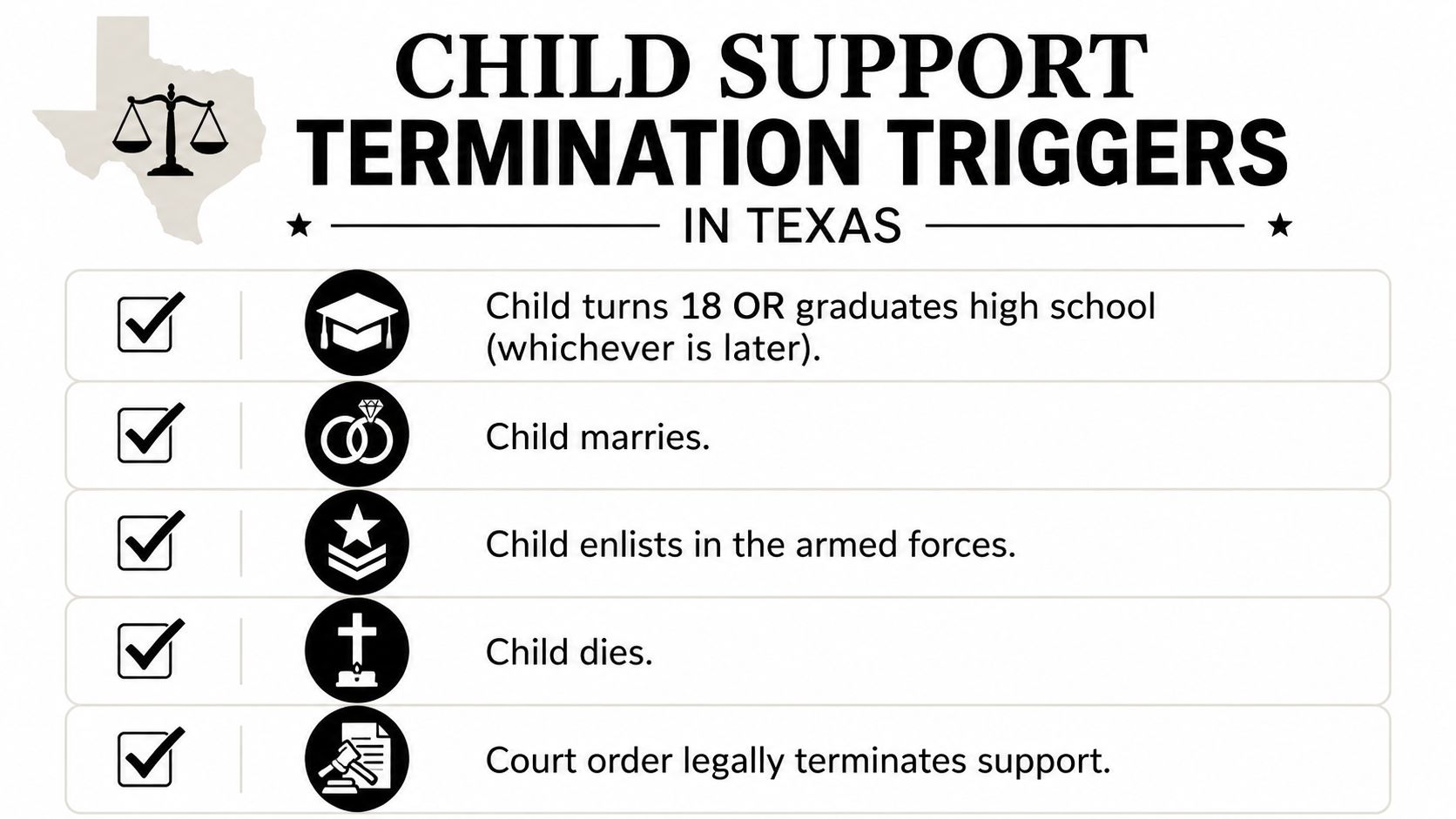
Texas gives you a defined set of events that end a current child support obligation in the ordinary case. The core rule is straightforward: under Tex. Fam. Code § 154.001 and § 154.006, support ends when the child turns 18 or graduates from high school, whichever occurs later. If the child is still enrolled full-time in high school at 18, support continues until graduation or age 19, whichever comes first, as explained in this Texas termination overview.
The main age and school rule
This is the trigger most parents deal with. The statute is designed to keep support in place through secondary school, but not indefinitely for a child who remains enrolled past the normal point.
A few examples make the rule easier to apply:
- Graduates at 17: support continues until 18
- Turns 18 during senior year: support continues until graduation
- Still in high school at 18: support can continue, but only until graduation or 19, whichever comes first
One source summarizing Tex. Fam. Code § 154.001 notes that if a child turns 18 in March 2026 and graduates in May 2026, support is owed through May 2026, and the obligation is capped at the end of that graduation month, according to this Texas child support termination guide.
Early termination events
Texas also recognizes events that can end support before the usual age-and-school milestone. Under § 154.001 and § 154.006, support may terminate early if the child:
- Marries
- Enlists in the armed forces
- Has disabilities of minority removed by court order
- Dies
Those triggers are summarized in this discussion of Texas child support termination events.
A statutory trigger tells you when support should end. It doesn't excuse you from getting the paperwork done.
Why enforcement still matters
If support hasn't been paid, termination doesn't erase the court's power. The legal tools available when a parent fails to pay child support are outlined in Enforcing Child Support Under §157.001. That becomes relevant when one parent assumes the case is over because the child is older, while the other parent is still owed money under an existing order.
How to Legally Stop Child Support Payments
The date your obligation should end is only half the job. In practice, support often keeps coming out of a paycheck until someone gets the right order signed and delivered to the right place.
That is the mistake I see over and over. A parent assumes the case is over because the child turned 18, graduated, or married. Payroll does not make that judgment. The employer follows the income withholding order already in the file until a new order tells it to stop.
The court process that actually ends deductions
The cleanest approach is to return to the court that signed the current support order and ask for an order terminating withholding. Titles vary by county and case posture. The practical goal does not. You need a signed order that changes what the employer and the state disbursement system are doing.
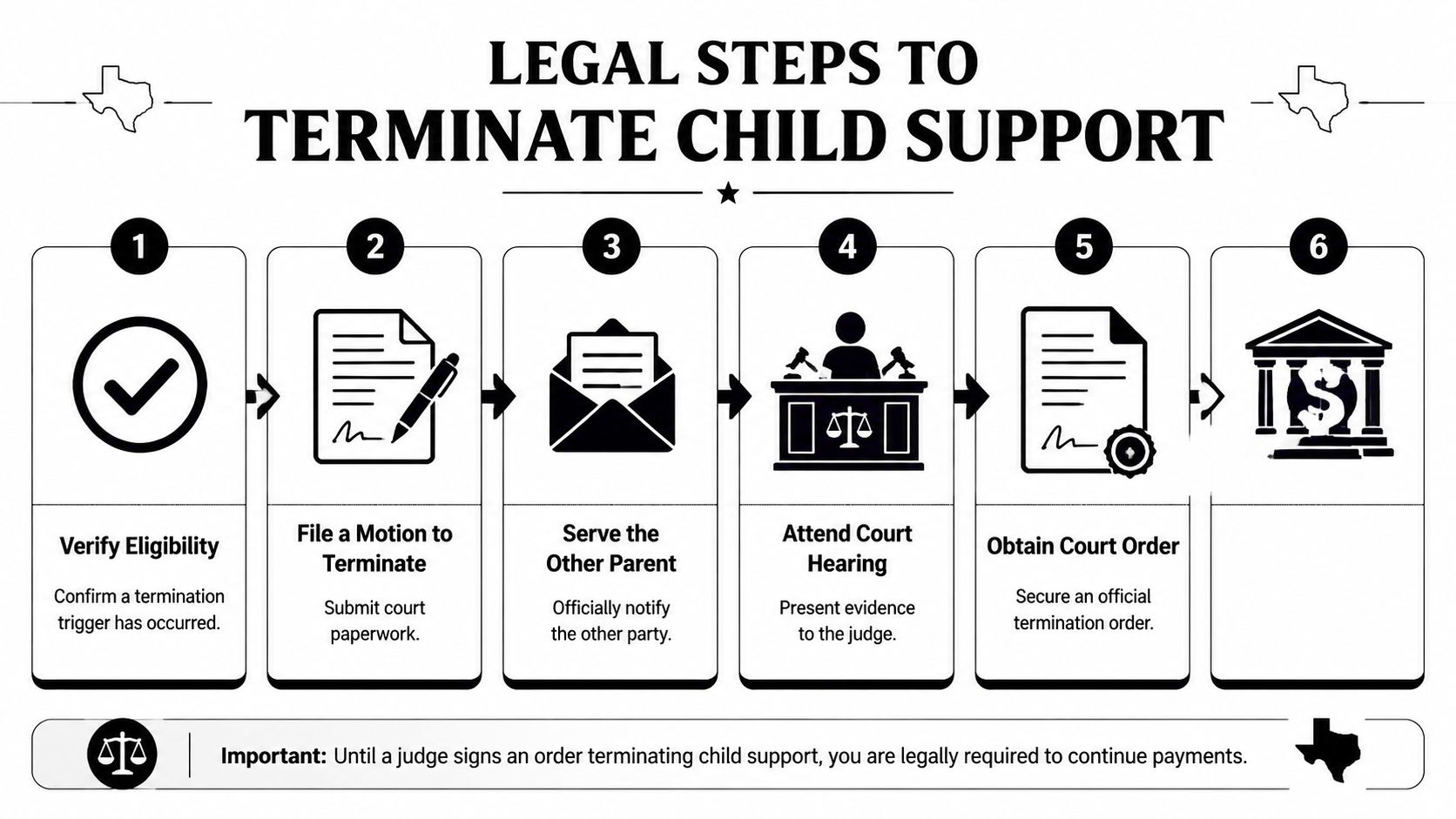
The usual sequence looks like this:
- Confirm the legal trigger with records that match the reason support ended, such as a birth certificate, graduation proof, marriage record, military enlistment documentation, or death certificate.
- Review the current order carefully for language about termination, withholding, medical support, and any unpaid balance that may still be collectible.
- File the proper pleading in the issuing court requesting termination of withholding or other relief tied to the end of current support.
- Serve the other parent or follow any notice procedure the court requires.
- Attend the hearing if one is set and present the documents that prove the obligation for current support has ended.
- Get a signed order and make sure it is sent to the employer, the clerk, and any state child support processing agency involved in the case.
Some cases are simple termination cases. Others are really mixed cases, where support for one child is ending but support for another child continues, or where the monthly amount should be recalculated instead of stopped entirely. In that situation, the process is closer to a modification case. Our guide on how to modify child support in Texas explains how those requests are handled.
What happens if you do nothing
Withholding usually continues.
That happens because employers are following an existing income withholding order, not making legal judgments about whether your child has aged out. If the order remains active in the payroll system, deductions often continue until a judge signs a new order and the employer receives it.
To understand the mechanics, our guide on Wage Withholding for Child Support in Texas gives a factual overview of how income withholding works and why employers do not stop on their own.
The video below gives a general overview many parents find useful before preparing the filing.
Evidence judges expect to see
Judges usually care less about argument than about whether the file contains clean proof. Bring records that line up with the termination ground and the date it occurred.
- For age-based termination: a birth certificate or other reliable proof of date of birth
- For graduation-based termination: school records, a diploma, or a letter from the school confirming graduation
- For early termination events: marriage records, military records, or a court order removing disabilities of minority
- For death: a death certificate or equivalent official record
If the order says withholding continues until further order, take that as written. Courts do.
The financial risk here is practical, not theoretical. Money can keep coming out after current support should have ended, and getting it back is rarely automatic. If there are arrears on the case, the court may stop current support but allow collection to continue on the unpaid balance. That is why parents need to address termination as a procedure, not just a date on the calendar.
Exceptions That Extend Child Support Indefinitely
Not every support case ends at 18, graduation, or 19. The largest exception is disability.
Texas law allows indefinite child support under Tex. Fam. Code § 154.302 when a child has a physical or mental disability that began before 18 and requires substantial care or supervision, as described in this summary of disabled-child support in Texas.

What the court looks for under Section 154.302
The disability exception isn't triggered by a diagnosis alone. The court looks at function, need, and timing.
The essential questions are usually these:
- Did the condition originate before age 18
- Does the child require substantial care or supervision
- Can the child support themselves independently
- What level of ongoing care is medically and practically necessary
That's why these cases are document-heavy. Medical records, school records, benefit records, and caregiver testimony often matter more than broad statements from either parent.
How indefinite support differs from ordinary support
Indefinite support cases are not merely “extended” standard cases. They often involve a different level of factual proof and a different strategy.
| Issue | Standard case | Disability case |
|---|---|---|
| Primary end point | Age and high school status | Need-based under § 154.302 |
| Proof focus | Birthday, graduation, enrollment | Disability origin, supervision needs, care evidence |
| Duration | Usually finite | Can continue indefinitely |
| Common dispute | Whether support should stop | Amount, duration, and recipient structure |
Some families also need to address who receives the funds and how they're managed. Texas law permits support to be directed in ways that match the child's circumstances. For a deeper discussion of that issue, see child support for disabled adult children.
College support and private agreements
Parents often assume Texas requires support through college. It generally doesn't. Courts can enforce what Texas law authorizes, and standard child support doesn't automatically continue because a child attends college.
That said, parents can enter agreements that go beyond the statutory minimum. If those terms appear in a decree or agreed order, the analysis shifts from pure child support law to enforcement of the parties' written obligation. In practice, that means you need to read the exact order, not rely on assumptions about what Texas “usually” does.
In these cases, the controlling language is often in the decree itself. One sentence can change whether an obligation ends on schedule or continues under a specific agreement.
Medical support can also travel on its own track. Courts may order it separately from base child support, and the exact order language matters.
The Arrearage Trap When Past-Due Support Never Ends
A child support case can end for current support and still stay very alive for collections. That's the arrearage trap.
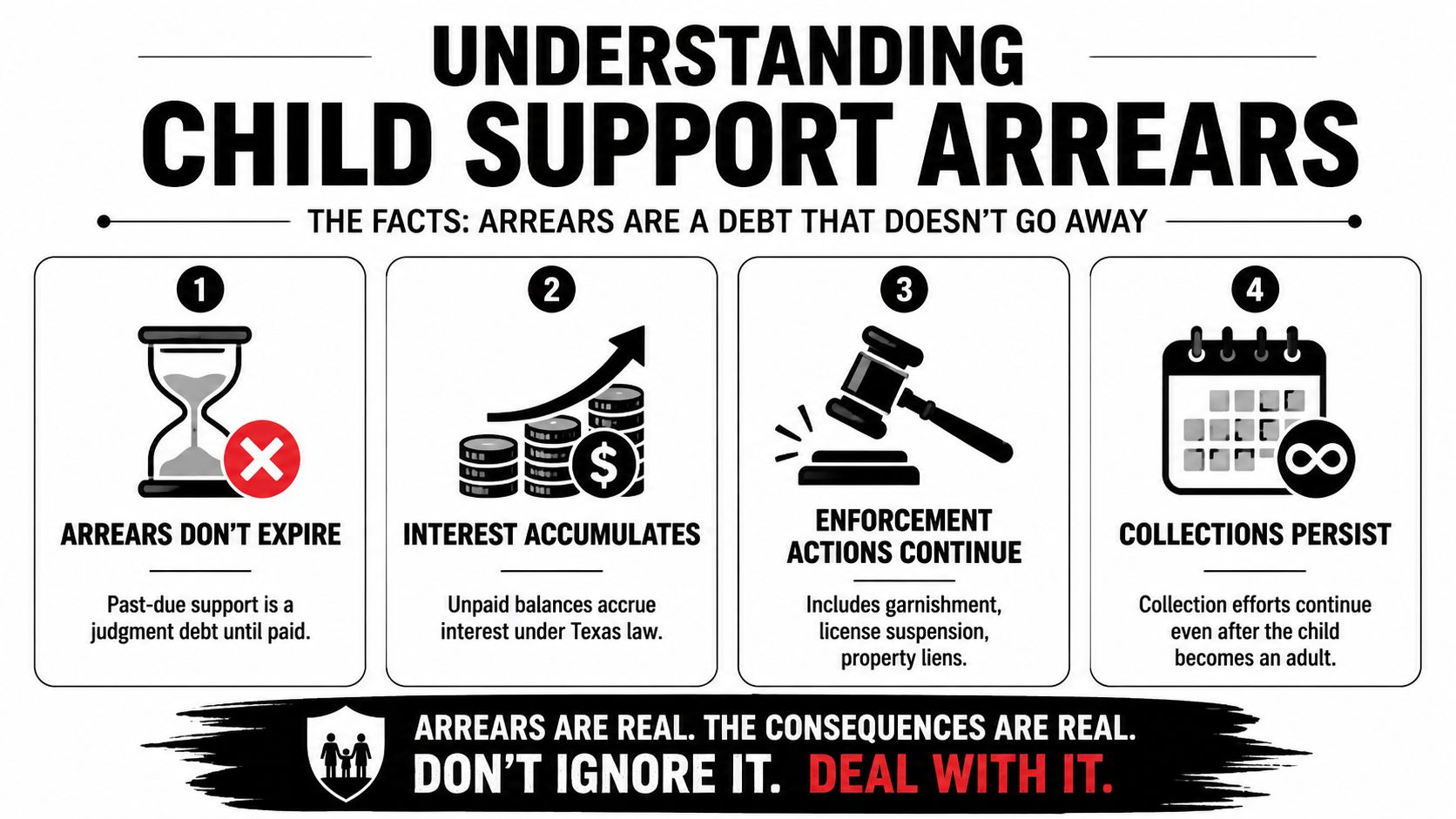
Texas Law Help makes the point directly: reaching the age limit or terminating parental rights does not erase arrears, and past-due support with interest continues until fully paid, as explained in Texas Law Help's child support article.
Why parents get blindsided
Parents tend to think in a single timeline. They focus on the child's birthday, the graduation date, or the date the child moved out. Arrears operate on a different timeline because they are a debt owed under a court order.
That means two things can be true at once:
- Current support has ended
- Collection efforts continue
This situation frequently leads to enforcement misunderstandings. A parent sees the child is now an adult and assumes the file should disappear. It won't if unpaid support remains on the ledger.
What continues after the child is grown
Wage withholding can continue for arrears even after the normal support obligation has terminated. Texas guidance on wage withholding explains that employers must continue withholding until formally notified that the obligation has ended, and arrearages remain subject to withholding until fully paid, according to this Texas Family Code child support overview.
For parents dealing with a past-due balance, Texas child support arrears gives a focused explanation of how those balances are treated.
What works if arrears exist
The wrong move is pretending the balance disappeared when current support ended. The better move is to get a current payment history, confirm what portion is current support versus arrears, and address the balance directly through the court or the enforcement system handling the case.
A practical checklist:
- Pull the payment record: Don't guess from bank statements alone.
- Separate current support from arrears: They are not the same obligation.
- Check whether interest has accrued: This affects payoff strategy.
- Get the withholding language reviewed: Some orders continue collections automatically for past-due amounts.
Parents often ask when does child support end in Texas. The better question in an arrears case is whether only current support ended, while debt collection remains active.
How New Laws Affect Support and Modification
Termination issues don't exist in isolation. They sit inside the larger framework of Texas child support calculations and modifications.
For support orders finalized on or after September 1, 2025, Texas raised the guideline cap from $9,200 per month to $11,700 per month in the obligor's net resources, and orders finalized on or after that date, including modifications, must use the new cap under Tex. Fam. Code § 154.125, according to this explanation of the 2025 Texas child support cap update.
Why the new cap matters
For many parents, the cap won't change the termination date. It will, however, matter in any pending modification, especially for higher-income households.
The guideline percentages listed in the verified material include:
- One child: 20%
- Two children: 25%
- Three children: 30%
- Four children: 35%
- Five children: 40%
Those percentages apply to net resources up to the applicable cap under § 154.125. In a courtroom, the calculation usually starts with net resources, then applies the guideline percentage, then moves to possible deviations if the facts justify it. Deviations are addressed under § 154.123.
A practical calculation example
Suppose a parent has one child before the court and net monthly resources that reach the guideline cap for an order finalized after September 1, 2025. The court would apply 20% under § 154.125 to net resources up to $11,700. If another parent argues that guideline support is unfair because of unusual expenses, parenting arrangements, or other statutory factors, the court may consider deviation under § 154.123.
That matters here for one reason. A termination filing is often tied to a broader request. One child may be aging out while support remains due for another child, or the family may need a revised amount rather than a full stop. In those situations, precision matters. Filing the wrong request can delay relief.
Texas Child Support Termination FAQs
Can parents agree to end child support early without a court order
They can agree between themselves, but that doesn't reliably protect either side. If the court order still requires support, informal agreements usually won't stop withholding or enforcement.
If my child is 18 and still in high school, when does support end
Under the verified Texas rule, support continues until graduation or age 19, whichever comes first, if the child remains enrolled full-time in high school after turning 18.
Does child support stop if my child joins the military or gets married
Yes, early termination can occur when the child marries, enlists in the armed forces, or has disabilities of minority removed by court order under the applicable Texas Family Code sections discussed above.
Will I still owe money if I'm behind when the case ends
Yes. Arrears are separate from current support and continue until paid.
Can 50 50 custody eliminate child support
Not automatically. Texas courts still look closely at income, net resources, the guideline framework in § 154.125, and whether deviation under § 154.123 is justified.
What if I overpay because withholding didn't stop
That usually becomes a separate court problem. The better approach is to file before the termination date arrives and make sure the employer receives the signed order promptly.
If you need to determine the end date, stop withholding correctly, or deal with arrears or a disability-based exception, Texas Child Support Law Office of Bryan Fagan handles Texas child support matters involving establishment, modification, enforcement, and termination under the Texas Family Code.