When the child support papers arrive, most parents go straight to one question. “What am I going to have to pay, or receive, each month?” That's the right question, but in Texas the answer isn't pulled from thin air. The law starts with a percentage formula, and once you understand that formula, the process becomes much less mysterious.
The confusion usually comes from two places. First, people assume the percentage applies to gross income. It doesn't. Second, many parents are still relying on outdated information that doesn't reflect the new $11,700 net monthly resource cap effective September 1, 2025 under Texas Family Code §154.125. That change matters in standard cases and even more in high-income cases.
If you're trying to understand child support percentage Texas rules in 2026, focus on three things. Start with the guideline percentages. Then figure out net monthly resources under Texas Family Code §154.062. After that, look at whether the court is likely to stay with the guideline amount or deviate under §154.123, especially in a 50/50 custody case or when income goes beyond the guideline cap.
Navigating Texas Child Support
A common scene in my practice looks like this. One parent has just been served. The other parent has already heard from the Attorney General's office or has filed through private counsel. Both are anxious, and both usually have a different idea about what “fair” means.
Texas doesn't decide child support based only on what feels fair. It uses a structured system. For most cases, the court begins with the guideline percentage in Texas Family Code §154.125, applies that percentage to the obligor's net monthly resources, and then asks whether there's a legal reason to deviate under §154.123.
That predictability helps, but only if the numbers going into the formula are right. Parents often miss bonus income, self-employment income, rental income, or the narrow list of deductions the law permits. Others don't realize that equal parenting time doesn't erase support automatically. It may support a deviation argument, but the court still starts from the guideline framework.
Practical rule: If you walk into court arguing only from fairness, you're behind. If you walk in with verified income records, a net resource calculation, and a specific argument under the Family Code, you're in a much stronger position.
Procedure matters too. A support case usually begins with a petition or a suit affecting the parent-child relationship, followed by service, an answer, financial disclosures, and then either a negotiated order or a hearing. Modification and enforcement follow their own tracks, and each requires a different kind of proof.
Clients don't need more noise. They need a usable framework. That starts with the percentages.
Understanding Texas Guideline Child Support Percentages
Texas guideline child support is built on a simple starting point. The percentage depends on how many children are before the court, and that percentage is applied to the noncustodial parent's net monthly resources, not gross pay. The percentages are set by law in Texas Family Code §154.125 and summarized in this Texas child support guidelines overview.
Under Texas Family Code guideline standards, child support is calculated as a percentage of the noncustodial parent's net monthly resources: 20% for one child, 25% for two children, 30% for three children, 35% for four children, and 40% for five or more children, with a statutory minimum of 40% for six or more children. The same framework is discussed in this explanation of Texas child support basics.
The baseline percentages
Here is the standard chart most parents need first.
| Texas Guideline Child Support Percentages | |
|---|---|
| Number of Children | Guideline Percentage |
| One child | 20% |
| Two children | 25% |
| Three children | 30% |
| Four children | 35% |
| Five or more children | 40% |
These percentages give the court a default number. They don't answer every case, but they provide the starting point in almost every hearing involving support.
What these percentages apply to
The biggest mistake I see is a parent multiplying the percentage by gross monthly income. Texas doesn't do it that way. The formula uses net monthly resources, and that term has a specific statutory meaning.
That means wages and salary are only part of the picture. Depending on the case, the court may also examine commissions, bonuses, self-employment income, dividends, and rental income. Then it subtracts only the deductions the statute allows.
For a parent trying to estimate support before mediation or court, How Child Support Is Calculated in Texas is useful because it focuses on the Texas guideline formula and how net resources determine the support amount.
Why the percentage is only the start
A guideline percentage isn't the same as a final order. If one parent has unusual medical expenses for the child, if the possession schedule is unusual, or if there are facts that support a deviation under §154.123, the judge can move away from the guideline amount.
Still, most successful support presentations begin with the guideline number and then build from there. That's how courts expect lawyers and parents to organize the issue.
How to Calculate Your Net Monthly Resources
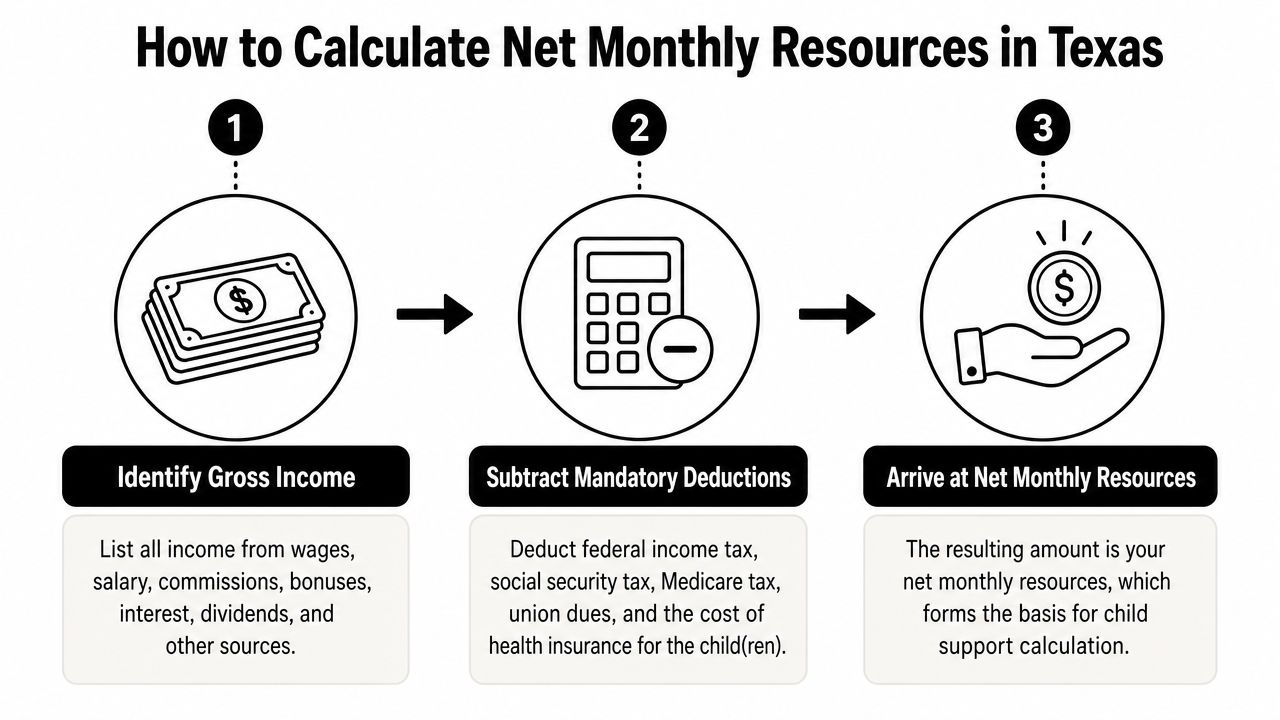
If you want to understand your likely child support number, start with Texas Family Code §154.062. That statute defines net resources, and the definition is narrower than many parents expect. It includes more than paycheck income, but it also limits deductions more tightly than people assume. This guide to how Texas courts calculate net resources tracks the same concept.
What counts as income
Texas courts look broadly at available income. As stated in this discussion of the updated Texas guideline cap and net resources, net resources include wages, bonuses, commissions, retirement income, and rental income, with the guideline calculation capped at $11,700.
In practice, that means you should gather:
- Pay from employment: Salary, hourly wages, overtime if it's part of your actual earnings pattern, commissions, and bonuses.
- Income outside a regular paycheck: Retirement income, rental income, and other recurring receipts that affect your actual resources.
- Self-employment records: If you're self-employed, the court won't rely only on what you say you “take home.” It will look at records that show what the business generates and what expenses are legitimate.
What the law allows you to subtract
Parents often overstate deductions. The statute does not let you subtract every monthly bill you pay.
Under §154.062, the allowed deductions are limited to:
- Taxes calculated under the statute: Social Security taxes and single-person federal income taxes.
- Child-specific coverage costs: Health, dental, or medical support costs for the child.
- Union dues: If they apply.
- Non-discretionary retirement contributions in the narrow situation recognized by the statute: This applies if the parent does not pay Social Security taxes.
The court cares less about your personal budget than your statutory net resources. Car payments, rent, credit cards, and lifestyle expenses usually don't reduce the guideline calculation.
A practical example
Assume a parent receives wages, a monthly commission component, and rental income. The court combines those income streams first. Then it subtracts the allowable taxes, any union dues, and the actual child-related health or dental insurance cost that fits under the statute.
What doesn't work is showing up with a spreadsheet full of personal expenses and expecting the court to treat that as a legal reduction. Judges usually want pay stubs, tax records, insurance cost documentation, and business records if the parent is self-employed. If income is irregular, the court may look at a broader earnings pattern rather than a single unusually low month.
What to bring to court or mediation
Good preparation changes these cases.
- Bring source documents: Pay stubs, tax returns, profit-and-loss records, lease statements, and benefits documents.
- Separate child-related deductions from family expenses: If the insurance covers several people, identify the child-specific cost clearly.
- Expect scrutiny in self-employment cases: Cash flow disputes are common. Unsupported expense claims usually fail.
- Prepare the math in writing: A clean net-resource worksheet is often more persuasive than a verbal estimate.
If your numbers are organized before the hearing, the support discussion becomes much more manageable.
The New $11,700 Child Support Cap in Texas
The biggest recent change in Texas child support law is the new cap on net monthly resources used for guideline calculations.
As explained in this summary of the current Texas child support cap, on September 1, 2025, Texas permanently raised the net resource cap from $9,200 to $11,700 per month under Texas Family Code §154.125(a). That means the guideline percentages now apply to net resources up to $11,700, not the prior cap.
Why this matters in real cases
A lot of online content is stale. If it still uses the old cap, it will understate the guideline amount in many higher-income cases.
For parents whose net monthly resources meet or exceed the cap, the change directly affects the maximum guideline amount:
| Number of Children | Maximum Guideline Payment at $11,700 Cap |
|---|---|
| One child | $2,340 |
| Two children | $2,925 |
| Three children | $3,510 |
| Four children | $4,095 |
| Five or more children | $4,680 |
Before the change, the cap was $9,200, and the old maximum for five or more children was $3,680, as described in this review of the 2025 Texas cap increase. For high-income earners, that difference is significant.
What the cap does and does not do
The cap doesn't mean a parent earning more than the cap can never pay more than the guideline amount. It means the standard percentage doesn't automatically apply above $11,700. Once income goes beyond that level, the court may consider whether additional support is appropriate in limited circumstances.
That's where careful lawyering matters. In some cases, the capped guideline amount is the practical endpoint. In others, a parent will argue that the child has proven needs that justify support above the guideline framework.
A short explainer is useful here:
Bottom line: The new cap changes the starting calculation in high-income cases. It doesn't eliminate disputes. It shifts them to whether the court should stay at the guideline amount or consider something beyond it.
When Courts Deviate from Guideline Support
Guidelines matter, but they aren't the end of the analysis. Texas Family Code §154.123 allows the court to deviate when applying the standard formula would be unjust or inappropriate under the circumstances.

Many parents are often surprised. They've heard the percentage, done rough math, and assumed that's the final answer. In contested cases, especially those involving shared possession or higher incomes, the primary fight is often about deviation evidence.
Equal parenting time and 50 50 cases
Texas doesn't have a simple automatic formula that wipes out support in every equal-possession case. Courts still begin with the guideline framework and then decide whether a deviation is appropriate under §154.123.
According to this discussion of child support and lower incomes in Texas, 35% of Texas custody cases involve 50/50 arrangements, and judges often reduce support by 15% to 25% in equal-time cases. That same discussion points out that many parents don't know how to prove undue hardship or how to handle adjustments when the new $11,700 cap is part of the case.
What works in these cases is evidence. Parents need to show the actual possession schedule, who pays for the child's recurring expenses, whether one parent carries most of the health coverage cost, and whether a guideline payment would overstate or understate what the child needs in an equal-time structure.
High-income cases above the cap
Once net resources exceed the current cap, the guideline percentage no longer controls the entire income picture automatically. At that point, a parent seeking more support needs more than a high salary figure. The court will want evidence tied to the child's proven needs.
That's where weak arguments usually fail. Saying “the other parent can afford more” isn't enough by itself. Courts want a concrete record of the child's expenses and a legal reason to move beyond the capped guideline amount.
Child-specific needs and unusual facts
Deviation arguments also come up when the child has unusual medical, educational, or other recurring needs. A judge may also consider the financial realities of the parents' arrangement and whether strict guideline support would be unfair in context.
For parents deciding how to handle these issues, options include private counsel, the Attorney General process in some cases, or a focused review with the Texas Child Support Law Office of Bryan Fagan when the dispute involves net-resource calculations, 50/50 deviations, arrears, or high-income support questions.
Courts don't reward broad complaints. They respond to organized proof tied to §154.123 factors.
Modifying and Enforcing a Child Support Order
A child support order isn't frozen forever. Jobs change. Children's needs change. Possession schedules change. When that happens, the legal question becomes whether the existing order should be modified or enforced.
Modification
To modify support, you usually need to file a petition to modify and show a material and substantial change in circumstances under the Texas Family Code. In practical terms, that often means a meaningful change in income, a major change in the child's needs, or a different parenting arrangement than the one the current order assumed.
The process usually looks like this:
- File the modification request: The case has to be opened properly with the court that has continuing jurisdiction.
- Serve the other parent: Formal notice matters. A judge won't modify support against a party who wasn't properly brought into the case.
- Exchange financial information: Updated income proof is often the center of the dispute.
- Attend hearing or finalize agreement: If the parents agree, the court can sign an agreed modification. If they don't, the judge decides.
Enforcement
When support isn't paid, the right move is usually enforcement, not endless informal negotiation.
Common enforcement tools include:
- Wage withholding: Often the fastest and most reliable route when the obligor has regular employment.
- Arrearage enforcement suits: These ask the court to confirm what is owed and enter enforcement relief.
- Liens and collection remedies: Depending on the facts, unpaid support can trigger property-related collection measures.
- Contempt remedies: In the right case, the court can impose serious consequences for willful nonpayment.
If you're on either side of an enforcement case, records are everything. Payment histories, wage withholding records, and prior orders usually decide where the hearing goes.
Common Questions About Texas Child Support
Is overtime included in child support income
If overtime is part of your actual earnings pattern, the court may treat it as part of the income picture when calculating net resources under §154.062. The court usually looks at credible income records, not a parent's hope that overtime might disappear soon. If the overtime is inconsistent, expect the court to examine a broader history rather than a single month.
What if a self-employed parent is hiding income
That issue comes up often. In those cases, the court may look beyond a claimed take-home number and examine business records, tax returns, bank activity, and the parent's spending pattern. What usually works is document-heavy proof, not accusation alone. If the records are incomplete or manipulated, the hearing becomes a credibility contest, and well-organized financial evidence matters.
Can parents agree to a different amount than the guideline support
Yes, parents can reach agreements, but the court still has to approve the order. If the agreed amount differs from the guideline framework, the agreement should be supported by facts the judge can accept under the Family Code. Also keep in mind that effective September 1, 2025, the cap on net resources for calculating guideline child support rose from $9,200 to $11,700 under Texas Family Code §154.125(a-1), and that cap applies to new orders and modifications finalized on or after that date, as noted in this explanation of the 2025 Texas child support cap change.
If you're dealing with a Texas child support case and need a precise analysis of guideline percentages, net resources, the new $11,700 cap, or a 50/50 deviation issue, Texas Child Support Law Office of Bryan Fagan handles establishment, modification, enforcement, and contested support matters across Texas.