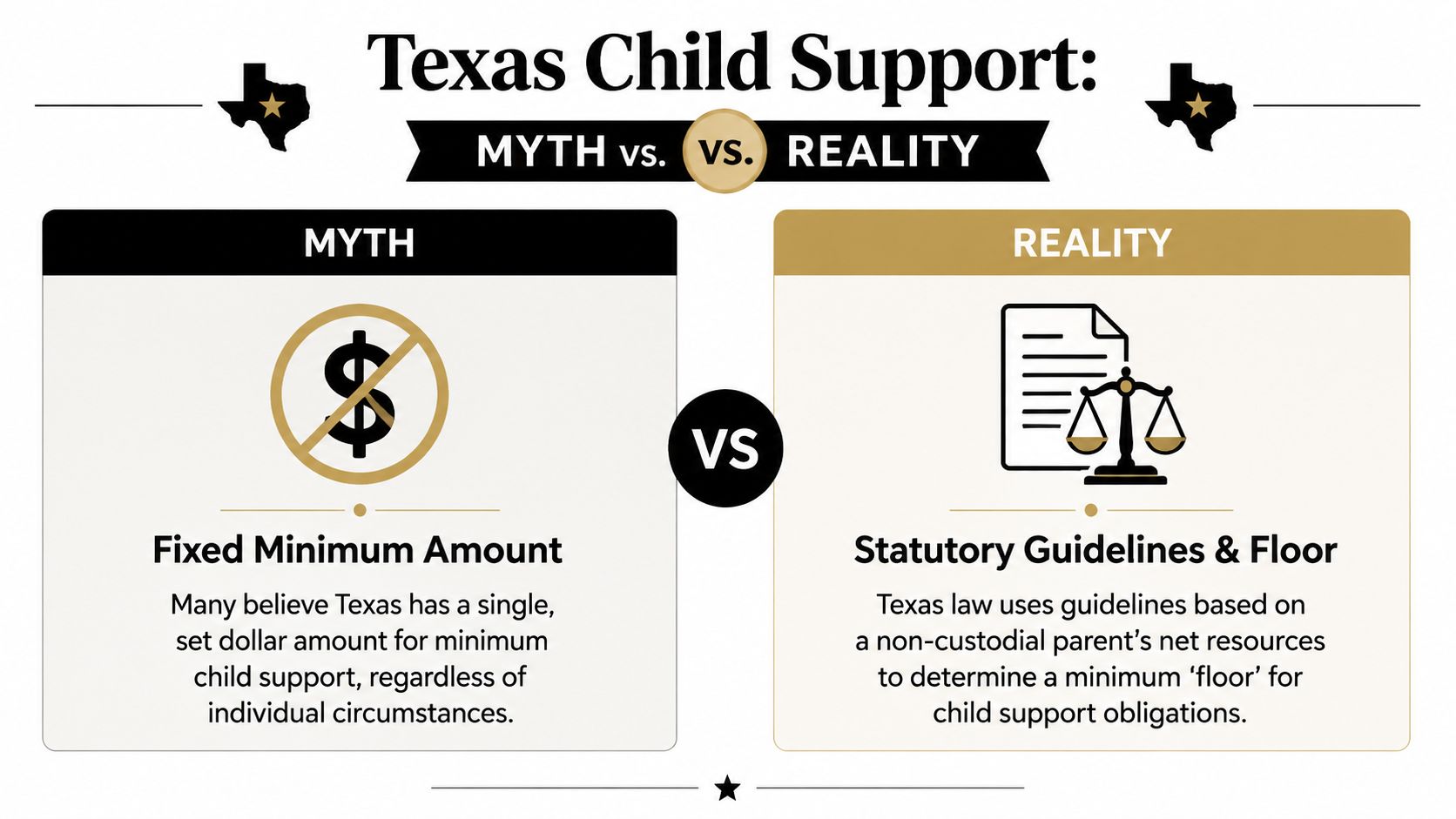
Texas doesn't have one fixed dollar figure for minimum child support. For most parents, support is calculated as a percentage of monthly net resources, and even an unemployed parent may still face a support obligation based on a minimum-wage resource baseline of about $1,160 per month, with reduced low-income percentages applied.
The most common bad advice on this subject is, "Just tell me the minimum payment in Texas." That's the wrong question. In court, judges don't start with a flat statewide number. They start with Texas Family Code §154.125 and the evidence proving what the obligor earns, what counts as net resources, whether the low-income schedule applies, and whether any deviation under §154.123 or added support under §154.126 is justified.
If you're preparing for a support case, the practical issue isn't just the formula. It's proof. Pay records, tax returns, health-insurance costs for the child, employment history, and credible testimony often decide whether the court uses your real income, a reduced low-income calculation, or a higher earning capacity the judge believes you should have.
The Myth of a Single Minimum Child Support Amount
Many parents expect to find a single, fixed dollar amount for minimum child support in Texas. That number does not exist. In court, "minimum" is usually shorthand for the lowest support a judge can justify after reviewing income proof, work history, insurance costs, and any facts that support a departure from the standard guideline result.
Under Texas Family Code §154.125, support is tied to the obligor's monthly net resources. In lower-income cases, the court can apply a reduced schedule instead of the standard percentages. The legal question is not whether a parent can claim a low payment. The question is whether the evidence supports using the low-income table, imputing income, or deviating from the guideline amount for a specific reason recognized by the statute.
What courts mean by minimum
In practice, "minimum" usually points to one of two courtroom paths.
- Low-income guideline support: If the paying parent's net resources fall within the lower-income range, the court may use the reduced percentages rather than the standard schedule.
- Imputed baseline income: If a parent is unemployed or working below capacity, and the record does not support a true zero-income finding, the court can calculate support from an earning baseline tied to minimum-wage employment.
That second path surprises many parents. A parent who shows up with no records and says, "I am not working," has not proved a zero support case. Judges regularly look at employment history, physical ability to work, prior wages, bank deposits, and credibility under oath. If the court believes the parent can earn at least minimum wage, support may be set from that baseline rather than from actual claimed income.
Proof decides whether the court goes low, standard, or higher
Cases are won and lost based on a critical understanding. The formula matters, but the file matters more.
For a wage earner, strong proof usually includes recent pay stubs, the most recent tax return, W-2s or 1099s, and health-insurance documentation showing the cost to cover the child. For a self-employed parent, courts often want more: business bank statements, profit-and-loss statements, invoices, expense records, and tax filings that can be compared for consistency. If the numbers do not line up, the judge may discount the parent's version of income.
Parents asking the court to use a lower figure should also be ready to prove why income dropped. Layoff paperwork, medical restrictions, job search records, and testimony that holds up on cross-examination can make the difference. Without that proof, a court may treat the parent as voluntarily underemployed and set support from earning capacity instead of actual current earnings.
Agreements still have to survive court review
Parents can agree on many parts of a family case, but child support is never purely a private deal. The judge still has to decide whether the proposed amount serves the child's best interest and fits the evidence in the record. That issue comes up often when parents try to waive support entirely or set an amount far below the guideline figure. If that is part of your plan, read whether parents can agree to no child support in Texas with that standard in mind.
The practical takeaway is simple. There is no universal minimum child support amount in Texas. There is only the amount a court can support with admissible proof, credible testimony, and the statutes that govern guideline support, low-income treatment, and justified deviations.
How Texas Guideline Child Support Is Calculated
The guideline system is straightforward once you understand the sequence. First, the court determines monthly net resources. Then it applies the percentage tied to the number of children before the court under Texas Family Code §154.125.
Texas uses net income, not gross income. The allowed deductions include Social Security taxes, federal and state income taxes based on a single filer with one exemption, union dues, and health insurance costs for the obligor's children, as summarized in FindLaw's Texas child support guidelines overview.
Guideline percentages under Section 154.125
| Number of Children | Percentage of Net Resources |
|---|---|
| One child | 20% |
| Two children | 25% |
| Three children | 30% |
| Four children | 35% |
| Five or more children | 40% |
Those percentages are the starting point in most cases. If you're comparing estimates, how to calculate child support in Texas gives a practical overview of how lawyers and courts approach the formula.
The 2025 cap matters in real cases
For higher-income parents, the statutory cap is critical. Effective September 1, 2025, Texas raised the monthly net resource cap from $9,200 to $11,700, and the maximum presumptive guideline support increased accordingly under Texas Family Code §154.125(a-1), as described in this discussion of the updated cap and guideline maximums.
That change affects strategy in several ways:
- Income proof matters more at the top end: once a parent reaches the cap, the fight often shifts from basic guideline math to whether the child has proven needs above the cap.
- Old assumptions may be wrong: parties who relied on the old cap can understate current exposure in negotiation.
- Modification review becomes more important: existing orders may no longer reflect the current guideline framework.
A plain-language resource such as How Child Support Is Calculated in Texas can help parents understand the formula, but in litigation the court will focus on admissible proof, not a rough online estimate.
The guideline formula is simple on paper. Cases become difficult when income is irregular, cash-based, self-employed, or intentionally obscured.
Child Support Calculation Examples in Practice
Courtroom child support disputes are rarely about memorizing percentages. They are about proof. A parent who can document income, deductions, and the child's actual needs usually walks in with the stronger case.
Low-income parent below the threshold
Take a parent with $900 in monthly net resources and two children before the court. Under the low-income schedule tied to Texas Family Code §154.125(b), the support amount is $180 per month.
That result only helps if the evidence supports the lower-income calculation. In practice, judges want pay stubs, benefit statements, tax returns, bank records, and testimony that lines up with those documents. A parent who says income is low but cannot explain regular deposits, side jobs, or cash spending creates a credibility problem fast.
I tell clients this early. If you want the court to use the low-income table, show the math and show the paper trail.
Standard income parent under the cap
Now use a straightforward guideline example. If the obligor has $1,000 in monthly net resources and owes support for one child, the guideline amount under §154.125 is $200 per month.
These cases still turn on evidence more often than people expect. The argument is usually over what counts as net resources, whether overtime is recurring, whether self-employment income is being understated, and whether claimed deductions are allowed under the statute. Lawyers prove these points with payroll records, employer testimony when needed, tax filings, profit-and-loss statements, and subpoenas if the other side is not producing reliable documents.
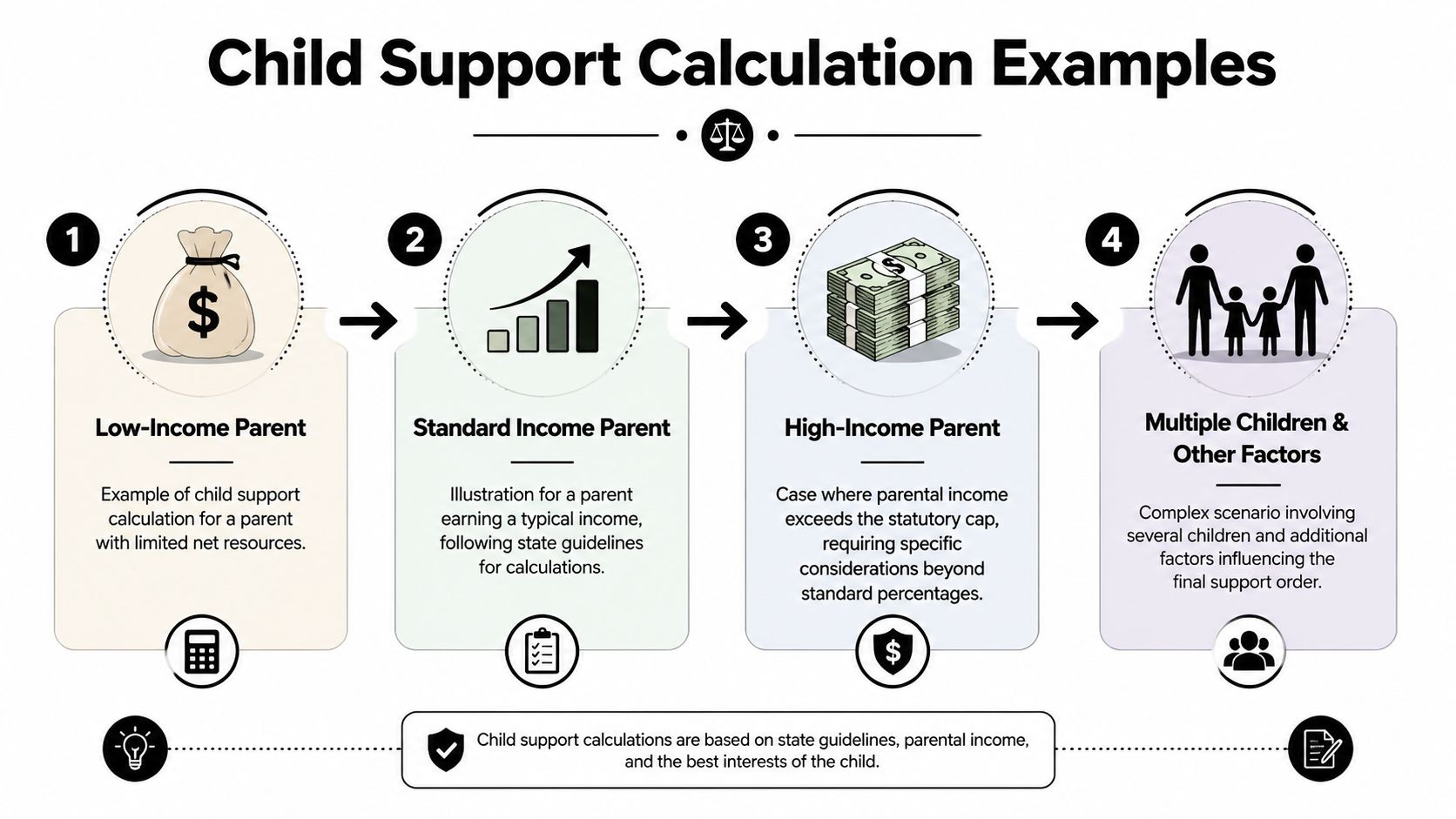
High-income parent above the cap
High-income cases require a different presentation. When monthly net resources exceed $11,700, Texas Family Code §154.126 limits the presumptive guideline calculation to that cap first. For one child, that presumptive amount is $2,340 per month. A parent asking for more has to prove the child's needs above the cap with specific evidence, not broad claims about wealth or lifestyle, as reflected in the Texas Family Code text for Section 154.126.
This is where preparation changes the outcome. The court will look for invoices, medical bills, tutoring expenses, tuition records when appropriate, therapy costs, childcare records, and testimony connecting each expense to the child. If the evidence mixes the parent's spending with the child's needs, the request for additional support gets harder to win.
Strong records usually beat emotional testimony.
Shared possession doesn't erase support
Equal possession schedules cause more confusion than almost any other support issue. A 50/50 arrangement does not automatically mean zero child support in Texas.
The court still looks at income disparity, who pays health insurance, who covers recurring school and activity expenses, and whether a deviation from the guideline amount is justified under §154.123. The parent asking the judge to move away from guideline support needs a proposed number that can be defended with facts, monthly budgets, and expense records. Vague fairness arguments do not carry much weight at hearing.
Once the amount is set, the order has to be drafted correctly and enforced if payments stop. A practical overview of that process appears in this guide on how to enforce child support in Texas.
Establishing and Enforcing Your Child Support Order
A support amount means very little until it's in a signed order. The process usually begins with a petition in family court or a child support case through the Office of the Attorney General. Both routes can produce enforceable orders, but they work differently.
Getting the order in place
Through the Attorney General's office, the focus is usually child support, medical support, and related parentage issues. Through private counsel, the case can be handled as part of a broader suit affecting the parent-child relationship, divorce, modification, or enforcement matter.
Most cases move through the same basic stages:
- Filing the case: One party asks the court to establish, confirm, or modify support.
- Service of process: The other parent must be formally served unless service is waived properly.
- Financial disclosure: Income proof, insurance information, and other records become central quickly.
- Temporary or final hearing: The judge hears evidence and applies Chapter 154 of the Texas Family Code.
- Final order and withholding: The signed order controls. Wage withholding is often the practical enforcement engine.
Enforcement is not optional
When support isn't paid, the receiving parent needs to act through the court or an enforcement agency. Informal complaints rarely fix arrears. Enforcement commonly involves wage withholding, liens, license consequences, and contempt-based remedies depending on the facts and the procedural posture.
The strongest enforcement cases are organized:
- Payment history: A clean ledger matters.
- Order language: Vague orders create avoidable fights.
- Document trail: Notices, prior communications, and payment records make hearings more efficient.
If you're trying to collect unpaid support, how to enforce child support in Texas outlines the main legal tools available and when they tend to matter most.
A child support case often turns on paperwork quality. Courts can enforce orders aggressively, but they need a precise record of what was ordered and what wasn't paid.
The Texas Child Support Law Office of Bryan Fagan is one option for parents who need help establishing, modifying, enforcing, or defending a support order under the Texas Family Code, particularly when income calculations or arrears are disputed.
When and How to Modify Your Child Support Order
A child support order doesn't update itself when life changes. Until a new order is signed, the old one controls. That's where many parents make expensive mistakes. They rely on text messages, side agreements, or temporary work changes and assume the court will sort it out later.

What counts as a real basis for modification
The legal standard is usually a material and substantial change in circumstances. In practice, courts look for meaningful changes that affect the parent, the child, or the support framework in a way that justifies a new order.
Examples that often support a modification request include:
- Involuntary job loss: especially when backed by termination records and a documented job search.
- Major income increase: if the parent now earns materially more than when the order was signed.
- Possession changes: when the child is spending materially different time with each parent than before.
- New child needs: medical, educational, or other ongoing needs that can be proven with records.
What usually doesn't work is a vague claim that money is tight, a voluntary reduction in income without a compelling reason, or an off-the-record agreement between parents to pay something different.
Proof decides modification cases
Parents often assume the court will accept their explanation if it sounds fair. Judges want proof. A successful modification case usually includes employment records, current pay information, insurance documents, and evidence tying the requested change to actual circumstances rather than preference.
If the case involves a high-income obligor, the changed guideline framework can matter too. A parent reviewing an older order may need to assess whether the current statutory cap affects the present analysis, but the court still needs a proper modification petition and competent evidence.
This overview helps explain why so many modification hearings turn on preparation rather than argument alone.
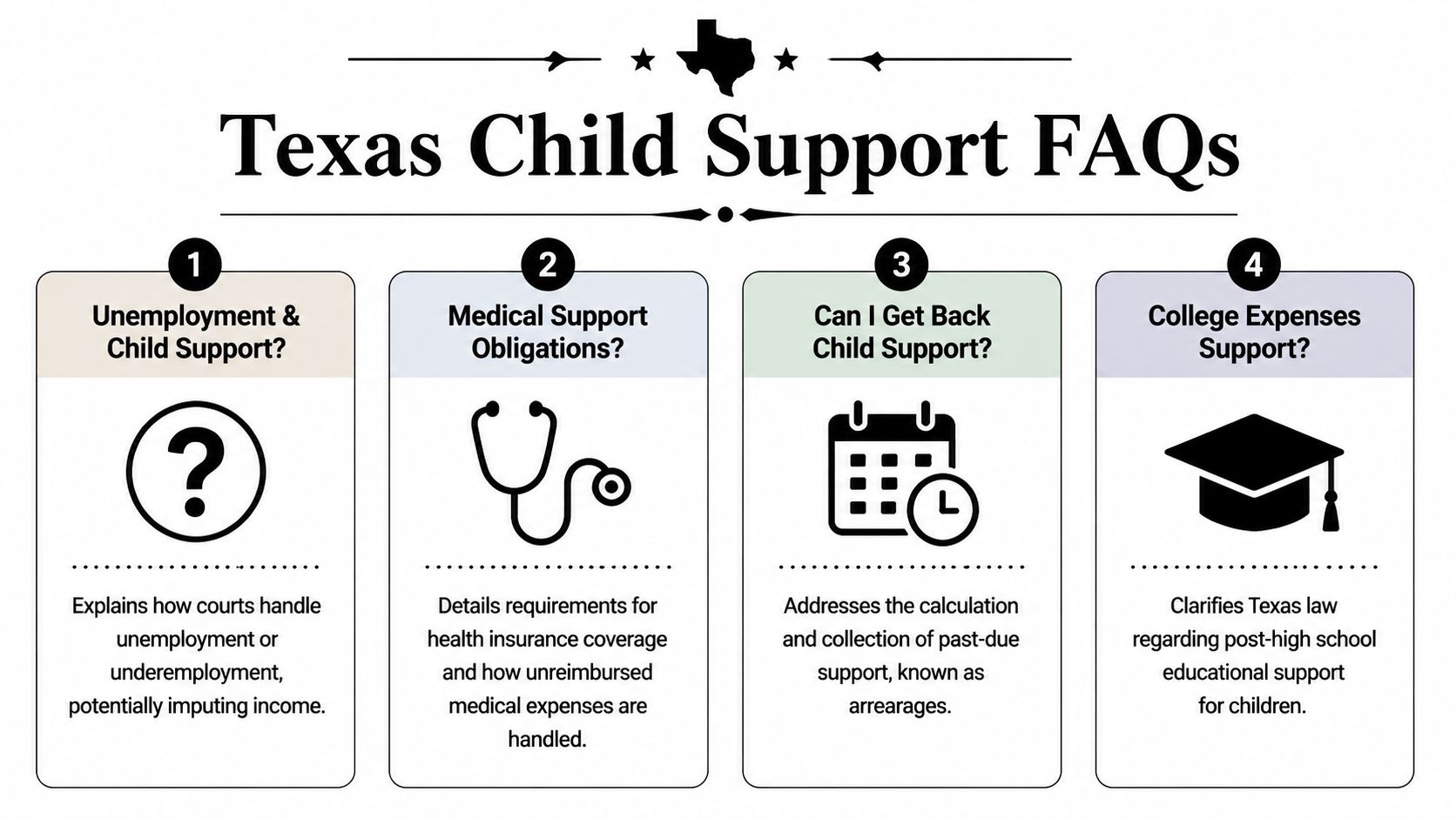
Answering Your Top Texas Child Support Questions
Parents usually don't struggle with the concept of support. They struggle with the parts that don't fit neatly into a calculator. These are the questions that change settlement bargaining power and hearing strategy.
Can a Texas court order retroactive child support
Yes. Courts can order retroactive child support in the right case. The key issues are usually whether the parent knew about the child, whether support was provided informally, what the financial circumstances were during the relevant period, and whether the evidence is organized enough to let the court make a clean ruling.
Retroactive claims are proof-heavy. If you're seeking back support, gather payment histories, messages discussing support, records of child expenses, and any evidence showing the other parent knew of the obligation and failed to pay.
Retroactive support cases are won by reconstructing the financial history carefully. General complaints about the past aren't enough.
Who pays health and dental insurance
Medical support and dental support are usually addressed in the same order that sets child support. Courts want a clear assignment of responsibility so there isn't a recurring fight every time a premium is due or an unreimbursed bill arrives.
That issue also affects the support calculation because health insurance costs for the obligor's children are part of the deductions used to reach net resources under the guideline framework discussed earlier. In practical terms, you should bring the insurance card, premium information, and employer benefit records to court.
Can parents agree to a different amount than the guidelines
Sometimes, yes. But the court does not rubber-stamp whatever the parents prefer. Under Texas Family Code §154.123, the court can consider whether a deviation from guidelines is appropriate, and judges still focus on whether the proposed order serves the child's interests and whether the number is grounded in credible facts.
Agreements tend to hold up better when they answer the practical questions clearly:
- How will regular support be paid
- Who carries medical and dental coverage
- How unreimbursed expenses will be shared
- What happens if income changes later
A vague agreement causes trouble. A precise agreement with evidence behind it has a much better chance.
What is the maximum guideline amount now
For cases governed by the updated cap, the answer changed significantly. Effective September 1, 2025, Texas raised the monthly net resource cap from $9,200 to $11,700. Under that cap, the maximum guideline support is $2,340 per month for one child and $2,925 per month for two children, as explained in this summary of the September 1, 2025 cap increase.
That doesn't mean every high-income case ends at the capped guideline number. In some cases, support above the cap is possible if the child has proven needs and the evidence supports a higher award. But the cap changes the baseline, and that affects negotiation, litigation posture, and modification analysis.
Does college change the support obligation automatically
Parents ask this often. The answer depends on the order and the facts. Texas courts focus first on the statutory support obligation and the controlling order language. If a parent wants college-related contributions addressed, that needs to be raised carefully and supported by the legal framework that applies to the case rather than assumed as automatic child support.
The larger practical point is this: support cases don't turn on internet myths. They turn on statutes, records, credibility, and careful courtroom presentation. If you're dealing with disputed income, arrears, retroactive support, a shared-possession case, or a high-income support fight, strategy matters as much as arithmetic.
If you need a case-specific plan, the attorneys at Texas Child Support Law Office of Bryan Fagan handle establishing, modifying, enforcing, and defending child support orders across Texas. A focused consultation can help you identify the controlling Family Code issues, organize the proof the court will consider, and decide whether to negotiate, file, or set the case for hearing.