Your child's 18th birthday is coming up, and you're trying to plan. One parent assumes support ends that day. The other parent assumes payments keep going until a judge says otherwise. Both can be wrong in Texas.
That misunderstanding causes real problems. I've seen parents stop paying too early because they thought adulthood alone ended the order. I've also seen parents keep paying through wage withholding long after eligibility ended because nobody filed the paperwork to stop it. When people talk about child support after 18 in Texas, they usually mean one simple question. In practice, it's several different legal questions: when the duty ends, when it can continue, how to calculate it, and what has to be filed to make the order match reality.
Texas law gives you a general rule, but it also creates narrow exceptions with strict proof requirements. The most common extension involves a child who is still in high school. The most important long-term extension involves an adult child with a disability that began before age 18 and requires substantial care or supervision. Arrears are a separate issue entirely. They don't disappear just because the child became an adult.
If you're preparing for court, or trying to avoid court by handling this correctly the first time, the strategy matters as much as the rule. Dates, attendance records, medical evidence, wage withholding forms, and the exact relief requested all matter.
The Myth of Child Support Ending at 18
A lot of parents treat the 18th birthday like a switch. Midnight hits, the child becomes an adult, and support ends. That's the myth.
The answer depends on the order, the child's school status, whether a disability qualifies under the Texas Family Code, and whether anyone has filed the right motion. If you act on assumptions instead of the court file, you can create arrears, overpay through withholding, or miss your chance to ask for extended support.
A common Texas scenario
A father calls because his son turned 18 last week. He wants to stop the deduction from his paycheck immediately. He's frustrated that support is still coming out.
The first question isn't “How old is your child?” The first question is whether the child is still enrolled in high school and whether the current order or withholding has been formally addressed. The second question is whether there are any arrears. The third is whether there's a disability issue that needs to be raised before the case drifts.
Practical rule: In Texas, the legal end of support and the practical end of payroll withholding often happen on different timelines.
Why parents get trapped
Parents usually fall into one of two mistakes:
- Stopping informally: A parent decides support “should be over” and stops paying without a court order or without checking the child's enrollment status.
- Waiting too long: A parent who needs an extension for high school or disability assumes the court will continue support automatically.
- Ignoring the withholding order: Even when current support should end, wage withholding may continue until a signed order is sent to the employer and the State Disbursement Unit.
- Confusing current support with old debt: Past-due support stays collectible even after the child is an adult.
That's why child support after 18 in Texas has to be handled as a procedural issue, not just a calendar issue. The parent who wins these disputes usually isn't the one with the strongest feelings. It's the one with the cleaner filing, the better records, and the right evidence lined up before the hearing.
The General Rule and the High School Exception
A parent calls in May because the child turned 18 weeks ago, but support is still being withheld. The answer usually depends on one question first: is the child still in high school and meeting the attendance rules?
Texas generally ends current child support at the later of two events: the child's 18th birthday or high school graduation. In practice, that means an April birthday does not end support if graduation is in June. It also means an early graduate usually remains covered until turning 18.

How the high school exception actually works
The exception is narrower than many parents expect. Past age 18, support continues only if the child is enrolled full-time in an accredited secondary school program working toward a diploma and satisfies minimum attendance requirements, as noted earlier in the article's statutory discussion.
The court will not extend support because a child plans to finish school, is close to graduating, or has had an irregular school history. Judges look for present enrollment and actual attendance. Those details decide the issue.
There is also a stopping point. If the child remains in high school after turning 18, support can continue only until graduation or age 19, whichever happens first. If the facts suggest the actual issue is a disability rather than an ordinary delayed graduation, the parent should look at Texas rules on child support for disabled adult children and raise that issue directly instead of trying to force it into the high school exception.
A simple timeline helps:
| Event | Usual result |
|---|---|
| Child turns 18 before graduation | Current support may continue while full-time enrollment and attendance continue |
| Child graduates before turning 18 | Current support usually continues until age 18 |
| Child is still in school after 18 | Support can continue, but not past graduation or age 19 |
| Child stops meeting attendance rules | A parent may have grounds to seek termination of current support |
What to file and what to bring
Parents lose these hearings by treating them like a paperwork formality. They are evidence hearings.
If support should continue under the high school exception, file a motion that asks for that relief clearly and attach records that show the child qualifies now, not six months ago. Good exhibits usually include:
- current enrollment verification from the school
- attendance records
- a recent transcript or counselor letter showing the expected graduation date
- the existing support order and withholding order
- any communication from the school about schedule changes, withdrawals, or credit recovery
If you are the paying parent and you believe the exception no longer applies, gather the same kind of proof from the other direction. Look for withdrawal records, attendance failures, or confirmation that the child is no longer in a qualifying program. A judge is far more likely to act on certified school records than on a parent's testimony that the child is "basically done."
One more point matters here. The legal rule and the payroll reality often split apart. Even when current support should end, income withholding may continue until someone gets the right order signed and delivered to the right places. That termination step belongs on your checklist as soon as the dates and school records are clear.
Extending Support for a Disabled Adult Child
A common fact pattern looks like this: support is about to end, the child is turning 18, and one parent assumes the court will keep support in place because the disability is obvious. That assumption causes expensive mistakes. In Texas, support for a disabled adult child can continue past 18, but only if someone asks for that relief and proves the statutory requirements.
Texas Family Code §154.302 permits post-18 support if the child has a physical or mental disability that began before age 18 and the child needs substantial care and personal supervision because of that condition. In practice, courts focus less on labels and more on function. A diagnosis by itself is rarely enough. The judge wants to see how the condition limits independent living, employment, daily safety, and routine decision-making.

What the court is actually deciding
These cases turn on three questions.
- Did the disability begin before the child turned 18?
- Does the child currently require substantial care or personal supervision?
- What amount of support is fair in light of the child's needs, the care already being provided, and each parent's finances?
Parents often mix this claim with the high school exception. Keep them separate. The high school rule and the disability rule rely on different facts, different proof, and often different timelines. If your pleading blends the two, you make the judge work harder to understand your request, and that usually hurts the side asking for relief.
The evidence package that usually wins
These are evidence-heavy hearings. A parent who shows up with only heartfelt testimony usually loses ground, even when the child plainly has serious limitations.
The strongest cases usually include:
- medical records showing diagnosis history and treatment over time
- physician or specialist letters addressing functional limitations, supervision needs, and expected duration
- records tying onset to a period before age 18, including pediatric records, school evaluations, or older therapy notes
- school records reflecting special education services, accommodations, or transition planning
- affidavits or testimony from the parent, caregiver, teacher, caseworker, or therapist describing day-to-day supervision
- proof of expenses such as therapy, medication, equipment, transportation, attendant care, and insurance costs
- financial records from both parents
Chronology matters more than many parents expect. If the child has clear current limitations but the file does not show onset before age 18, the case becomes much harder. Courts can be sympathetic and still deny the request.
What weak proof looks like
A few things come up over and over in failed cases. One is a short doctor letter that confirms a diagnosis but says nothing about when the condition began or why the child needs substantial supervision. Another is vague testimony that the child "cannot live alone" without examples of what occurs if no one supervises medications, transportation, hygiene, meals, money, or appointments.
Judges also notice when expense claims are inflated or poorly documented. A simple monthly budget with receipts, invoices, and insurance statements carries more weight than a round-number estimate scribbled on a legal pad.
How to file the case the right way
File before current support ends if possible. That gives the court a cleaner record and reduces the risk of a gap in enforceable current support.
The motion or petition should do four things clearly:
- identify the statutory basis for post-18 disability support
- state facts showing onset before 18
- describe the child's present supervision and care needs in concrete terms
- request the specific relief you want, including support, medical support if appropriate, and continuation or modification of withholding if that issue is in play
Attach what you can. Bring the rest in admissible form for the hearing. If key medical records are missing, get them early. If a treating provider will not appear voluntarily, consider subpoena timing well before the hearing date. If the other parent is likely to argue that the child can work or live independently, be ready with testimony that addresses actual functioning, not general optimism.
For a practical backgrounder on these claims, see child support for disabled adult children. Use it as a starting point, not a substitute for evidence.
Strategy for the parent paying support
The paying parent still needs a real defense, not just disagreement. If the disability is established, the more productive fight is often over scope and amount. Look closely at whether the claimed expenses are disability-related, whether other benefits offset part of the need, and whether one parent is asking the court to fund costs that are not tied to supervision or care. That approach is usually more credible than denying obvious limitations.
The reverse is also true. If support should continue and the paying parent keeps treating the case as optional, the court can enter an order that outlasts the assumptions that caused the problem in the first place.
Calculating Support for an Adult Child
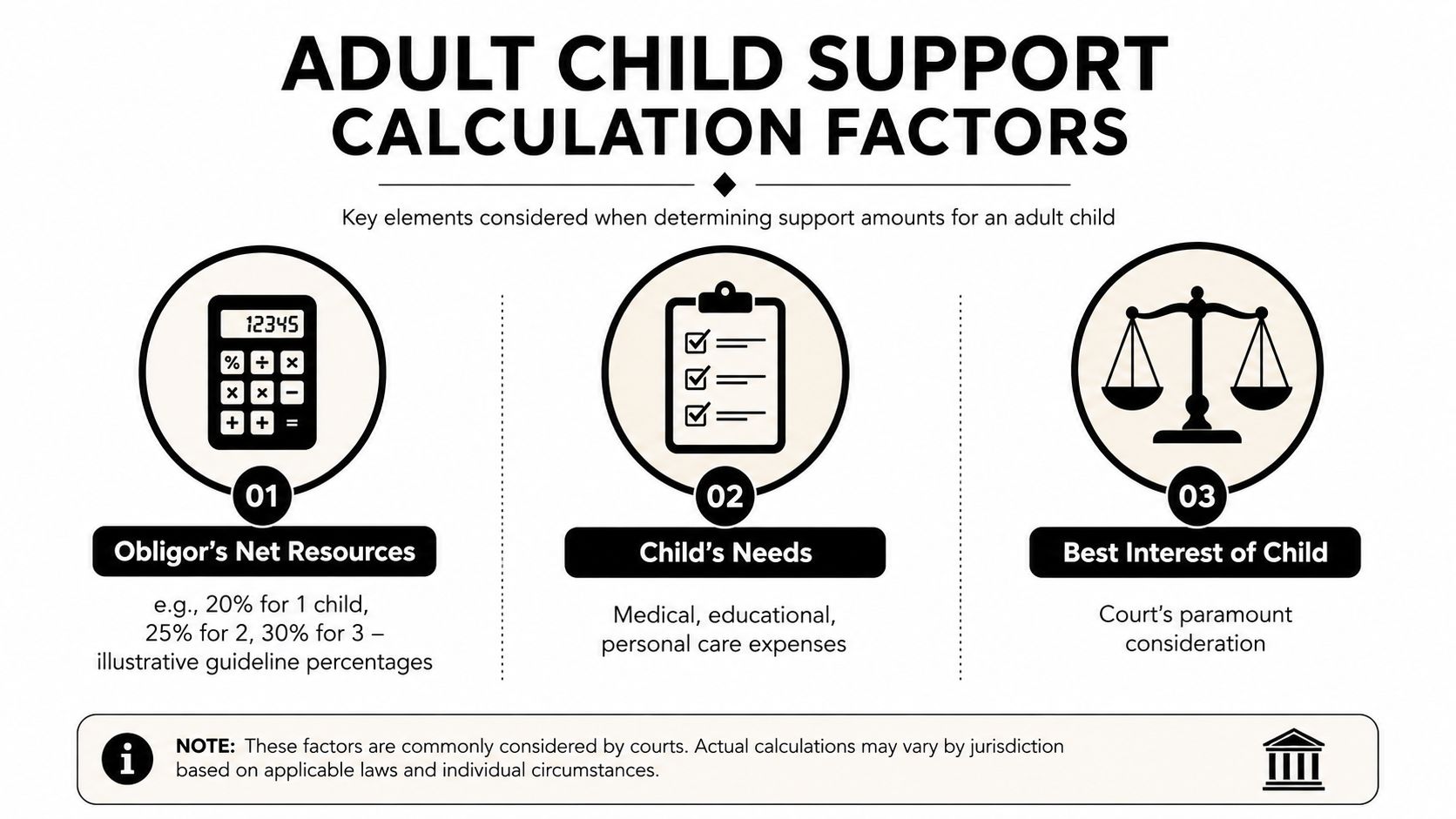
Once a court decides post-18 support can continue, the primary dispute usually becomes amount. Parents often assume the disability finding answers that question. It does not. The court still has to decide what the obligor can pay, what the adult child needs, and whether guideline support fits the facts of this case.
Texas still starts with net resources and the guideline structure. Adult-child cases often break from a standard minor-child calculation because the court may need evidence of ongoing care costs, public benefits, and limits on the child's ability to live independently.
Start with net resources and the guideline cap
Texas Family Code §154.062 sets out how courts calculate net resources. The court begins with gross income, then subtracts items the statute allows, such as Social Security taxes, federal income tax within the statutory framework, union dues, and the cost of the child's health insurance premium. If you need a practical refresher on the math, see this guide on how to calculate child support in Texas.
For higher-income cases, the guideline percentage does not automatically apply to every dollar earned. The court applies the percentage to net resources up to the statutory cap. If the parent seeking support wants more than the presumptive amount, that parent needs proof of additional needs tied to the adult child.
That proof matters. Judges usually want to see numbers that can be tested, not broad statements that care is expensive.
Building the amount in a disabled adult-child case
In a routine case involving a younger child, guideline support may do most of the work. In an adult disability case, I usually want a month-by-month care picture. The cleaner the record, the better the chance the court sets an amount that reflects reality instead of guesswork.
A useful presentation often breaks expenses into categories like these:
- Medical care: doctor visits, therapy, prescriptions, medical equipment, and recurring treatment
- Personal care and supervision: attendant care, transportation, respite, in-home help, and safety monitoring
- Housing-related costs: added expenses tied to the child's condition, if supported by the facts
- Education or vocational support: programs connected to the child's functioning or level of independence
- Uncovered insurance costs: premiums, copays, deductibles, and condition-related expenses not paid elsewhere
The court can also weigh whether another source already covers part of the need. Medicaid, Medicare, trust distributions, or other public benefits do not automatically end a support claim, but they can affect the amount. Good lawyering here is not just asking for more. It is separating true out-of-pocket need from costs already covered by another program.
When courts move above guideline support
Texas courts can depart from guideline support when the evidence supports it. In adult-child cases, the common reason is simple. The child's proven needs exceed what the guideline amount would cover.
That is usually where one side wins or loses the case.
A parent asking for above-guideline support should bring a documented care budget, recent invoices, benefit statements, pharmacy records, insurance explanations of benefits, and testimony from the parent or caregiver who handles day-to-day care. A parent resisting an inflated request should test each line item. Is it recurring or occasional? Is it disability-related or a general household expense? Is it already being paid by a third party? That is the level of detail that tends to move the court.
Modification standards still matter
An order for an adult disabled child is not immune from later review. If the child's condition changes, care costs rise, benefits begin or stop, or a parent's resources shift in a meaningful way, either side may have grounds to seek modification.
Income classification also matters. Some sources are excluded from child support calculations under Texas law, and that issue comes up often in disability cases. Before filing, get the income documents, benefit letters, and payment history together. The amount of support usually turns on documents first, argument second.
A practical rule applies here. If you want the judge to use a number, be prepared to show where it came from, why it is recurring, and why it is tied to this adult child's actual needs.
The Legal Process for Extending or Terminating Support
Most mistakes in post-18 cases happen after a parent learns the rule but before anyone files anything. Texas courts don't fix these cases for you. You have to put the issue in front of the court that issued the order, ask for the right relief, and prove the right facts.
The process differs slightly depending on whether you're trying to extend support, modify the amount, or stop withholding. The structure is similar in each situation.

The core steps
File in the correct court
File your petition or motion in the court that signed the existing child support order. If you are seeking an extension based on disability, say that clearly. If you are seeking termination of current support or withholding, ask for that specific relief.Serve the other parent
Proper service matters. If the other side isn't served correctly, your hearing can get delayed or your order can become vulnerable later.Prepare for evidence, not just argument
A high school extension needs enrollment and attendance proof. A disability extension needs medical and care evidence. A termination request needs proof the qualifying event occurred and that current support should stop.Get a signed order and distribute it
If withholding is involved, the signed order must get to the employer and the State Disbursement Unit. Without that step, payroll deductions may continue.
This overview is reflected in the Office's resource on a motion to modify child support in Texas, which addresses the modification process generally.
A short video can help some parents visualize the process before they file.
The step obligors miss most often
The biggest procedural trap is wage withholding. In Texas, child support obligations do not automatically terminate for withholding purposes. The obligor must file a formal Motion to Terminate Withholding for Child Support, and withholding continues until a signed judicial order is provided to the employer and the State Disbursement Unit, according to this explanation of terminating child support withholding in Texas.
That means the parent paying support can be legally right about eligibility ending and still keep paying if the paperwork isn't completed.
A termination case usually needs these documents:
- Proof of the trigger: graduation records, age-related proof, or other event supporting termination of current support.
- Current payment record: especially if there's any question about arrears.
- Proposed order: many courts expect a usable order, not just a request.
- Employer information: if withholding must be updated quickly.
What works and what wastes time
What works is precision. Ask for current support to end, specify whether withholding should end, and address arrears separately. If there's any possibility of unpaid balances, don't assume the court will infer what you mean.
What wastes time is filing a vague “modification” without saying whether you want termination, extension, a change in amount, or all three. Judges see too many motions that identify the problem but not the remedy.
A parent can also file a petition to terminate or modify with the issuing court, and failure to do so can leave support and interest issues unresolved, as discussed in this Texas termination overview. In some cases, parents hire private counsel for that process. The Texas Child Support Law Office of Bryan Fagan is one firm that handles establishment, modification, enforcement, and defense of child support matters under the Texas Family Code.
Enforcing Arrears and Medical Support After 18
A parent often learns about this problem after the child has already turned 18. Current support stops, everyone assumes the case is over, and then an unpaid balance surfaces through the Attorney General's records, a credit report, or an old reimbursement claim for health insurance and uninsured expenses. Age does not wipe out that debt.
Unpaid child support remains enforceable until it is paid, along with any interest that accrued under the order. The same practical rule applies to medical support. If one parent was ordered to provide insurance, pay premiums, or reimburse out-of-pocket medical costs, those obligations can still be enforced after the child becomes an adult. The court treats those items as part of the support case, not as informal family debts.
The mistake I see most is assuming the judge will sort out a messy file. Enforcement cases are document cases. If you want a court to confirm arrears, enter a money judgment, or order compliance on medical support, tie every dollar to the language of the order and to a payment history the court can follow.
What to gather before you file
Start with the order itself. Then build the file around four categories of proof:
- Child support payment history: payment ledger, registry record, wage withholding history, and any proof of direct payments
- Medical support records: insurance premium statements, proof of coverage, notices showing a lapse in coverage if insurance was ordered, and employer benefits records if available
- Unreimbursed medical expenses: bills, receipts, explanation of benefits forms, proof you sent the other parent notice, and proof of nonpayment
- Interest and arrears summary: a clear worksheet showing principal, dates due, dates paid if partially paid, and the balance you want confirmed
Details matter here. If the order required notice of uninsured expenses within a certain time, prove that notice was sent. If the other parent paid something directly to a provider, account for it. Judges are far more willing to enforce a clean calculation than a rough estimate.
Child support arrears and medical arrears are related, but they are not the same claim
Keep them separate in your pleadings and in your evidence. Monthly support arrears usually come from the payment record. Medical support disputes often turn on narrower facts, such as whether insurance was maintained, whether reimbursement was requested correctly, and whether the charge falls within the order.
That distinction affects strategy. A parent may have a straightforward arrears claim for unpaid monthly support but a weaker claim for medical reimbursement because the receipts were never sent as required. On the other side, an obligor may concede the payment record but still contest a stack of medical charges that were never documented properly.
What an enforcement filing should ask the court to do
A good enforcement motion is specific. It should identify the missed payments or medical obligations, list the dates and amounts, and request the exact relief sought. Depending on the facts, that may include confirmation of arrears, judgment for unpaid medical support, interest, attorney's fees if allowed, and orders to bring payments current.
Vague requests cause delay. So does filing a motion that says support is “owed” without attaching a clear summary. If the child is already 18, the court is not deciding whether current support should continue. The court is deciding what remains unpaid under existing orders and what remedy fits that record.
If you are owed support or medical reimbursement, act like you are preparing an accounting file for court, not a folder of family paperwork.
That approach saves hearings and reduces avoidable fights over math.
Practical problems that come up after 18
Collection gets harder with time. Employers change. Insurance records disappear. Parents lose access to old portals and explanation of benefits statements. A delay also gives the other side more room to argue about missing credits, late notice, or incomplete proof.
For obligors, the risk runs the other way. A parent may believe all support ended at 18, keep paying through wage withholding without checking the balance, and later find out current support should have stopped while arrears remained collectible. That is why payment records and withholding records need to be reviewed together, not separately.
If there is a real arrears dispute, get the ledger, compare it to the order, separate current support from past-due support, and do the same for medical obligations. That is how these cases are won.
Frequently Asked Questions About Post-18 Support
A lot of post-18 disputes start the same way. One parent assumes support ended automatically. The other assumes it continues because the child still lives at home, is still in school, or has medical needs. The order controls until it is changed, clarified, or the withholding is properly stopped.
Can parents agree privately to keep paying support after 18 without going to court
Yes, but a private agreement and a court order are not the same thing.
Parents can agree that one of them will keep helping with rent, food, tuition, or insurance after the legal duty to pay child support ends. That may work fine while both sides cooperate. The problem shows up later, usually when payments stop or one parent wants to enforce the deal like a support order. If the agreement was never put into a signed order, enforcement gets much harder.
The practical step is simple. Put the agreement in writing, define the amount, due date, duration, and what ends the obligation, then ask the court to approve it if you want court-level enforceability.
Does child support continue if my child goes to college and lives at home
Usually no.
Texas does not extend regular child support just because a child enrolls in college, stays in the family home, or remains financially dependent in the everyday sense. Parents can agree to college support. A court usually cannot impose standard post-18 support on that basis alone.
That distinction matters in consultations. Parents often bring proof of tuition and housing costs, expecting those facts by themselves to continue support. The better first step is to review the order and ask whether there is a disability issue, an unpaid balance, or only a voluntary college-support discussion.
If my adult disabled child receives SSI, does that affect support
It can, but not in the simple way many parents expect.
SSI is not treated as income for ordinary child support calculations. If a parent's only income is SSI, that usually changes the support analysis in a major way. The harder question is how the child's benefits, the child's actual care needs, and each parent's available resources fit together under the evidence.
Bring more than a diagnosis. For a disability-based extension, courts usually need medical records, physician opinions, school or program records if relevant, and proof showing the condition existed before the child turned 18 and requires substantial ongoing care or supervision.
Can support be reinstated if my child drops out and later goes back to school
Do not assume the answer is yes.
The high school exception is narrow, and timing matters. If there is a dropout, re-enrollment, delayed graduation, or alternative program, get the attendance records, enrollment dates, and expected graduation documents before anyone makes a legal decision. These cases often turn on the exact sequence of events, not a general impression that the child was "still in school."
A parent who waits too long usually creates avoidable proof problems.
What should I gather before seeing a lawyer or going to court
Bring the order first. Then bring the records that match the issue you are asking the court to decide.
For a termination question, bring the current support order, any income withholding order, recent paystubs showing deductions, and a payment ledger.
For a high-school dispute, bring enrollment records, attendance records, withdrawal paperwork, transcripts, and the graduation date.
For a disability extension, bring medical records, diagnoses, treatment history, prescriptions, therapy records, school accommodation records if they exist, and a short timeline showing when the condition began and how it limits independent functioning.
For arrears or medical support, bring payment histories, reimbursement requests, receipts, explanation of benefits statements, and any written notice you sent or received.
If you need help with child support after 18 in Texas, Texas Child Support Law Office of Bryan Fagan handles establishment, modification, enforcement, arrears, medical support, and termination issues under the Texas Family Code. A focused review of the current order, the child's status, and the payment record usually shows what should be filed next.