You file your tax return, count on the refund to catch up on rent, fix a car, or cover school clothes, and then the money never lands in your account. In Texas child support cases, that shock usually means one thing. The Office of the Attorney General reported your arrears for federal offset, and the Treasury intercepted the refund before you ever touched it.
If you're the parent owed support, the frustration looks different. You know the other parent got a refund. You know they owe back support. But the payment that reaches your case is smaller than expected, delayed, or sent somewhere else first. That usually comes down to a detail many lawyers gloss over: assigned arrears come before unassigned arrears.
That priority rule drives who gets the intercepted money. If you don't understand it, you can walk into court, mediation, or an OAG review with the wrong strategy.
Why Tax Refund Interception Matters for Texas Parents
You expect a refund to solve a short-term problem. Then the Treasury takes it for child support arrears, and a new challenge arises. In Texas, that intercept can change rent money, settlement strategy, and even who receives the payment on the case.
The point many parents miss is not the intercept itself. It is the arrears classification behind it. If the case includes assigned arrears, the state can be paid before the parent who is owed support receives anything. If the case involves unassigned arrears, the family is first in line for that portion. That priority order decides where intercepted money goes, and it explains why a refund can be taken in full but only part of it reaches the household expecting it.
The surprise usually hits both sides
For the parent who owes support, the common mistake is assuming a late payment or informal deal will stop the offset once the case has been certified. That is a bad assumption. Once the federal process is in motion, the refund is often gone before the parent realizes the case was queued for intercept.
For the parent owed support, the common mistake is expecting the intercepted refund to flow straight through to them. That does not always happen. If public assistance created assigned arrears, the state may apply the refund there first. If only part of the debt is unassigned, only that part may reach the family after the higher-priority amount is satisfied.
That is why parents need to ask the right question first. Not “Was the refund intercepted?” Ask, “How much of the arrears is assigned, and how much is unassigned?”
Practical rule: Before you argue about missing refund money, confirm the arrears breakdown, confirm whether any debt is assigned to the state, and confirm the case is set up for federal tax refund offset collection.
The stakes are bigger than one refund
Texas uses refund interception because arrears are large, persistent, and expensive to ignore. As of April 2025, Texas parents collectively owed about $19 billion in unpaid child support, according to Texas child support statistics discussed here. The same source notes that arrears can accrue interest, which makes an old balance harder to fix and gives the state more reason to keep collecting through every available enforcement tool.
A refund intercept also creates pressure on negotiations. A parent who owes support may finally be ready to settle, but the assigned portion limits flexibility because that money is not treated the same way as unassigned arrears owed directly to the other parent. If you ignore that hierarchy, you can waste time proposing terms the state will not honor.
A court order still controls the bigger picture
A tax refund intercept collects past-due support. It does not change the support order that created the debt. If the monthly amount is wrong, the fix is still a modification case under the Texas Family Code.
Guideline support remains tied to net resources under Texas Family Code §154.125, and courts may depart from guideline support based on the factors in §154.123. After September 1, 2025, the monthly net resource cap under §154.125 rose from $9,200 to $11,700, which means one child at the cap reaches $2,340 per month. But an older order does not update itself. Until a new order is signed, arrears continue to build under the existing one, and intercepted refunds will be applied against that existing debt under the assigned-versus-unassigned priority rules.
Understanding Tax Refund Interception Basics
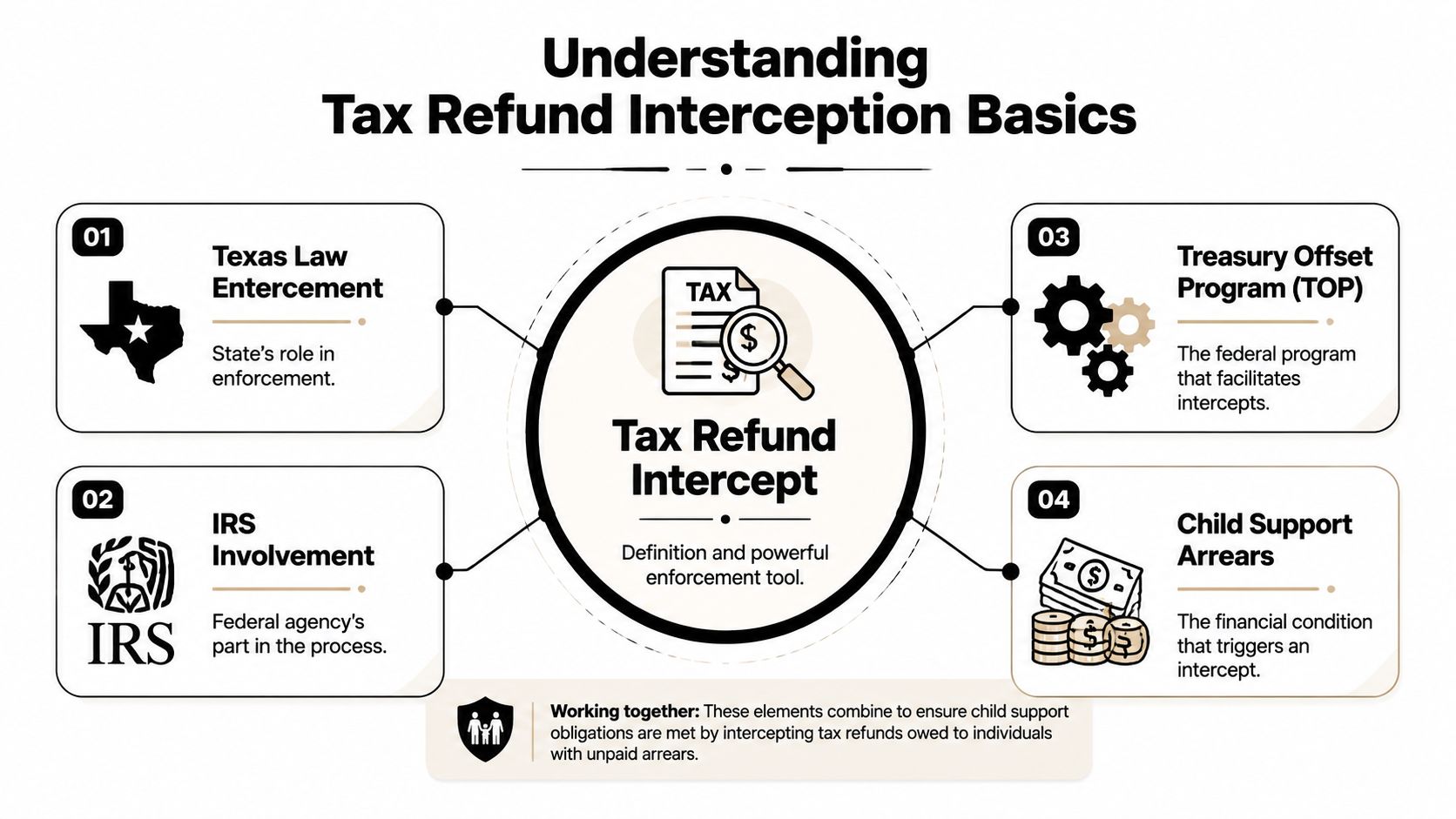
Your refund is scheduled, you already have plans for it, and then the money never hits your account. The Treasury sends it to child support instead. That is what a child support tax refund intercept in Texas does. Texas reports qualifying arrears for federal offset, the federal system matches that debt to your refund, and the refund is redirected before you touch it.
It is automatic once your case is certified. You do not get a last-minute chance to spend the refund first and argue later.
What triggers the intercept
The trigger is past-due support that qualifies for federal offset. The intercept targets arrears. It does not scoop up support that is not yet delinquent, and it does not rewrite the monthly order. Once the case is submitted through Texas child support enforcement procedures, including tools described in our guide to Texas child support enforcement actions, the refund can be captured through the federal offset system.
Do not treat this as a discretionary collections choice by the Office of the Attorney General. It is a standard enforcement process tied to arrears reporting.
Where parents get burned. Assigned arrears come before unassigned arrears
This is the part parents miss. An intercepted refund does not always go straight to the other parent.
Texas cases can include assigned arrears and unassigned arrears. Assigned arrears are amounts tied to public assistance reimbursement. That portion is owed to the state. Unassigned arrears are amounts still owed directly to the family. If both exist, the payment priority matters. It affects who gets paid first and how much of the refund a parent receives.
That hierarchy changes settlement strategy. If you are the parent owed support, do not assume every intercepted dollar is coming to you. If you are the parent who owes, do not promise the other parent that a refund intercept will wipe out the balance they care about most. The assigned portion can absorb part or all of the refund before unassigned arrears are touched.
Why the original support calculation still matters
Bad numbers at the start often create the arrears that lead to an intercept. This is why understanding the original order matters. As explained in our guide on How Child Support Is Calculated in Texas, guideline support is based on net resources under Texas law. If income was overstated, undercounted, or never updated when circumstances changed, the arrears problem usually gets worse with time.
An intercept collects the debt already on the books. It does not fix a support amount that should have been modified earlier.
Current support and arrears are separate accounts
Texas guideline support under Texas Family Code §154.125 uses a percentage of monthly net resources. Missed payments under that order become arrears. Once that arrears balance is reported for offset, the federal refund can be applied to it.
Keep the two tracks separate in your head. A seized refund reduces arrears. It does not automatically satisfy the next monthly payment, and it does not stop future arrears from building if regular support is still unpaid.
If your refund was intercepted, check the arrears breakdown immediately. You need to know how much was applied to assigned arrears and how much, if any, went to unassigned arrears owed directly to the other parent.
Legal Authorities and Regulatory Framework
Texas child support cases run on two tracks at once. State law creates and enforces the obligation. Federal law supplies the machinery that seizes the refund. If you don't separate those roles, you'll argue with the wrong agency about the wrong issue.
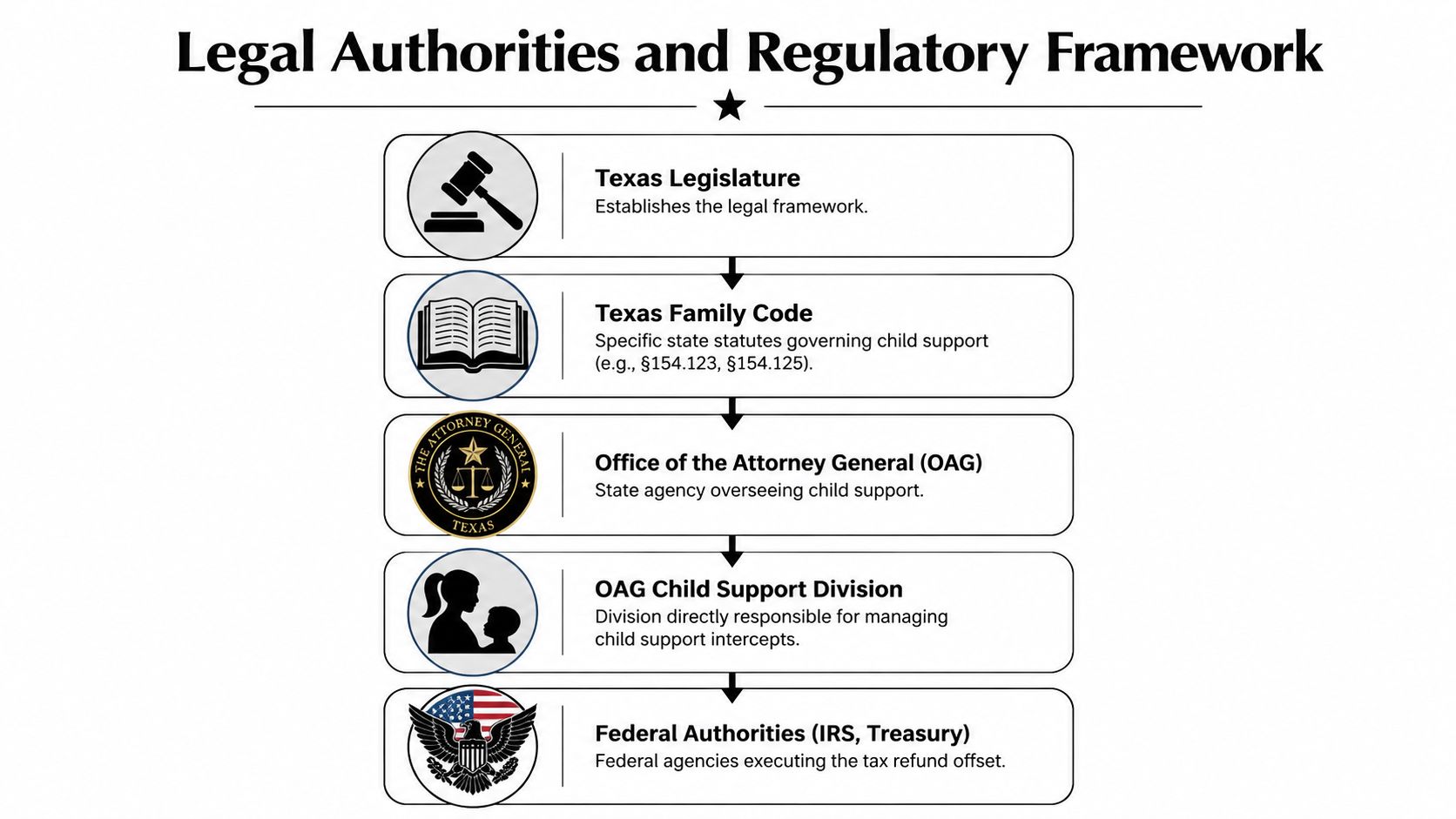
What Texas law controls
The support order itself comes from a court order or an enforceable administrative process. Texas Family Code §154.125 governs guideline support. Texas Family Code §154.123 gives the court room to deviate from guidelines based on case-specific factors. That matters because the size of the support obligation often determines whether arrears develop in the first place.
For a first order, Establishing a Child Support Order in Texas gives the basic framework for how a support order is created through a court or the Attorney General. Once the order exists and the obligor falls behind, enforcement tools under later Family Code chapters come into play.
What the OAG and federal agencies control
The Office of the Attorney General Child Support Division manages reporting and enforcement. The federal government doesn't calculate your Texas support order. It executes the offset after the state submits the debt.
The cleanest summary appears in this Texas refund garnishment article: tax refund interception in Texas operates exclusively through the Treasury Offset Program (TOP), which allows the IRS to seize the entire federal refund unless the non-obligor spouse files IRS Form 8379 ("Injured Spouse Allocation") to protect their share of the overpayment. The OAG reports the debt to TOP, triggering an automatic intercept that the noncustodial parent can challenge only by administrative review.
That last sentence matters. Once reported, this is not a casual customer-service dispute with the IRS. The IRS follows OAG instructions. If the debt record is wrong, you attack the record through review.
Parents dealing with broader collection issues should also understand the range of Texas child support enforcement tools, because refund interception usually appears alongside other pressure points, not in isolation.
Confidentiality limits what can be said in court
Federal tax information has special protection. Under 26 U.S.C. §6103, child support attorneys and agency staff can't freely disclose the IRS source of an offset payment in court. That matters when a parent tries to argue, "Judge, my tax refund already paid my support."
A court may only see the payment classified as an involuntary payment, not hear open testimony from agency staff identifying it as an IRS offset. That can shape credit disputes and modification arguments, especially when a parent is trying to apply intercepted funds against current support instead of arrears.
Courts care about the payment record, the order, and the legal classification of the payment. They don't let parents rewrite those labels because the source feels obvious.
Trigger Events Timeline and Procedural Steps
You file your federal return expecting a refund. Weeks later, the money is gone, and the notice arrives after the fact. That is how Texas parents lose options.
Timing controls this process. It also controls who receives the intercepted money first. If your case includes both assigned and unassigned arrears, the intercept can clear government-reimbursement debt before any family-paid arrears see a dollar. Parents miss that point all the time, and it changes what to do before tax season starts.

The sequence that usually controls
The process usually runs in this order:
- Arrears become eligible for federal intercept. Once child support debt reaches the reporting threshold, the case can be certified for federal tax refund offset. If you need the larger arrears context, review this explanation of back child support in Texas.
- The OAG certifies the debt for offset. That certification puts the case into the federal collection stream.
- Treasury checks for a match. If the IRS processes a return with a refund, the Treasury Offset Program screens it against certified child support debt.
- The refund is taken. Part or all of the federal overpayment is intercepted.
- The money is posted under the arrears rules. Parents often make bad assumptions at this stage. Intercepted funds do not automatically go to the portion of arrears the family wants paid first.
This video gives a useful high-level look at the process and why timing matters.
What parents should do before the intercept hits
Parents owed support should verify that the OAG ledger is accurate, the case is still active for enforcement, and the arrears are classified correctly. The assigned versus unassigned split matters. If public-assistance reimbursement is still sitting ahead of family-owed arrears, the refund may be intercepted without producing the payment the custodial parent expects.
Parents facing interception need to act before filing, not after the refund disappears.
- Before filing taxes: Confirm the arrears balance, ask whether the case has been certified for federal offset, and check how the arrears are classified.
- After a notice arrives: Request administrative review fast if the balance, identity, or case status is wrong.
- If the order no longer fits your income: File a modification case. Enforcement staff cannot rewrite your support amount for you.
- If you filed a joint return: Review whether the non-obligor spouse should submit Form 8379 to protect that spouse's share.
One practical warning. A custodial parent may see a large intercept and assume the family will receive it. That assumption is often wrong if assigned arrears remain unpaid. The order of application matters as much as the amount intercepted.
Modification procedure is separate and mandatory
If the amount in the support order is the problem, fix the order under Texas Family Code §156.401. Do not wait for an intercept dispute to solve an order problem. It will not.
The procedure is straightforward:
- File the petition
- Serve the other parent
- Attend the hearing
- Present proof of the qualifying change
- Get a signed order
Existing orders stay in force until a judge signs a new one. If you know the amount is wrong and keep waiting, the arrears keep growing, and federal intercept stays on the table.
Calculation Methods and Joint Return Impacts
The most misunderstood part of a Texas child support tax refund intercept isn't whether the refund can be taken. It's who gets paid first after it's taken.
The answer is simple. Assigned arrears come first. Unassigned arrears come second. If you owe both, the state gets priority before the family sees the remainder. If the custodial parent doesn't have a full-service OAG case open, the family portion won't be disbursed through this process the way many parents expect, according to the Texas Attorney General's explanation of federal stimulus payments and tax returns.
The allocation rule that changes outcomes
Assigned arrears usually mean debt tied to public assistance reimbursement. Unassigned arrears mean debt owed directly to the custodial household.
That distinction changes strategy in real cases. A custodial parent may believe a refund intercept should satisfy "my back support." But if the obligor also owes assigned arrears, the intercepted funds can be consumed there first.
Here is the basic hierarchy.
| Arrears Type | Priority Treatment |
|---|---|
| Assigned arrears | Applied first from intercepted federal refund |
| Unassigned arrears | Applied only after assigned arrears are satisfied |
A practical example without guesswork
Suppose a parent has multiple child support cases and a federal refund is intercepted. If one case includes assigned arrears owed to the state and another includes unassigned arrears owed directly to a parent, the offset doesn't follow emotion or recent promises. It follows priority.
The state portion is paid first. Only the remainder, if any, moves to family arrears. In multi-case situations, that often explains why the receiving parent sees less than expected or nothing at all from a particular intercept cycle.
The biggest mistake I see is a parent focusing on the total arrears number without asking what kind of arrears make up that number.
Joint returns create a second problem
If the obligor files a joint federal return with a new spouse, the entire refund can be seized unless the non-obligor spouse files IRS Form 8379, the injured spouse allocation form, as described earlier in the legal framework section. That's not a Texas family court form. It's a federal tax protection tool.
My advice is blunt. If you're the non-obligor spouse and you know your husband or wife owes Texas child support arrears, don't wait until the refund vanishes to learn what Form 8379 does. Handle it proactively.
Prevent Disputes with Appeals and Payment Plans
Your refund gets intercepted, and then the fight starts. One parent assumes the money should already be in hand. The other assumes a payment plan will stop the offset. Both are often wrong because the dispute usually turns on records, timing, and arrears classification, especially whether the debt is assigned or unassigned.
That classification matters here as much as it did in the intercept itself. If the balance includes assigned arrears owed to the state, arguing over what the other parent should receive misses the point. The first question is whether the OAG ledger correctly classified the debt and applied the intercepted funds in the right order.
If the balance or classification is wrong, request administrative review fast
An intercepted refund is hard to reverse once the case has been certified for offset. Your strongest move is an administrative review based on a specific record error. Ask for the payment ledger, the arrears breakdown, and the case history showing how the debt was coded.
Do not call with a general complaint. Point to the exact problem.
Use your Texas child support payment history records and compare them against the OAG ledger line by line. Bring prior orders, proof of any authorized direct payments, payment confirmations, and any notice showing the arrears total. If assigned arrears were listed when they should have been unassigned, or if a payment was posted to the wrong case, that error affects who gets paid from the intercept and how much remains collectible.
If the order is outdated, file to modify the order
Modification and intercept review are different tracks. Administrative review deals with whether the debt record is accurate. Modification deals with what support should be from the date of filing forward.
Under Texas Family Code §156.401, a court can modify child support after a material and substantial change or when the statutory standard is met. Guideline support is calculated under §154.125. A court can vary from guideline support under §154.123 when the facts support a different amount. If proven needs exceed the guideline amount, §154.126 can support an award above the cap.
Here is the practical rule. A modification does not erase arrears that already accrued under an existing order. If your refund was intercepted because support built up under the old order, filing to modify now may stop the problem from getting worse, but it will not cancel certified arrears that were already sent for collection.
Payment plans help with future enforcement, not certified offset debt
Payment plans have value. They can reduce new arrears, show compliance, and improve your position in enforcement proceedings under Chapters 157 and 158.
They do not automatically pull back a federal tax refund intercept.
If you owe both assigned and unassigned arrears, a payment plan also will not change the priority of where an intercepted refund goes. The state portion still gets paid first until assigned arrears are satisfied. Parents who ignore that rule end up fighting over money that was never available to the family portion in the first place.
Do not argue in court about the IRS source of the payment
Judges care about credits and allocations. They do not need a speech about where you believe the money came from.
In court, the primary issue is whether the ledger reflects the payment correctly and applies it to the proper obligation. Treat the intercept as an involuntary payment and focus on the accounting. If you want credit, prove the posting. If you want to challenge the posting, prove the classification error, the case error, or the amount error.
If the matter overlaps with enforcement, modification, and arrears review, the Texas Child Support Law Office of Bryan Fagan handles those proceedings under the Texas Family Code.
Practical Checklists and Next Steps for Texas Parents
Most parents don't need more theory. They need a clean next-step list.
If you're the parent owed support
Use this checklist:
- Confirm the case status: Make sure you have a full-service OAG case open if you expect to receive any family portion of an intercepted refund.
- Review the arrears type: Ask whether the case includes assigned arrears, unassigned arrears, or both.
- Pull the payment ledger: Use your Texas child support payment history records to compare what the system shows against what you expected.
- Keep your orders organized: Save the current order, any modification orders, and any enforcement orders in one file.
- Move if support is outdated: If the monthly amount no longer fits the facts, file for modification instead of waiting for arrears to keep building.
If you're the parent facing interception
Your checklist is different:
- Check the arrears balance early: Don't wait until tax season to learn you're exposed.
- Request administrative review if needed: Do this when the record is wrong, not when you're unhappy with collection.
- File Form 8379 if a joint return is involved: Protect the non-obligor spouse's share.
- File to modify under §156.401 if circumstances changed: Job changes, income shifts, and cap issues don't fix themselves.
- Bring proof to court: Pay stubs, tax records, health insurance costs, childcare records, and prior payment evidence all matter.
What I recommend in hard cases
If your dispute involves assigned arrears, multiple households, old payment records, or a high-income support calculation, don't handle it casually. The legal issues overlap. §154.123 deviation arguments, §154.125 guideline calculations, §154.126 proven-needs disputes, and §156.401 modification standards can all collide in one hearing.
Parents lose these cases when they show up with opinions instead of records.
Bring the order, the ledger, the proof of service, the tax filing facts, and the exact relief you're asking for. Texas courts reward preparation.
A final point. Intercept cases feel personal because they usually hit at the worst time. But the winning approach is procedural. Identify whether the problem is priority, accounting, or the underlying order. Then attack that specific issue directly.
If you're dealing with a child support tax refund intercept in Texas and need a clear strategy on arrears priority, modification, or enforcement, contact Texas Child Support Law Office of Bryan Fagan. The firm works with Texas parents on establishing, modifying, enforcing, and defending child support orders under the Texas Family Code, including cases involving high-income calculations, arrears disputes, and payment record issues.