Texas child support is built on a percentage-of-income formula under Texas Family Code Chapter 154, and daycare is not automatically added on top. In a Texas case, daycare has to be argued as a necessary, work-related expense that can support a deviation under §154.123.
That's the practical fight most parents walk into court with. One side shows invoices and says the bill is real, the other side says the guideline amount already covers everything, and the judge has to decide whether daycare belongs inside the support structure or whether it's just another cost the receiving parent should absorb.
If you're dealing with child support daycare expenses texas, stop thinking in generic terms like “fair split.” Texas judges care about net resources, need, work-related necessity, and whether the evidence proves daycare is part of the child's actual support needs. The parent who walks in with clean records usually controls the outcome.
Why Daycare Changes the Child Support Conversation in Texas
A Texas parent rarely shows up asking for “daycare” in the abstract. They show up because work hours, school schedules, and custody exchanges don't line up neatly, and a childcare bill keeps arriving every month whether the order mentions it or not. That's when the dispute starts, because child support in Texas is not built as a receipt-by-receipt reimbursement system.
Texas uses an income-percentage model, not a cost-itemization model. The Office of the Attorney General's guideline calculator reflects that structure, with support tied to monthly net resources up to the current $11,700 cap effective September 1, 2025. The percentages are fixed, but daycare is not built into that fixed number as a separate line item. That's why the parent who wants daycare included has to prove more than inconvenience.

Practical rule: if the daycare expense is tied to work or school, present it as a child-support issue, not a side argument about parenting style.
The numbers show why the fight matters. Child Care Aware's Texas price sheet lists annual center-based care at $11,024 for an infant, $10,608 for a toddler, and about $24,000 for two children in center-based care, with a separate family child care figure of $9,724 for an infant. A Texas-focused 2025 report summarized by Axios said the average annual cost for one infant and one toddler is about $21,600, roughly 27% of Texas median household income. Those figures explain why daycare is often one of the largest non-housing expenses in a Texas household. Texas price sheet
The strategic point is simple. Daycare is leverage, not a default add-on. If you frame it correctly, it can push a court toward a higher order or a separate allocation. If you frame it badly, the judge may treat it as ordinary household overhead.
The Statutory Framework Behind Texas Child Support
Texas child support lives inside §154.125 and §154.123 of the Texas Family Code. Section 154.125 supplies the guideline percentages, and §154.123 gives the court room to deviate when the facts justify it. That's the legal structure you have to use, not the structure you wish existed.
The guideline percentages apply to the obligor's monthly net resources, and current Texas guidance caps those resources at $11,700 per month. Under that cap, the standard percentages are 20% for one child, 25% for two, 30% for three, 35% for four, and 40% for five or more. The Attorney General's calculator and TexasLawHelp both reflect that cap and those percentages. Texas child support calculator
What the guideline does and does not do
The guideline formula answers one question, how much support should be paid from net resources. It does not automatically price out daycare, and it does not assume every child has the same care arrangement. That matters because a parent can earn enough to hit the guideline cap and still face serious childcare costs that the formula doesn't fully absorb.
TexasLawHelp also explains that judges can order additional support based on the child's needs. That is where daycare enters the fight. If daycare is necessary for work or school, it belongs in the court's needs analysis, not as a casual extra expense. TexasLawHelp child support guidance
The judge is not looking for sympathy. The judge is looking for a statutory reason to move off the guideline number.
The practical consequence is this. A parent who brings in proof of actual childcare expenses can argue that §154.123 justifies a deviation, especially when the daycare cost is recurring, work-linked, and reasonable for the child's age. The issue is not whether the bill exists. The issue is whether the bill is legally connected to the child's support needs.
For a broader statutory overview, Texas parents often start with the Texas Family Code child support materials at Texas Family Code child support resources. The point of the statute is not to flatten every family into the same number. It's to give the court a base amount, then let the evidence adjust that base when the child's actual needs demand it.
When Daycare Triggers a Deviation Under Section 154.123
A daycare invoice by itself does not win a deviation. A court needs the full story, and the full story is usually work, school, childcare necessity, and a bill that's being paid every week or month because someone has to care for the child while the parent works. That's the lane where §154.123 matters.
What judges respond to
Courts respond to documents, not arguments in the air. Bring the enrollment contract, payment history, receipts, and proof of the parent's work schedule or school attendance. If the daycare cost is reasonable for the area and tied to a real work need, it becomes much easier to argue that the guideline amount alone doesn't satisfy the child's actual support needs.
The strongest cases usually show four things:
- Daycare is required for work or school. An employer letter, class schedule, or shift record can connect the expense to employment.
- The amount is real and recurring. Paid invoices and bank records prove the charge isn't hypothetical.
- The provider is legitimate. Enrollment paperwork shows the child is in care.
- The cost is reasonable. Courts are more likely to take a serious look when the expense looks ordinary, not inflated.
That is the difference between asking for a court to “help with daycare” and proving a needs-based deviation. Texas judges don't grant deviations on emotion. They grant them when the evidence shows the child's support structure has to include childcare to keep a parent working.
Above-guideline support versus shared daycare expense
These are not the same argument. In some cases, a parent asks for an order above the guideline amount under §154.123 because the child's needs justify it. In others, the parties ask the court to allocate daycare between them, either by percentage or by direct responsibility for a specific provider bill. The better choice depends on the possession schedule, incomes, and whether one parent is already paying most of the cost out of pocket.
That's why the strongest filing usually names the expense with precision. Don't say “daycare is expensive.” Say the child needs care so the parent can work, the bill is recurring, and the current order doesn't absorb it. That's the argument Texas family judges understand.
Calculation Examples for Daycare and Support
A child support worksheet is where vague arguments die. Numbers force everyone to choose a position, and Texas judges pay attention when the math lines up with the testimony. For a practical overview of the worksheet process, How Child Support Is Calculated in Texas is a useful reference point.
Example one, two children, daycare pushes the real burden higher
Assume an obligor has $4,000 in monthly net resources and the case involves two children. Under the guideline formula, the support percentage is 25%, which produces a base support amount of $1,000 per month. If one child is in daycare because the other parent works and the provider invoice is recurring, the receiving parent can ask the court to treat that daycare as part of the child's support needs under §154.123.
That does not mean the court will add the full bill on top of the guideline number. It means the court can decide the guideline amount doesn't fully address the child's actual care needs. In a case like that, the daycare record becomes the key piece of evidence, not the parent's frustration.
Example two, 50/50 possession still needs a daycare analysis
A 50/50 possession schedule does not erase childcare costs. It changes the argument. If both parents work and the child needs daycare during each parent's work hours, the court may look at actual possession blocks, who uses care more often, and whether the parents should split the cost directly instead of forcing one parent to absorb it through the support number.
Under §154.062, net resources still matter, but the possession schedule changes how a judge views fairness. In shared-custody cases, the daycare fight often turns on who needs the provider, who enrolled the child, and who pays the invoices. That's why a 50/50 case needs a possession calendar, not just a child support spreadsheet.
Example three, high-income case at the cap
At the current guideline cap of $11,700 in monthly net resources, one child produces a guideline amount of $2,340 per month before any deviation analysis under §154.123. That number matters because once the cap is hit, the case is no longer just about the guideline percentage. It becomes a question of whether the child's proven needs justify support above the base figure, and daycare can be part of that proof. High-income child support guidance
| Scenario | Net Resources | Guideline Support | Daycare Cost | Outcome |
|---|---|---|---|---|
| Two children, base guideline case | $4,000 | $1,000 | Work-linked daycare shown by invoices | Court may consider deviation under §154.123 |
| 50/50 possession, both parents work | Qualitatively established | Determined by possession and income facts | Shared daycare burden | Court may allocate daycare between households |
| High-income case at the cap | $11,700 | $2,340 for one child | Proven recurring childcare expense | Court may evaluate an above-guideline request |
Bottom line: the worksheet gets you to the starting point. The daycare evidence is what can move the court off that starting point.
For identifying income sources that feed the worksheet, What Counts as Net Resources for Child Support is useful because it focuses on which income sources are included when Texas child support is calculated. In these cases, that detail matters as much as the daycare invoice itself.
Evidence and Procedural Steps to Request or Modify Orders
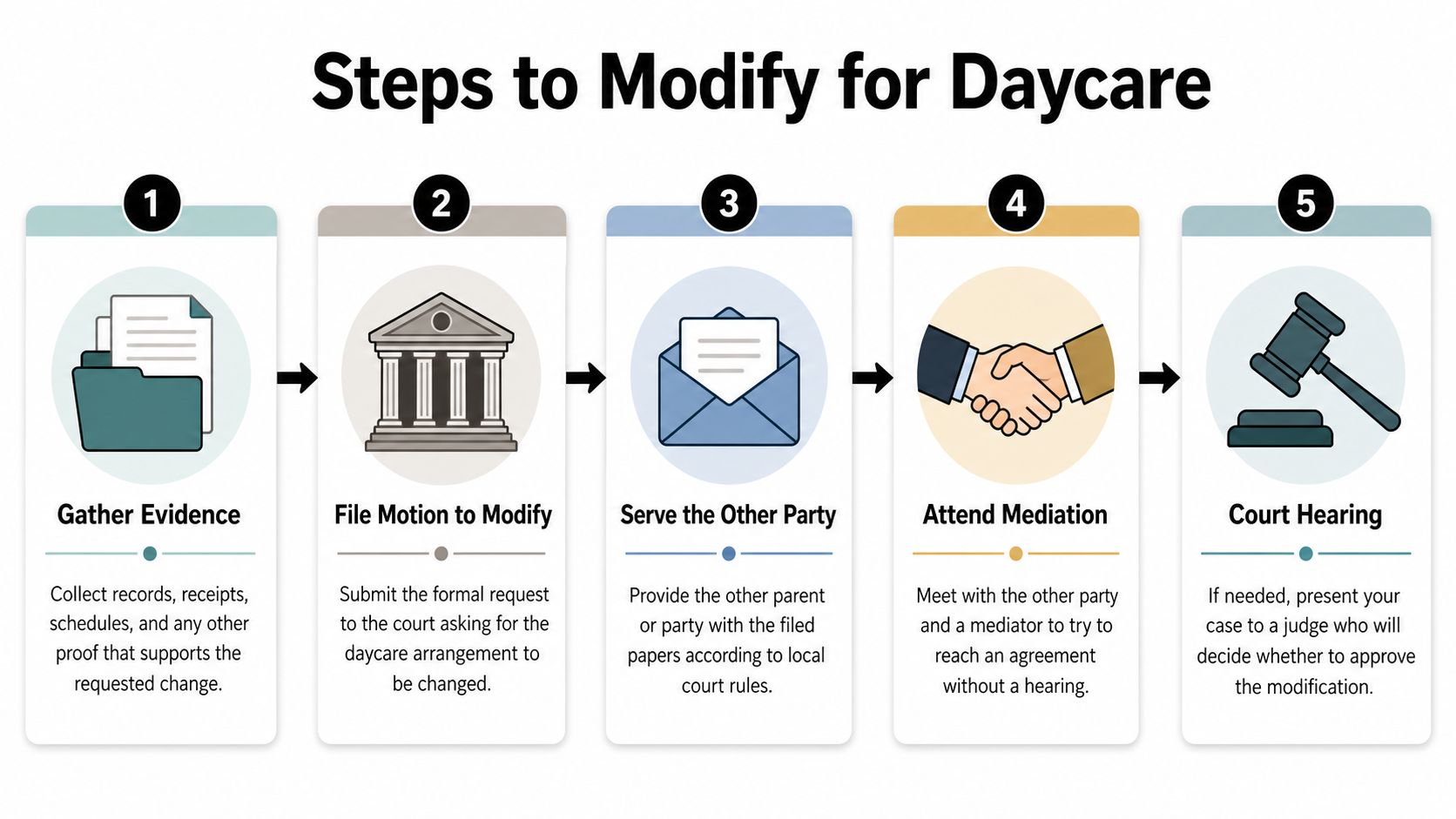
A daycare dispute is won before the hearing starts. If you wait until the courtroom to assemble the story, you've already given the other side too much room to argue that the cost is optional, inflated, or not tied to work. File a clean case, and the judge has something real to rule on.
Build the file before you file
Bring the documents that prove necessity and payment:
- Provider contract and enrollment forms. These show the child is in care.
- Payment history and receipts. They prove the bill is recurring and current.
- Employer verification or class schedule. This connects daycare to work or school.
- The prior order. The judge needs to see what is being modified.
- Any communication about sharing the expense. It helps show the dispute is real, not manufactured.
Texas modification practice usually runs through Texas Family Code §156.401 when there's a material and substantial change in circumstances. Texas guidance commonly cites a 20% or $100 difference, or three years since the last order, as the usual threshold that makes a modification worth pursuing. Once the petition is filed, the other parent has to be served, and the case moves toward hearing or agreement.
What the procedure actually looks like
The filing starts the case, service gives the court power over the other parent, and then the matter usually goes through a temporary orders setting, settlement talks, or a final hearing. Temporary orders hearings often decide who pays daycare in the short term, which is why the first affidavit matters so much. If the documents are organized, the dispute can settle fast. If they aren't, the hearing turns into a credibility fight.
For many parents, the next move is legal strategy, not more arguing by text message. Texas Child Support Law Office of Bryan Fagan handles child support modifications, enforcement, and high-income support disputes across Texas, and that kind of structured review is exactly what a daycare case needs before anyone files.
The smartest filing doesn't ask the court to guess. It asks the court to read the documents and apply §156.401 and §154.123 to the actual childcare reality.
Enforcement, Arrears, and Retroactive Daycare Claims
When a parent refuses to pay a court-ordered daycare share, the problem stops being a budgeting dispute and becomes an enforcement case. At that point, the issue is not whether the expense is fair in the abstract. The issue is whether the order is being ignored.
Texas can enforce child support through wage withholding and contempt tools, and daycare-related obligations can be folded into that enforcement posture when the order clearly requires payment. Once the unpaid amount becomes arrears, the receiving parent should preserve every invoice, every proof of payment, and every message showing noncompliance. That record is what turns a complaint into a case.
Enforcement versus retroactive reimbursement
These are different remedies. Enforcement asks the court to make someone comply with an existing order. Retroactive reimbursement asks the court to compensate for past expenses that were not paid the way they should have been. If the order already required daycare contributions, enforcement is usually the cleaner route. If the order never addressed the expense and the parent paid anyway, retroactive relief becomes a harder, more document-heavy request.
A retroactive claim is also time-sensitive. Texas practice commonly treats four years as the general limit on retroactive support claims, with exceptions in narrower situations. That means the parent who waits too long risks losing influence, even when the underlying daycare expense was legitimate. Retroactive child support guidance
The tactical choice that matters
If the other parent is working and daycare is necessary, don't treat the issue as a casual repayment request. Build the record, then decide whether the right move is modification, enforcement, or retroactive reimbursement. A good lawyer will sort that out by looking at the order language, the payment trail, and the dates of each invoice.
Courts reward precision. Vague complaints about missed daycare payments usually go nowhere.
If the order is being ignored, a contempt or enforcement path may be the right answer. If the expense has changed materially, a modification under §156.401 may be stronger. The wrong filing wastes time and gives the other side an easy defense.
Strategic Moves That Actually Change Outcomes
Daycare cases are won by lawyers who can connect net resources, possession schedules, and actual invoices into one coherent story. Courts do not care about a pile of receipts unless those receipts prove a legal point under §154.123 or §156.401.
What actually moves the number
Challenge the net resource calculation when it's wrong. Self-employment deductions get overstated. Bonuses get ignored. Stock compensation gets missed. Those mistakes matter because the support percentage is applied to the final resource number, not to a parent's rough estimate of income. In a 50/50 case, the possession schedule can change whether daycare is treated as a shared cost or a deviation issue.
A structured legal strategy session helps the parent sort the case before filing. That's where you pin down the daycare provider, the monthly cost, the exact days care is needed, and the likely courtroom path. If the theory is clean, the judge has a clean issue to decide.
The practical move is to stop arguing about fairness and start proving necessity. Texas child support daycare disputes are about documentation, statutory fit, and timing. Get those three pieces right, and the case looks very different in front of a judge.

Common Questions About Daycare and Child Support in Texas
Is daycare automatically included in Texas child support? No. Texas uses the guideline formula under §154.125, and daycare has to be tied to a real work or school need before a court treats it as part of the support analysis under §154.123. Bring invoices and proof of necessity.
Can 50/50 custody change who pays daycare? Yes. A 50/50 schedule changes the analysis because the court looks at actual possession and who needs care during work hours. The right next step is to map the parenting schedule against the daycare hours.
Can a parent be ordered to pay half of daycare even if they're not the daytime caregiver? Yes, if the court finds the expense is reasonable and tied to the child's care needs. The judge can allocate costs based on incomes, possession, and the child's best interest. Review the order language before agreeing to anything.
How long can I seek retroactive daycare reimbursement? Texas retroactive support practice commonly uses a four-year limit. If the invoices are older than that, act fast and get counsel to evaluate whether any exception or enforcement route still exists.
If you're dealing with a daycare dispute in Texas, get the numbers and the order language reviewed before you file anything. Texas Child Support Law Office of Bryan Fagan handles child support modifications, enforcement, high-income calculations, and daycare-related support disputes, and you can learn more at Texas Child Support Law Office of Bryan Fagan.