You know the feeling. The paycheck stubs look thin, the story about “barely getting by” doesn't match the new truck in the driveway, and your child's support order seems stuck on a number that doesn't reflect reality. In Texas, that gap is exactly where imputed income comes in, because child support is supposed to track a parent's net resources, not just the number printed on a pay stub. For parents dealing with child support imputed income Texas disputes, the primary challenge is usually about proving earning capacity, not arguing over labels.

Texas law gives courts a structured way to deal with that problem, and it's not a guesswork exercise. Under Texas Family Code §154.0655 and related child support provisions, courts start with evidence of resources and can look deeper when the numbers on paper don't tell the full story. If you want a quick primer on the income issue itself, underreporting income child support Texas is the exact kind of issue that often shows up in these cases.
When a Parent's Income Doesn't Tell the Whole Story
A parent says they “can't afford much,” but the financial records point somewhere else. Maybe they left a steady job, shifted income through a business, or accepted work that pays far less than their background suggests. Texas courts do not have to accept the reported number at face value when the evidence shows a parent may be earning more than they claim.
Why this issue matters
Child support in Texas is tied to net resources, and that matters when one parent's reported income is artificially low. If the court accepts a number that does not reflect real earning ability, the guideline calculation starts from the wrong place. That is why imputed income disputes often arise in cases involving self-employment, underemployment, or no reliable documented earnings.
The practical problem is straightforward. A parent can control what appears on a W-2, but they cannot control how a work history, education, professional licenses, and the local job market may shape the court's view of earning potential. Texas law gives judges authority to respond to that mismatch, so these cases turn on evidence and strategy, not frustration.
Practical rule: If the income story on paper looks too low for the person's background, gather proof before you argue about support.
The calculation side is easier to understand once income has been pinned down. For a useful overview, see How Child Support Is Calculated in Texas. If the issue is whether a parent has been leaving income off the table, underreporting income child support Texas shows the kind of conduct that often leads to an imputed income fight.
What Is Imputed Income Under the Texas Family Code
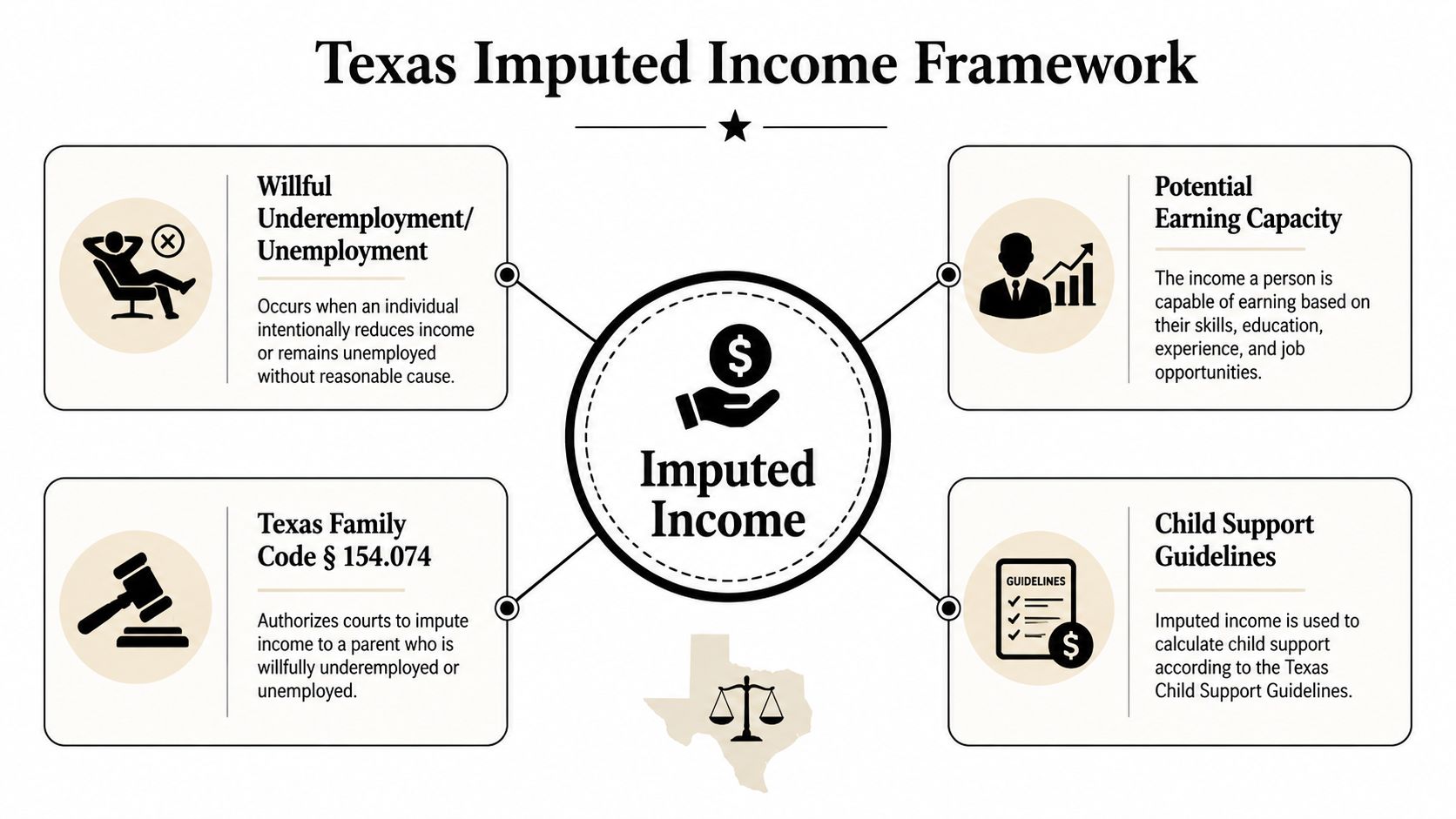
A parent's reported paycheck does not always tell the full story. A parent may be capable of earning more than what shows up on a pay stub, tax return, or business draw, and Texas courts can account for that gap when child support is at issue. Imputed income is the income figure the court assigns based on what a parent should be earning, rather than the amount the parent says is coming in right now. Texas Family Code §154.066 lets the court apply child support guidelines to earning capacity when a parent is voluntarily unemployed or underemployed, and that distinction matters in actual litigation. The court is not punishing a parent for changing jobs. It is deciding whether the change reflects a real shift in circumstances or a choice that leaves support artificially low.
Actual income versus earning capacity
Actual income is the money a parent reports from current work, business operations, or other sources. Imputed income is the figure the court uses when that reported amount is incomplete, unreliable, or set below what the evidence supports. Judges do not reach that number by guesswork. They can review work history, education, licenses, job skills, job search efforts, and the local job market to decide what a parent is reasonably able to earn.
Texas law also gives courts a baseline when proof is thin. Under Texas Family Code §154.068, if the court does not have reliable proof of a parent's resources, it presumes income at the federal minimum wage for a 40-hour week. That presumption protects the support calculation from collapsing when records are missing, but it does not cap the analysis. If the evidence shows greater earning ability, the court can impute a higher amount.
The court starts with proof, then turns to earning capacity when the proof is missing or does not fit the facts.
That rule matters because child support should track real earning ability, not a number chosen for litigation advantage. A parent with no documented income can still face a support order based on the minimum-wage presumption, and the court then applies Chapter 154's percentage rules to the resources it has found. The amount assigned at the front end affects every step that follows, especially now that the $11,700 net resource cap effective Sept. 1, 2025 changes how much income is counted before guideline percentages are applied.
For a practical look at how net resources fit into the support formula, see the Texas guideline breakdown in How Child Support Is Calculated in Texas. The key point is simple, the income number has to be right before the percentage calculation can be right.
Common Scenarios Where Texas Courts Impute Income
Courts usually don't impute income because a parent's paycheck is inconvenient. They do it when the facts suggest the reported income is not a fair measure of earning ability. Texas Family Code §154.066 is built for those situations, and the evidence usually falls into a few repeat patterns.
Voluntary unemployment and underemployment
A parent who leaves a stable job without a credible reason can trigger imputation. The same is true when someone takes a major pay cut and the change doesn't make sense in light of prior earnings, training, or the local job market. A judge will look closely at whether the change was necessary or merely a way to lower support.
Self-employment and business ownership
Self-employed parents can create the toughest disputes because income can be disguised as business expense, retained in accounts, or blurred with personal spending. If the business pays for personal items, or if the reported draw looks far lower than the standard of living, the court may question the numbers. That does not mean every business owner is hiding income, but it does mean the records need to be clean.
High-income compensation that is irregular
Bonuses, commissions, and non-traditional pay can also create fights. A parent may argue that only base salary should count, while the other side points to recurring bonus history or other compensation that reflects true earning power. In high-income cases, this becomes especially important because the guideline calculation interacts with the statutory cap discussed below.
No reliable earnings record at all
When there is no dependable proof of current income, the court can fall back to the minimum wage presumption under §154.068 and then decide whether the facts justify something higher. A parent who has the skills, background, and job opportunities to work more than minimum wage can be imputed accordingly.
Mini-example: A father with a long sales history quits his commission job, says he is “between careers,” and offers no job search record. The court may not accept the zero-income claim if the evidence shows he still has the same earning capacity. In that setting, the support order is likely to follow the earning capacity analysis, not the story he presents.
Calculating Imputed Income and the New 2025 Guideline Cap
A parent who claims little or no income can still face a child support order based on what the court believes that parent can earn. Once the judge decides to impute income, the next step is to translate that earning figure into net resources, because Texas child support starts there, not with gross pay. The guideline percentage in Texas Family Code §154.125 is then applied to that net number, so the quality of the income evidence often drives the final support order.
How the calculation works
The court first assigns a monthly net resources figure to the parent. That number may come from proven earnings, minimum wage under §154.068, or a higher earning capacity the evidence supports. Then the court applies the guideline percentage tied to the number of children, with the standard percentages of 20%, 25%, 30%, 35%, and 40% for one through five or more children, respectively, as reflected in the Texas calculator and Chapter 154 framework. How Texas courts calculate net resources is the calculation issue that often controls the final number.
The guideline cap matters just as much. The Texas Attorney General's calculator states that the guidelines are designed for monthly net resources up to $11,700, and that figure is the ceiling used for the standard formula Texas child support calculator. Texas law summaries also note that this cap increased from $9,200 to $11,700 effective September 1, 2025, a significant increase. In an imputed-income case, that higher ceiling can change the support picture quickly, because a parent with attributed earnings may now land in a different guideline range than the one they expected.
A simple worked example
If the court imputes net resources at the cap, the guideline amount for one child is 20%, which equals $2,340 at the current cap. For two children, 25% equals $2,925. For three children, 30% equals $3,510. The same percentages continue up the schedule for four and five or more children, and the Texas calculator reflects the cap-based limitation on the standard guideline computation.
The strategic point is straightforward. Before anyone argues about percentages, the fight is usually over the income figure the court should use. If the imputed number is wrong, the support order is wrong.
Proving Your Case Evidence and Documentation
A strong imputed-income argument is built on proof that a judge can trust. Texas courts can look at background factors like assets, residence, employment history, job skills, education, age, health, criminal history, employment barriers, work-search record, local opportunities, and prevailing wages under §154.0655, but those factors only help if you bring real evidence into the courtroom. If the record is thin, the court will often default to the minimum-wage presumption instead of a higher earning figure.
The evidence that usually moves the needle
- Tax records and pay history: Past returns, W-2s, 1099s, and pay stubs can show what the parent earned before the income drop.
- Work history and applications: Prior jobs, job search logs, and rejections can help show whether the parent is making a real effort to work.
- Bank and spending records: Deposits, transfers, and lifestyle expenses can reveal whether the reported income matches actual spending.
- Business records: For self-employed parents, invoices, ledgers, expense reports, and account statements can uncover personal spending through the business.
- Vocational evidence: A vocational evaluator can compare the parent's background to local job opportunities and prevailing wages.
A case without documents is usually a case without a strong position. Social media posts can also matter when they show travel, purchases, or work activity that conflicts with the income claim, but those posts work best when they're paired with financial records instead of used alone. The judge needs a coherent story, not a pile of screenshots.
What works in court is consistency. If the documents, the spending, and the work history point to the same earning level, your argument gets much stronger.
For a practical evidence checklist, evidence needed for child support case Texas is the right way to think about preparation. The point is not to overwhelm the court, it's to show that the parent's real earning power is higher than the number they're presenting.
How Imputed Income Affects Legal Actions
Imputed income is not a separate lawsuit. It is an argument that fits into the case you already have, and the procedural posture changes how you use it. In an initial SAPCR, the court is setting the first order. In a modification, the court is deciding whether a support change is justified. In enforcement, the issue may be whether a parent really lacks the ability to pay or is claiming poverty after the fact.
Where the argument fits
An initial child support order gives the court the cleanest chance to get the number right from the start. If one parent is hiding income or working below capacity, the evidence can shape the first order before the bad number becomes the baseline.
A modification case is different. Texas law allows support to be revisited when circumstances change, and that matters when a parent's income drops suspiciously or the job situation changes materially. The earlier legal guide on Texas child support notes that material changes in income or job status can trigger recalculation, which makes imputation a useful tool when the new income story doesn't hold up.
Enforcement is another pressure point. If a parent who owes support claims they can't pay arrears, the court may still examine whether they are voluntarily underemployed or whether their claim is supported by actual evidence. That distinction matters because child support enforcement and income-imputation issues often overlap in the same courtroom.
Texas also allows retroactive support in the right case, which can matter when a parent underpaid during a period when the court should have used a higher income figure. The more complete the record, the better the court can decide whether a correction is appropriate.
Next Steps How the Law Office of Bryan Fagan Can Help
An imputed-income case rises or falls on details. The court needs a reliable income picture, and the parent asking for support, or defending against an inflated claim, usually needs a plan for gathering records, analyzing earnings, and presenting the facts in a way the judge can use. That's where focused legal strategy matters more than broad arguments.
The Law Office of Bryan Fagan handles Texas child support disputes involving imputed income, high-income calculations, and guideline-cap issues. The firm works on evidence collection, earning-capacity analysis, and courtroom presentation in cases where the reported income does not match the actual financial picture.
If the facts in your case suggest that support should be based on earning capacity instead of a low reported number, get advice before the numbers harden into an order. A consultation can clarify what documents matter, how Texas Family Code §154.066, §154.068, and §154.125 apply, and whether your case calls for a first order, a modification, or enforcement action.
If you're dealing with a child support dispute where the other parent's income doesn't add up, the Texas Child Support Law Office of Bryan Fagan can help you build the record and present the right legal argument. Visit Texas Child Support Law Office of Bryan Fagan to talk through your situation and get a strategy suited to your case.