You get the termination email, or your supervisor walks you out, and your first real thought isn't about your résumé. It's about the child support order that hits on the same date every month.
That reaction is normal. It's also where a lot of Texas parents make the mistake that causes the longest damage. They assume job loss automatically changes child support. It doesn't. The order keeps running until a judge signs a new one.
If you're dealing with child support after job loss texas, treat it like a court problem, not just a money problem. The legal system cares about dates, documents, and whether your unemployment was involuntary. It also cares whether you moved quickly or let arrears pile up while hoping things would sort themselves out.
Texas courts will reduce support in the right case. They will also refuse relief when a parent quits, gets fired for cause, stops looking for work, or shows up in court with nothing but a story. What works is evidence. What fails is delay.
The Moment Your Job Ends Your Child Support Clock Starts Ticking
A parent loses a job on Friday, skips the next child support payment, and tells the other parent, "I can't pay until I get back on my feet." That sounds reasonable in ordinary life. In a Texas courtroom, it usually creates a second problem on top of the first one.
Under Texas law, your support obligation doesn't pause because your paycheck stopped. The existing order stays enforceable until the court changes it. That means every unpaid month can become arrears while you're still trying to figure out your next step.
The legal issue starts immediately because modification turns on proof. You need to show what happened, when it happened, and why the court should treat the job loss as a real change in circumstances instead of a temporary setback or a self-created reduction in income.
Child support cases after job loss are often won or lost in the first few weeks, not at the final hearing. The paperwork trail starts on the day employment ends.
Texas judges see the same patterns over and over. The parent who was laid off in a company reduction and started applying for work right away presents differently than the parent who resigned in frustration, waited weeks to file anything, and can't document a serious job search.
If you act quickly, the case becomes manageable. If you do nothing, the order keeps accruing, enforcement tools stay available, and the pressure gets worse when you finally do file. This is one of those situations where speed matters because the court can only sign relief after you bring the issue before it.
Your First 72 Hours A Damage Control Checklist
You lose your job on Monday. By Thursday, the facts you saved or failed to save may shape how a Texas judge views your case months later. That is not an exaggeration. In modification cases, the first problem is rarely the hearing. It is the record.

In these first three days, the goal is simple. Build a file that shows the income drop was involuntary, recent, and significant enough to support a modification. If you wait, documents disappear, memories get fuzzy, and the other side gets more room to argue you caused the problem or are dragging your feet.
Secure proof of how the job ended
Start with the documents that explain the separation. Judges care about the difference between a layoff, a discharge for cause, a resignation, and a vague "mutual parting." Those labels affect whether the court sees your unemployment as involuntary or self-created.
Pull and save:
- Termination or layoff notice
- Severance agreement or separation packet
- Final pay stub and year-to-date earnings
- Any HR email explaining restructuring, downsizing, or position elimination
- Benefit information, including health coverage and accrued PTO payout
- A written timeline with dates, names, and the reason given for the separation
If you were fired, do not hide that fact. Get the paperwork and deal with it directly. Some terminations still support modification. What hurts people in court is evasiveness.
Start a job-search log immediately
A parent asking for reduced support needs to show current earnings and earning capacity. Those are different things. If the court believes you can earn more than you claim, it may assign imputed income and calculate support from that number instead of your actual unemployment.
That is why your search record matters. It is often the difference between "I am trying" and proof that stands up in court.
Use one running log and update it daily. Include:
- Date
- Employer
- Position
- Pay range, if listed
- How you applied
- Interview or follow-up activity
- Outcome
- Reason the job was lower-paying, outside your field, or otherwise not comparable
Save the backup too. Application confirmations, recruiter emails, rejection notices, interview invitations, and screenshots from job platforms all help. If a judge asks what you have done since the termination date, you need an answer tied to documents.
For a plain-language explanation of the legal standard behind these cases, review this guide on material and substantial change in circumstances in Texas child support cases.
Communicate carefully with the other parent and the child support system
Do not send a long emotional message. Send a short written notice that states three facts: your employment ended, you are looking for replacement work, and you intend to seek a formal modification. Keep it factual.
Avoid these mistakes:
- Promising a reduced amount the court has not approved
- Asking the other parent to make an "informal deal"
- Saying you will stop paying until you get another job
- Arguing about blame in text or email
If the Office of the Attorney General is involved in your case, report the employment change promptly and keep proof of that communication. Save confirmation emails, portal screenshots, fax confirmations, or certified mail receipts. Procedure matters here. If you later need to show the court that you acted quickly and in good faith, these small records help.
Protect cash flow without creating bad exhibits
Look at your bank activity as if the other side's lawyer will read it. Sometimes they will.
Keep spending focused on basics that support work and stability, such as housing, transportation, utilities, food, and phone service. Apply for unemployment benefits quickly if you may qualify, and save the application, determination, and payment records. Make partial child support payments if you can do so consistently. Partial payments do not change the order, but they can reduce arrears and show the court you did not ignore the obligation.
Do not transfer money to friends or relatives to make your balance look worse. Do not start paying discretionary expenses while claiming you cannot pay support. Judges notice those inconsistencies fast.
Decide how the case will get filed
Within 72 hours, decide who is preparing the modification. That may be a private lawyer, the Attorney General process, or self-representation if the facts are simple and you understand the paperwork. Delay usually costs more than a filing fee.
Texas courts modify support by signed order, not by side agreement. Filing earlier does not guarantee immediate relief, but waiting nearly always makes arrears larger and your proof weaker.
If you need help assembling the filing package, one option is the Texas Child Support Law Office of Bryan Fagan, which handles child support modification matters under the Texas Family Code, including documentation and court representation for income-change disputes. Whether you use that office, another family lawyer, or proceed through the Attorney General review process, act while the paper trail is still fresh.
Proving a Material and Substantial Change in Court
You lose your job on Monday. Your support hearing is six weeks away. By then, the judge will care less about the shock of the layoff than about what you can prove with documents.
Texas courts modify child support under Texas Family Code §156.401. The legal question is whether your circumstances changed enough, and for the right reasons, to justify a new order. Sympathy does not carry this issue. Records do.
You must prove a material and substantial change in circumstances before the court will reduce child support.
What the court is looking for
Most judges focus on three points:
- Did your income materially change?
- Was the income loss involuntary?
- What are you capable of earning now, even if you are unemployed today?
That third point causes problems for many parents. A current paycheck is not the only number the court can use. If the judge believes you are underemployed by choice, delaying a job search, or earning less than you reasonably could, the court may assign income to you. That is imputed income, and it can keep support much higher than you expected.
The strongest cases show a clean before-and-after picture. The prior order was based on regular earnings. The job ended because of a layoff, plant closure, restructuring, medical limitation, or another event outside your control. The parent then made prompt, documented efforts to replace that income.
Involuntary loss versus voluntary loss
Circumstances like these frequently prompt modification requests. Job loss is not enough by itself. Judges want to know why the job ended and whether the reduction in income was avoidable.
| Job loss type | How courts tend to view it | What you need to prove |
|---|---|---|
| Layoff or restructuring | Usually treated as involuntary | Termination letter, employer notice, final paystub, separation paperwork |
| Medical inability to continue work | Can support modification if well documented | Medical records, physician restrictions, work history |
| Quitting without strong cause | Often treated as self-inflicted underemployment | Specific facts showing good cause, plus proof you pursued replacement work |
| Firing for cause | Often disputed and closely examined | Employment records, context for the termination, evidence you did not engineer the income drop |
A resignation is not automatically fatal. Sometimes a parent leaves work for documented medical reasons, unsafe conditions, or a required relocation tied to military or family circumstances. But if the facts look like a strategic pay cut, the court may leave the order in place and calculate support from earning capacity instead of current wages.
That is the trade-off. A quick filing helps preserve your claim, but a weak explanation for the job loss can hand the other side an imputed-income argument.
The threshold many parents miss
Not every income drop supports a modification. In many cases, the court will ask whether the change would alter the existing support amount enough to matter under the statute. Texas guideline support under §154.125 is tied to net resources, so the math matters, not just the story.
For many parents, the practical screening question is whether the new number would differ from the current order by 20% or $100. If the drop is brief, minor, or poorly documented, the judge may decide there has been no qualifying change. For a closer look at how courts analyze that standard, see this Texas explanation of substantial change in child support cases.
Proof that helps, and proof that hurts
Bring the documents that answer the court's questions directly. Good evidence usually includes termination paperwork, recent paystubs, tax returns, unemployment records, job applications, interview confirmations, and bank records that match the income story you are telling.
Bad facts are just as important. Judges notice when a parent claims inability to pay but keeps discretionary spending high, turns down comparable work, waits months to apply for jobs, or shifts into a lower-paying role without a solid reason. Those facts support a finding of voluntary underemployment.
One hard truth applies in every case.
The current child support order stays enforceable until a judge signs a new one.
That means a strong modification case is built on timing, credible records, and a job-loss explanation the court can verify. If any of those pieces are missing, the hearing can become less about your unemployment and more about why the court should assume you can still earn what you used to make.
How to File for a Child Support Modification in Texas
You got laid off on Friday. Rent is due next week. Child support is still set at the number from your old paycheck. In Texas, nothing changes until the case is filed and a judge signs a new order. Waiting costs money.
Court filing versus Attorney General review
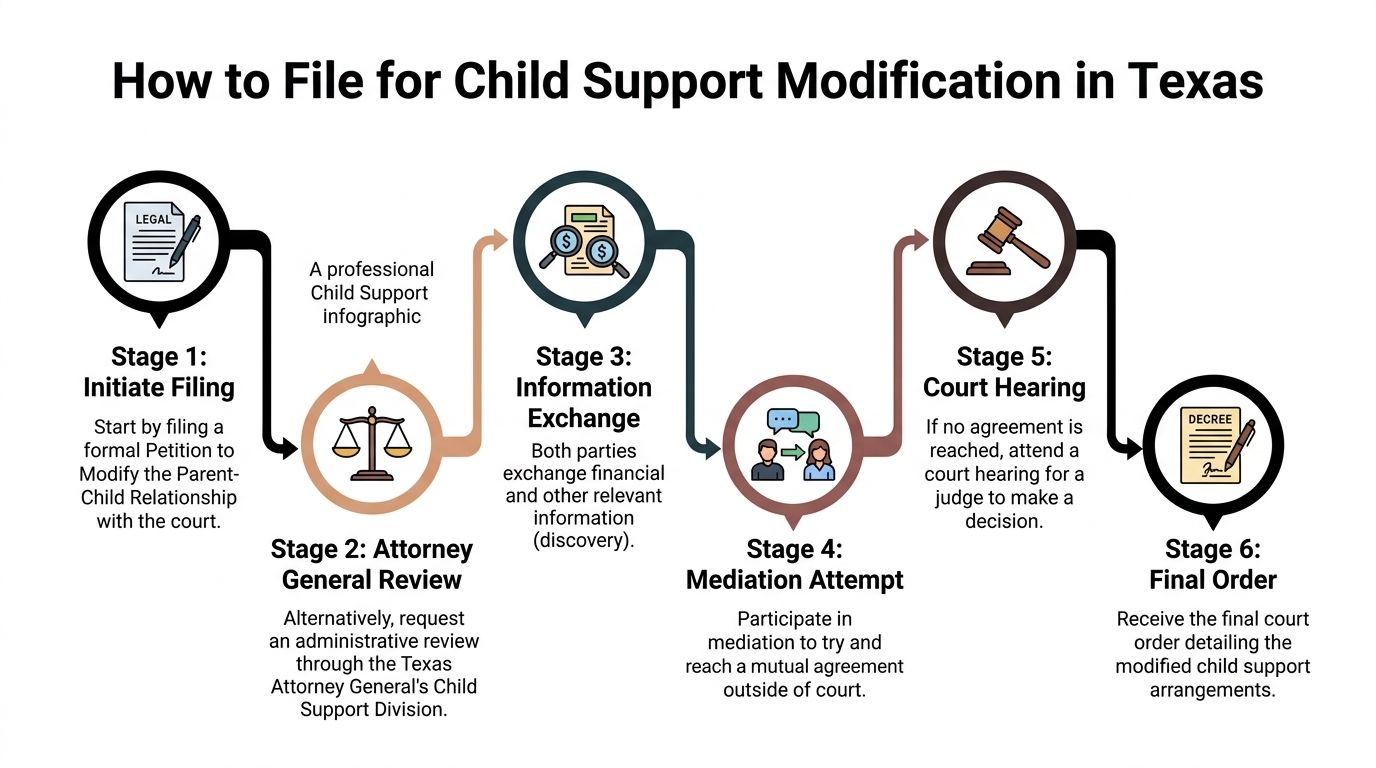
Texas parents usually have two ways to start a modification. One is to file in the court that signed the current order, typically through a Petition to Modify the Parent-Child Relationship. The other is to ask the Office of the Attorney General to review the case through the child support review process.
The choice matters.
A direct court filing usually makes more sense when job loss is disputed, the other parent is hostile, arrears are already building, or you expect a fight over whether you are unemployed by choice. The Attorney General process can be useful when both parents are cooperative and willing to exchange financial records early. If no agreement is reached there, the case can still end up in court.
Under Texas Family Code §156.401, the court can modify support if the order has become materially and substantially different from current circumstances, or if the statutory threshold is met. In a job-loss case, the procedural issue is usually not whether support feels unaffordable. It is whether you can prove a qualifying change with records a judge will trust.
File in the correct court, with the correct request
Start with the current order. Confirm which court has continuing, exclusive jurisdiction. Filing in the wrong court creates delay you cannot afford, especially if enforcement is already a risk.
Your petition should clearly request a modification of child support and, if the facts support it, temporary orders while the case is pending. General statements that income dropped are weak. A stronger pleading states the date employment ended, the reason for separation, current income sources, whether unemployment benefits have started, and why the reduction was involuntary.
For a procedural walkthrough of the filing steps, see this guide to how to modify child support in Texas.
Build the evidence package before the hearing is set
Judges do not reduce support because a parent says, "I lost my job." Judges reduce support when the documents line up and the timeline makes sense.
Have these records ready before filing or immediately after:
- Current support order and wage withholding order
- Termination or layoff paperwork, including any severance terms
- Recent pay stubs and tax returns
- Proof of unemployment benefits or proof you applied
- Health insurance cost information for the child, if that may affect the calculation
- Job search records, including applications, interview emails, recruiter contacts, and rejection notices
- Bank statements that match your claimed income and expenses
- Proof of any side income, contract work, or self-employment receipts
Many self-represented parents hurt their own case by filing first, then starting to gather proof later. By the first hearing, they have a termination email and a lot of explanations. The other side has months of payment history showing the old order went unpaid. That is not the record you want.
Service and procedure are not technicalities
After filing, the other parent must be served correctly unless service is waived in a legally valid form. If service is defective, the hearing may be reset, and any order entered can be attacked later.
The usual sequence looks like this:
- File the petition in the court with jurisdiction
- Serve the other parent
- Exchange financial documents if requested or ordered
- Attend mediation, a review conference, or settlement discussions if the court requires it
- Request a hearing if the case does not settle
- Present testimony and exhibits
- Get a signed modification order
- Make sure income withholding is updated if support changes
That last step matters. A signed order without an updated withholding process can create confusion, missed payments, and preventable enforcement problems.
A short visual often helps clarify the sequence:
Temporary orders can help, but do not count on them
Texas courts can enter temporary orders in modification cases. Sometimes that is the right move after a sudden layoff. Sometimes it is not worth the fight, especially if the court can set a final hearing quickly.
The better strategy is to prepare for the judge who will ask hard questions: Why did the job end? What have you done since then? What income do you have today? What can you earn right now?
If your answers are supported by exhibits, a temporary reduction is possible. If the record is thin, the court may leave the current amount in place until final hearing.
What makes a filing persuasive
Strong modification cases are organized around proof, not sympathy.
What helps
- A prompt filing after the job loss
- Employer records showing the separation was involuntary
- A clean timeline from last paycheck to unemployment benefits to job search
- Financial disclosures that match bank records and testimony
- A child support calculation tied to the Texas guidelines under Family Code Chapter 154
What causes trouble
- Quitting without a documented reason tied to health, layoffs, or other legitimate facts
- Turning down comparable work
- Missing or inconsistent income records
- Cash income left out of sworn disclosures
- Waiting months to file while arrears accumulate
- Asking the court to erase unpaid support that accrued before modification
One point clients often do not like hearing is this: filing for modification is only half the job. The other half is proving you are acting like someone who wants to get back to work. If the judge sees avoidable unemployment or incomplete disclosures, the court may use earning capacity instead of actual income.
Navigating Imputed Income and High-Earner Calculations
The most contested issue in many child support after job loss texas cases isn't whether income fell. It's whether the court believes your current income is the right number to use.
Texas courts can assign imputed income under Family Code §154.306-307 when unemployment or underemployment lacks good cause. That power is the court's safeguard against manipulation, and it appears in ordinary cases and high-income cases alike.

How judges decide what you can earn
Verified guidance states that Texas courts assess earning capacity based on historical W-2s, education, and market data when unemployment lacks good cause. It also states that for high earners, guideline calculations are capped at $11,700 net monthly effective September 1, 2025, and that modification outcomes are stronger with compelling job search proof, including 20+ applications per month, according to this discussion of reducing child support after job loss in Texas.
In practical terms, judges tend to examine:
- Your recent earnings history
- Your education and credentials
- Your field and transferable skills
- What jobs are available in your market
- Whether your search reflects serious effort
If you were earning a substantial salary and then claim zero earning capacity with little proof of a broad search, the court may reject your current income figure. If you were laid off from a specialized role and can show repeated applications, recruiter contacts, and a tight labor market in your field, you have a much better chance of pushing imputation lower.
A judge doesn't have to accept unemployment at face value. The court can decide that your earning capacity is higher than your current paycheck.
A practical calculation example
Start with the guideline structure under §154.125. Verified data provides the percentages: 20% of net income for one child, 25% for two children, with increasing percentages for more children.
Now apply that to a high-earner framework. If the court uses the guideline cap of $11,700 net monthly effective September 1, 2025, one child at 20% yields about $2,340 under the guideline cap, based on the verified explanation in the source above.
That doesn't mean every high earner pays only the capped amount. It means the standard guideline calculation starts there. Under §154.123, the court may consider deviations when a child has proven needs that justify support beyond the basic guideline amount.
High earners often miss the real issue
Many high-income parents focus only on the cap. The court often focuses on credibility.
If a parent had a strong compensation history, substantial credentials, and a narrow job search, the court may impute income aggressively. If the same parent can show a documented market downturn, serious search efforts, recruiter communications, and a realistic transition timeline, the judge is more likely to ground the number in present reality.
A useful way to think about it is this:
| Question | Why it matters |
|---|---|
| Was the loss involuntary? | It affects whether reduced current income is treated as legitimate |
| Is the search documented? | It shows whether unemployment is temporary hardship or avoidable underemployment |
| Is prior income still realistically available? | It drives whether the court uses historical earnings or a lower figure |
| Are there proven child-specific needs under §154.123? | It affects whether the court deviates from guideline support |
How to fight a bad imputation record
If you're heading toward hearing, your best counter to imputation is not argument. It's documentation.
Bring records that show:
- Comparable job applications: Not just easy-click submissions. Show serious applications in your field and adjacent roles.
- Interview activity: Screeners, interviews, follow-up emails, and recruiter correspondence.
- Skill maintenance: Licensing renewals, continuing education, or certification work if relevant.
- Market conditions: Job postings, recruiter feedback, and hiring freezes in your sector if they affect realistic earning potential.
For high earners especially, §154.123 can become important when one side argues for deviation based on the child's needs. That issue should be evidence-based, not rhetorical. Judges want proof of the child's actual needs, not broad statements about lifestyle.
Managing Arrears and Enforcement Actions While Unemployed
Parents usually call about modification because they're worried about paying less. They should also worry about what happens if they pay nothing and let the file go quiet.
In 2021, 4.1 million parents nationally received child support payments totaling $20.2 billion, and the average monthly payment was $441, according to this Annie E. Casey Foundation summary of Census child support statistics. The point for Texas parents is straightforward. Child support is a large, active enforcement system, and unpaid balances don't sit harmlessly in the background.

What can happen while you're out of work
Verified Texas guidance warns that unpaid support during unemployment can lead to contempt of court charges, wage garnishment, license suspension, and potential jail time. Once a new order isn't in place and payments are missed, the arrears issue can take on a life of its own.
The practical danger is timing. If you get re-employed before addressing arrears, income withholding can attach to the new paycheck quickly. That often hits just as you're trying to stabilize rent, transportation, and daily expenses after a period of unemployment.
Why partial action is better than silence
If you can't pay the full amount, silence is the worst move. Courts and enforcement agencies read silence as avoidance.
Better responses include:
- File the modification promptly: This is the legal step that addresses the order itself.
- Keep payment records: If you make partial payments, preserve every receipt and confirmation.
- Respond to notices: Ignoring mail from the court or the child support system invites default problems.
- Address arrears directly: If a balance already exists, deal with it as a separate issue instead of pretending the modification filing erases it.
For a closer look at how unpaid balances are handled, this explanation of Texas child support arrears is a useful reference.
A pending modification doesn't cancel arrears that accrued under the old order. You still need a plan for the debt you've already created.
The strategic point most parents learn too late
A modification case is about tomorrow's payment. An enforcement case is about yesterday's nonpayment. Those are related, but they are not the same fight.
If you move fast after job loss, you improve your chances on both fronts. If you wait, you may find yourself trying to defend contempt allegations while also asking for a reduction. That is a much harder posture.
Frequently Asked Questions About Texas Child Support and Job Loss
Does losing my job automatically reduce child support in Texas
No. The current order stays in effect until a judge signs a modified order. Job loss may support a modification, but it doesn't change the obligation by itself.
Can I stop paying child support if I have no income
No. Texas courts may still impute income under §154.306-307 based on earning capacity. If you can't pay the full amount, file for modification quickly and keep proof of any partial payments you do make.
Do visitation problems excuse nonpayment
No. Possession and access are separate from child support. If the other parent interferes with visitation, that is a different legal issue and doesn't cancel the support order.
How do severance or unemployment benefits affect my case
They can matter because the court looks at available resources and current financial circumstances. Don't hide them. Disclose them and present the records accurately.
What if I find a new job before the hearing
Tell your lawyer or update your disclosures immediately. The court needs current information. A new job doesn't destroy your case, but it can change the proposed support amount.
How long does a modification take
It depends on the court, the county, service, and whether the case settles. Some matters resolve through agreement. Others require a contested hearing. Delay usually comes from poor service, incomplete records, or disputes about whether the unemployment was involuntary.
Will the judge reduce my support to zero
Usually not. Courts often assign some earning capacity even when a parent is unemployed, especially if the record suggests the parent can work.
If you've lost your job and need a court-ready plan for modifying support, Texas Child Support Law Office of Bryan Fagan helps parents across Texas with child support modification, imputed income disputes, arrears strategy, and hearings under the Texas Family Code. The most useful first step is getting your documents organized and filing before delay turns a job loss into a larger enforcement problem.