A parent who is behind on support usually comes to me with the same fear. The bills are stacked up, a wage withholding notice is coming, and bankruptcy sounds like the only way to get breathing room. The problem is simple and frustrating at the same time, child support and bankruptcy in Texas do not work the way most other debts do.
If you file Chapter 7 or Chapter 13, you may be able to deal with credit cards, medical bills, and other unsecured debt. Child support is different. Texas follows the federal rule that child support is a non-dischargeable domestic support obligation, so filing bankruptcy does not erase the monthly duty, and it does not wipe out arrears either. The Texas Attorney General says a noncustodial parent must keep paying current support, and past-due support cannot be cleared through bankruptcy Texas Attorney General guidance on child support and bankruptcy.
That distinction changes the whole strategy. A bankruptcy case can still matter, but it usually changes the fight around support, not the support order itself. If you are trying to understand what a Texas judge, a bankruptcy trustee, and the Office of the Attorney General can each do at the same time, the details matter.
Why Texas Parents Run Into the Bankruptcy Problem
A common call starts the same way. A father in Houston falls behind after a layoff. A mother in Dallas is covering rent, childcare, and car repairs while support keeps coming out of her paycheck. Then one more letter arrives, this time about garnishment, contempt, or collection action, and bankruptcy starts to sound like a lifeline.
The first surprise is usually the hardest one to absorb. Filing bankruptcy does not stop child support from coming due. Texas law and federal bankruptcy law treat support as a domestic support obligation, which means the payment duty survives the filing. The Texas Attorney General's guidance is direct about it. Current support must keep being paid, and arrears do not disappear in bankruptcy.
What that means in a real Texas case
If the support order says $800 a month, that obligation still exists after the petition is filed. If the parent is already behind, those missed payments are still owed after the case ends. Bankruptcy may help on the debt side of life, but it does not let a parent walk away from support.
Texas family law also keeps the duration of the duty grounded in the child's status, not the parent's financial stress. Support generally continues until the child turns 18 or graduates from high school, and it may continue longer for a child with a disability. The Office of the Attorney General explains that support collection can continue while the case is open, and parents who need a closer look at enforcement can review how Texas collects back child support.
Practical rule: If the debt is child support, bankruptcy is not a reset button. It is a separate case that may help with other bills, while support keeps moving on its own track.
That is why a generic bankruptcy filing can backfire if the parent assumes everything stops. The better approach is to map out the support order first, then decide how bankruptcy fits around it.
How Texas Calculates Child Support
A Texas support order starts with net resources, not gross pay. That means the court looks at income after the deductions the Texas Family Code allows, then applies the guideline percentage schedule in §154.125. The standard percentages are 20% for one child, 25% for two, 30% for three, 35% for four, and 40% for five children, and the guidelines apply to net resources up to $11,700 per month.
A simple worked example
Suppose a parent has $6,000 in net monthly resources and owes support for two children. The guideline starting point is 25%, so the support amount is $1,500 per month before any deviation analysis under §154.123. If the same parent supports five children, the starting point is 40%, which comes to $2,400 per month on the same net resource base.
If the parent earns above the cap, the court does not stop at the guideline percentage alone. The court still uses the guideline calculation for the capped amount, and income above $11,700 per month can support additional child support based on the child's needs and the court's discretion.
| Texas Guideline Percentage of Net Resources | |
|---|---|
| Number of Children | Percentage of Net Resources |
| One | 20% |
| Two | 25% |
| Three | 30% |
| Four | 35% |
| Five | 40% |
The phrase “net resources” is where many disputes start. Income sources counted in that calculation can be broader than a paycheck alone, and the firm's What Counts as Net Resources for Child Support summary helps identify which income streams the court may count.
Key point: Bankruptcy planning only makes sense after you know the actual monthly support number. Otherwise, you are budgeting around a guess.
For high-income cases, the cap and deviation rules can matter as much as the guideline itself. §154.123 gives the judge room to consider the child's needs and the surrounding facts, not just the percentage schedule.
Current Support Versus Arrears in Texas
Texas courts and bankruptcy courts draw a sharp line between current support and arrears. Current support is the payment that comes due each month under the order. Arrears are the unpaid balance that accumulates when a parent misses one or more monthly obligations.
That difference is easy to see on a ledger. If a parent owes $800 a month and misses three months, the arrears start at $2,400, before any collection costs or other court-related adjustments. The missed payments do not become a new kind of debt just because they sit unpaid. They stay child support, and that matters because support obligations receive special treatment in and outside bankruptcy.
Texas parents often discover arrears during enforcement, not at the moment they miss a payment. The state can pursue unpaid support through collection tools, and the balance keeps growing until it is paid or otherwise resolved under the law. If you want the collection side spelled out step by step, the process is explained in how Texas handles back child support collection.
Why the distinction matters in bankruptcy
Current support is never part of the discharge fight. It must keep being paid going forward. Arrears are a debt, but they are a domestic support obligation, so bankruptcy does not wipe them out either. That is the legal reason a parent can file and still leave the case owing every missed support payment.
Texas family law also keeps the order enforceable through its own mechanisms. The monthly obligation does not vanish because the debtor needs bankruptcy relief on other bills. A judge can still expect compliance with the support order, and the other parent can still push for enforcement if payments stop.
If you are reading a court order, label each line before you talk bankruptcy. Current month, past due balance, interest, and any other court-ordered amount are not the same thing.
That sorting exercise prevents a lot of confusion in the courtroom. It also keeps a parent from making the common mistake of treating every dollar tied to the order as if it can be bundled into a bankruptcy discharge. It can't.
Chapter 7 Versus Chapter 13 in Texas
A Texas parent who files bankruptcy usually wants one thing, relief from pressure. Chapter 7 and Chapter 13 can both help with debt, but neither one changes the basic rule for child support. Support stays in force, and the bankruptcy court does not wipe out arrears just because the filing is pending.
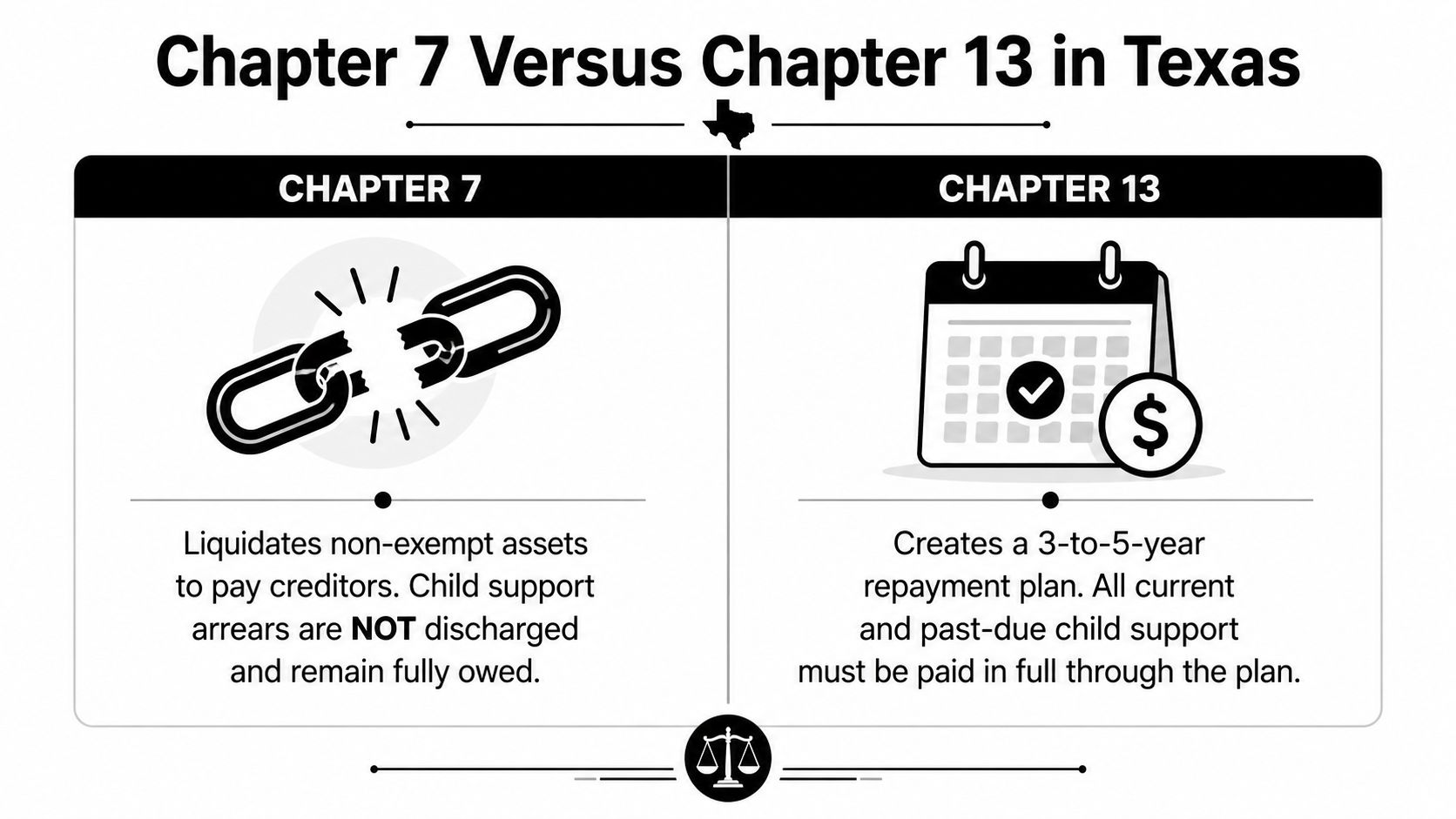
Chapter 7 is the faster liquidation case. It can erase many unsecured debts, such as credit cards and medical bills, but domestic support obligations are excluded from discharge. Child support arrears survive the case, and the ongoing support order continues exactly as written. The practical effect is straightforward, the parent may come out of Chapter 7 with less overall debt, yet still owe every missed support payment.
Chapter 13 is the repayment case. It uses a court-approved plan that usually runs three to five years, and domestic support obligations have to be treated as priority claims. That means the parent generally has to stay current on new support while also paying arrears through the plan. If current support falls behind during the case, the plan can become difficult to maintain because support compliance is required, not optional.
Side by side, what changes in practice
Chapter 7
- Clears many unsecured debts.
- Does not discharge child support arrears.
- Does not stop the ongoing duty to pay current support.
Chapter 13
- Creates a court-supervised repayment structure.
- Requires support arrears to be paid in full through the plan.
- Still requires ongoing current support while the case is pending.
That structure matches Texas guidance on bankruptcy and support. Domestic support obligations receive priority treatment, and child support collection is not treated like ordinary creditor collection. For a clear explanation of those exceptions, see Texas Law Help bankruptcy issues guidance.
The strategic difference depends on which side of the case you are on. For a noncustodial parent, Chapter 13 can sometimes create a workable path to catch up while keeping a home or vehicle. For a custodial parent, the filing does not mean the past-due balance disappeared, and it does not justify slowing enforcement. Either way, the support order keeps its own force.
How Texas Enforces Support During Bankruptcy
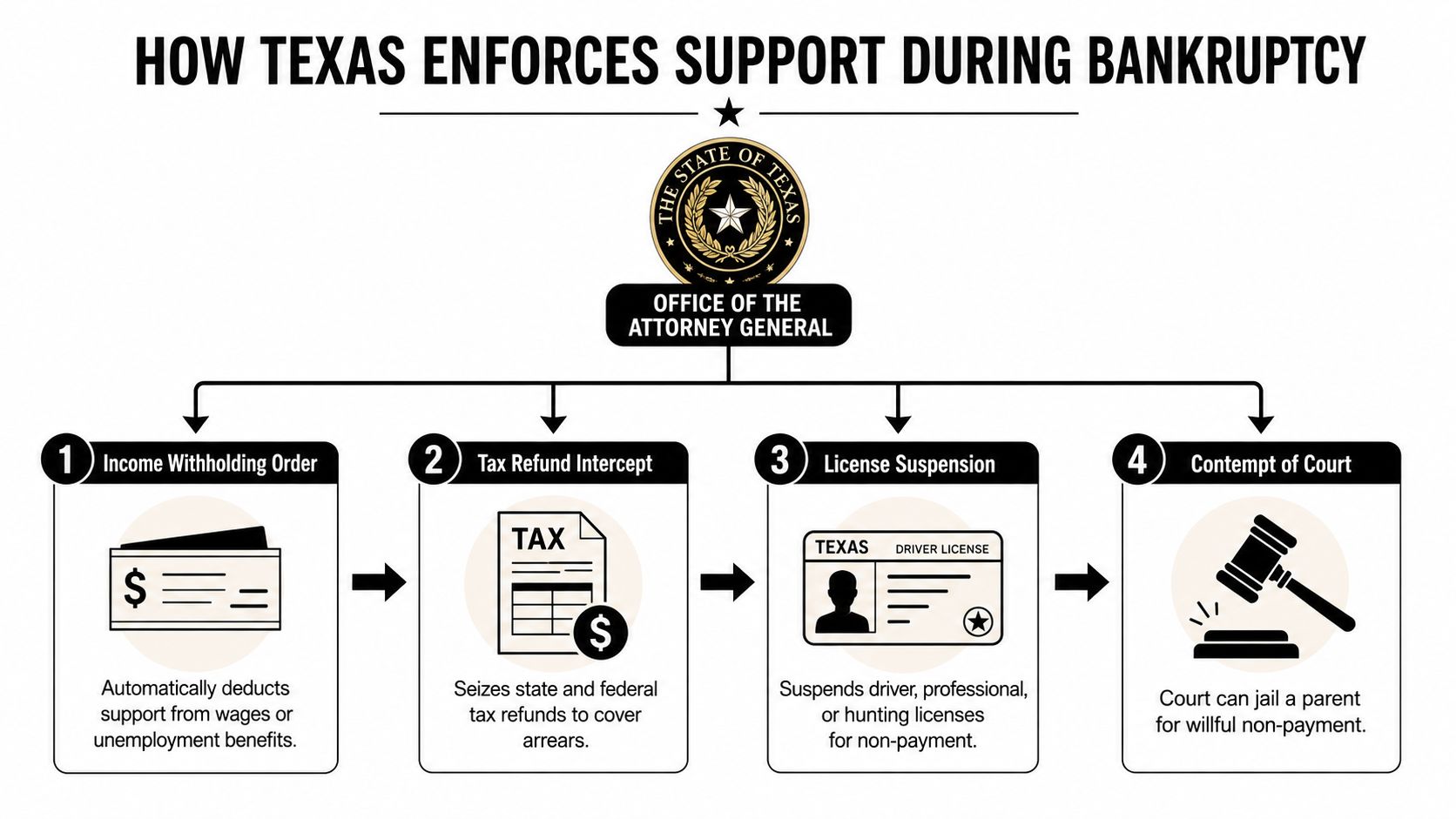
Texas does not wait for a bankruptcy case to end before enforcing child support. The Office of the Attorney General and the courts can keep using support tools because federal law makes an exception for domestic support obligations. That exception is why child support collection survives the automatic stay in a way most ordinary debt collection does not.
The tools that keep working
Income withholding under Texas Family Code §154.125 remains the most common enforcement method. Wages can still be withheld for support, and that process is built to keep payment moving even while other debts are being reorganized. Tax refund interception is another common tool, along with license suspension and contempt proceedings when nonpayment is willful.
If a debtor tries to use bankruptcy to block support collection, the state can respond. The support claim is not treated like an ordinary unsecured creditor's claim, so the parent should expect collection activity to continue unless the court has specifically limited some unrelated action.
The practical lesson for custodial parents is straightforward. Do not assume the filing means the other side gets a break on support. Verify the case, confirm whether the support action falls inside the bankruptcy exception, and keep the enforcement file organized.
If you need the enforcement route broken down, the steps are summarized in how to enforce child support in Texas.
Real-world takeaway: A bankruptcy filing can change the pace of debt collection, but it usually does not stop Texas from collecting child support through withholding, interception, or court enforcement.
That matters in contempt court too. A judge can still look at whether the parent had the ability to pay and chose not to. Bankruptcy does not erase that history.
Filing, Service, Hearings, and Modification in Texas
A support case starts with paperwork, not with a judge making assumptions. The parent seeking support or a change to support files the petition or motion, then the other parent must be served so the court gets proper jurisdiction over the dispute. After that, the parties exchange financial information, often through a Sworn Statement of Net Resources, before the hearing.
That sequence matters in bankruptcy cases because disclosure is central in both systems. A debtor cannot hide income and still expect the support calculation to hold. Texas family courts want the financial picture before they decide whether the existing order should stay in place or be changed.
Modification standards that actually control the case
Under Texas Family Code §154.123, a court can consider a material and substantial change in circumstances. Texas also has the three-year guideline review rule, which can allow review when the order no longer fits the guideline framework. Those are the standards that matter, not the fact that someone filed bankruptcy.
A hearing may be before a judge or an associate judge. The court looks at the evidence, the current financial circumstances, and whether the requested change fits the Family Code. If the parent is trying to modify support because bankruptcy changed their cash flow, the court still asks whether the legal standard for modification is met.
Practical caution: Bankruptcy does not modify a child support order by itself. A Texas court has to enter the change.
That is true for both sides. The parent paying support should not assume a bankruptcy filing gives them a lower order. The parent receiving support should not assume the bankruptcy filing freezes the family court process either. Support modifications and bankruptcy proceed on separate tracks, even when they overlap in the same month.
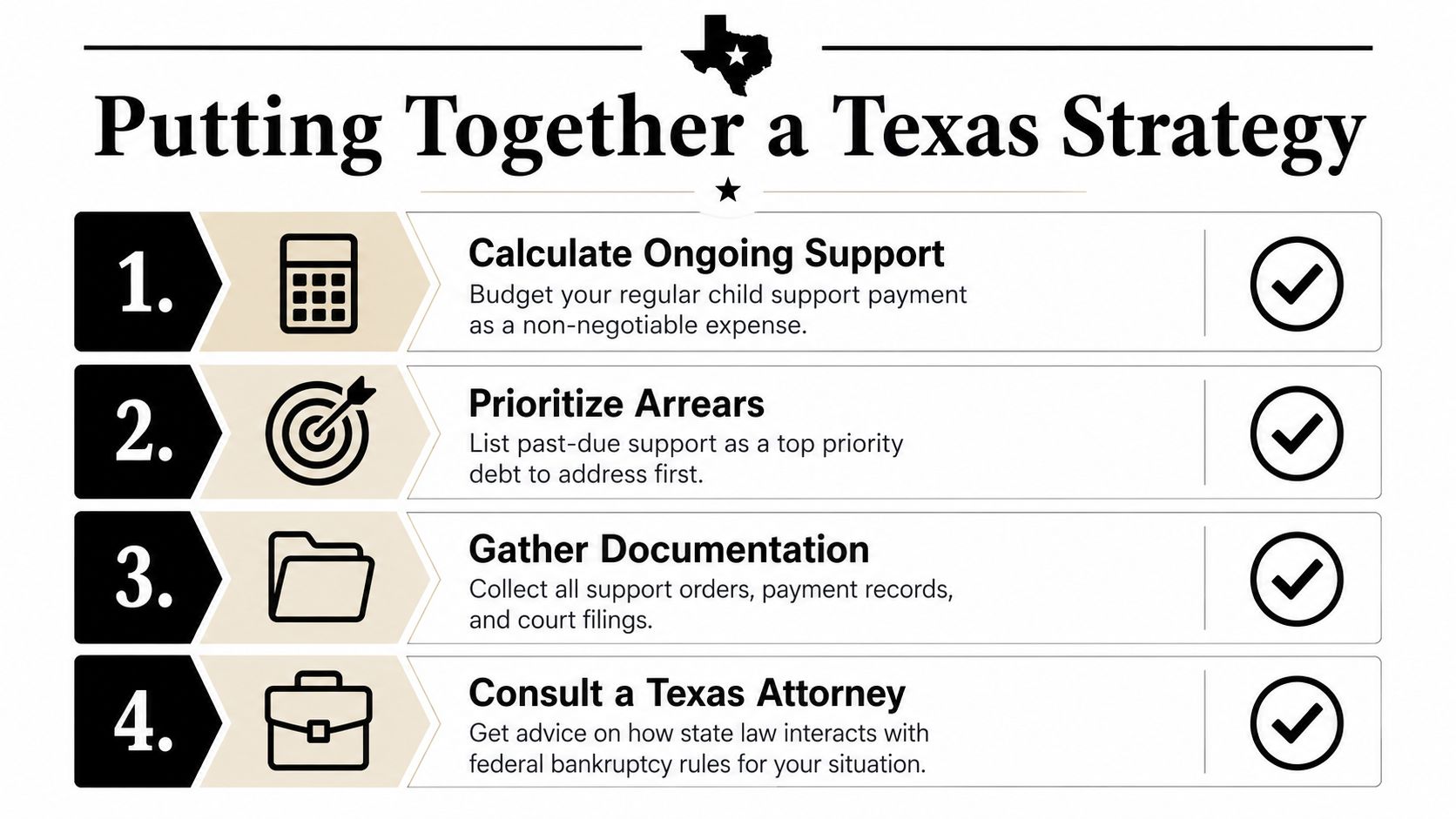
Putting Together a Texas Strategy
A good Texas strategy starts with the first question a parent asks in my office, what still has to be paid even if bankruptcy is filed? Current child support still has to be paid. Past-due support also stays on the books. That is the starting point, because bankruptcy changes the collection setting, not the support duty itself.
The parent paying support needs to budget the current order as a required monthly expense, keep arrears separate from dischargeable debt, and gather pay stubs, tax returns, support records, and proof of prior payments. That paperwork matters because Texas courts and bankruptcy courts both rely on the same financial picture, even though they use it for different reasons.
The custodial parent should move with the same discipline. Confirm the bankruptcy case number, review what the automatic stay does not reach, and keep the support file organized so wage withholding, liens, or other enforcement tools can continue where allowed. If the core issue is that the existing order no longer fits the facts, the better answer may be modification, not a fight over a debt that bankruptcy will not wipe out.
A parent who wants to understand the limits of relief should also read about Texas child support arrears forgiveness. The name sounds promising, but the law is tight. Texas can address arrears in limited ways through enforcement choices and case-specific relief, yet bankruptcy does not erase the underlying support obligation.
A short checklist that keeps the case focused
- Calculate ongoing support. Know the current order and treat it as a monthly bill that must be paid.
- Separate arrears from other debt. Past-due support is a priority obligation and survives bankruptcy.
- Gather documentation. Keep support orders, payment history, income records, and bankruptcy filings together.
- Get legal advice early. Texas support law and federal bankruptcy law overlap, but they do not work the same way.
Texas Child Support Law Office of Bryan Fagan handles support establishment, modification, enforcement, arrears disputes, high-income calculations, and guideline issues under the Texas Family Code. In a bankruptcy case, that work often has to be done alongside the bankruptcy timeline, because the support order, the arrears balance, and the court's enforcement options all keep moving at once.
If the case also involves retroactive support or a 50/50 custody dispute, the strategy becomes more technical. That is especially true when income is disputed or the support amount may sit above the guideline cap discussed earlier.
Common Texas Questions on Bankruptcy and Child Support
Will bankruptcy stop an existing wage withholding order? Usually no, because support collection is protected from the automatic stay under the rules discussed above. Can arrears be reduced through bankruptcy? No, past-due support survives the case as a domestic support obligation. Can a Texas court modify support while bankruptcy is open? Yes, family court can still address support under §154.123 and the guideline statutes, but the court has to enter the modification. What if the parent dies or becomes disabled? Texas family law keeps support tied to the child's age and condition, and support may continue longer for a child with a disability.
If you're dealing with child support and bankruptcy in Texas, the timing and paperwork matter as much as the legal rule. Texas Child Support Law Office of Bryan Fagan helps parents sort out support orders, arrears, modification requests, and enforcement issues that overlap with bankruptcy. Visit Texas Child Support Law Office of Bryan Fagan to get help with your case and move forward with a plan that fits Texas law.