You're in the middle of a custody schedule that looks fair on paper. The kids spend equal time in both homes, the calendar is balanced, and yet one parent is still talking about child support. That's the point where child support and 50/50 custody Texas stops being a simple parenting-time question and becomes a money question tied to net resources, not just overnights.
Texas courts don't treat equal possession as an automatic off switch for support. If one parent earns more, the order can still move money from the higher-income home to the lower-income home, even when both parents see the children the same amount. The result can feel counterintuitive, but it follows the Texas guideline model under the Family Code.
Why 50/50 Custody Does Not Cancel Child Support in Texas
A common courtroom scene goes like this. Two parents split the week equally, both stay involved, and both buy clothes, school supplies, and groceries. Then the income numbers come out, and the parent with the stronger paycheck realizes equal possession time doesn't end the support discussion.
Texas child support is built on a percentage-of-income model that applies to the obligor's monthly net resources, not to the parenting calendar alone, as explained in Texas child support guidance. That's why a parent can have 50/50 possession and still owe support if the other parent's resources are lower. The basic legal tension is simple, even if the result isn't, equal time does not equal equal financial capacity.
What the court is actually balancing
The court looks at the support obligation through a financial lens first. In many cases, the higher-income parent ends up paying something because the guideline system starts with the obligor's net resources and then asks whether the facts justify a deviation under Texas Family Code §154.123.
Equal parenting time helps with fairness arguments, but it doesn't erase the guideline math.
That's why parents are often surprised during temporary orders or final trial prep. They expected the possession schedule to control the outcome, but the support order turns on income, resources, and documented needs. If the numbers are lopsided, the judge may still order support even with equal possession.
What this means in real life
For the parent who expects to receive support, 50/50 custody is not a barrier if the other parent earns more. For the parent who expects to pay, the main issue is proving the right net resource figure and showing why the guideline amount should be adjusted, if it should be adjusted at all.
A 50/50 schedule can reduce conflict over day-to-day expenses, but it doesn't automatically settle the support issue. That's why the first question in court usually isn't who has the children more often, it's who has the greater financial resources and what the guideline formula produces.
How Texas Calculates Net Resources and Guideline Support
Texas starts with monthly net resources, not gross pay. That matters in court because a paycheck on paper is not the number the judge uses under the Family Code. The calculation begins with income that counts under Texas law, then subtracts the items the statute allows, which is why the child support result can look different from what either parent expected from a W-2 or pay stub. For a clean explanation of the calculation steps, see how Texas courts calculate net resources.
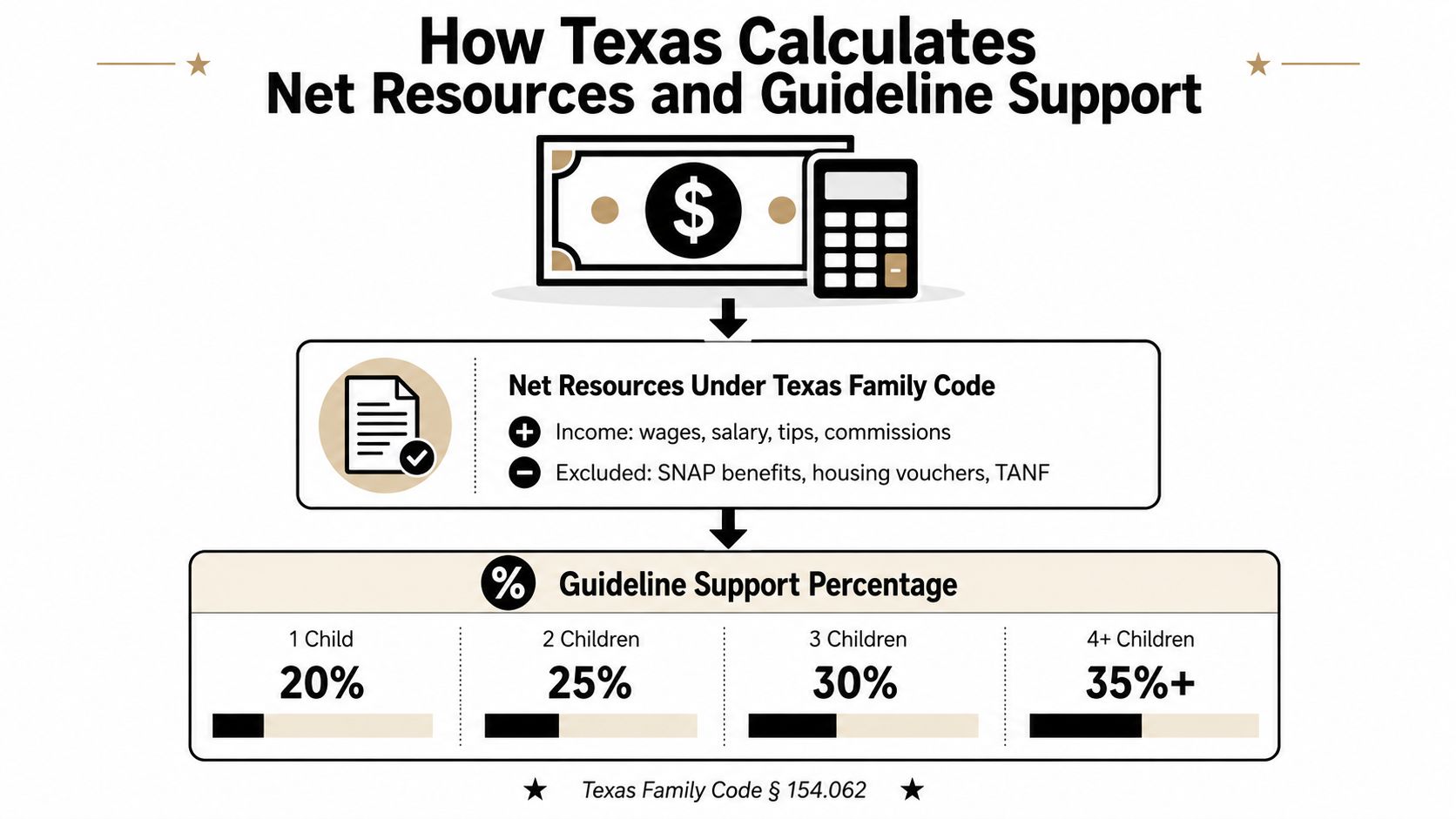
The basic formula is straightforward. The court identifies the obligor's net monthly resources, then applies the guideline percentage for the number of children. Texas uses 20% for one child, 25% for two children, 30% for three children, 35% for four children, and 40% for five children, with at least 40% for six or more children Texas child support guidance. In a 50/50 case, judges often start with that guideline number and then ask whether the facts support a different outcome under §154.123.
The cap now drives more of the conversation in higher-income cases. The guideline framework applies only up to $11,700 in monthly net resources effective September 1, 2025 Texas child support calculator guidance. That means the court can calculate a guideline amount on the capped figure, then treat income above the cap as part of the deviation analysis rather than the automatic guideline formula. Equal possession does not change that math.
A practical example helps. Before September 1, 2025, the cap was $9,200. At the one-child rate of 20%, the maximum guideline amount under the prior cap was $1,840 per month. With the new cap at $11,700, that maximum became $2,340 per month Texas child support calculator guidance. At the capped income level, the same structure also produces $2,925 per month for two children and $3,510 per month for three children How Child Support Is Calculated in Texas.
That is why 50/50 custody does not end the support analysis. Equal possession time may support a lower order, but the court still looks at income, resources, and whether the guideline amount fits the children's actual needs. If one parent has substantially higher net resources, the judge may still order support even when the schedule is split evenly. If the parents' incomes are closer together, the support issue often turns on whether the request for a deviation is supported by documents, not assumptions.
The parent asking for support should focus on proving the other side's net resources. The parent who expects to pay should focus on getting the resource calculation right and showing why the guideline number should be adjusted, if there is a real basis to adjust it. That is where the formula matters most in practice. Once the court has the net resource figure, the rest of the analysis is usually about whether the guideline result matches the evidence the judge has in front of them.
What Judges Actually Consider in a 50/50 Possession Case
A judge doesn't treat 50/50 custody like a magic phrase that wipes out support. The court looks at whether equal possession also means equal financial strength, and it usually doesn't. Texas law allows deviation under Texas Family Code §154.123 when the guideline amount doesn't fit the children's actual situation.
The under-covered point is that equal possession time can support a deviation, but it doesn't guarantee one. Courts still ask whether the order matches the children's needs and both parents' financial realities, especially when one parent carries higher resources or more stable income.
A 50/50 schedule can be a strong fairness argument, but it's not a substitute for proof.
The factors that tend to matter most are practical, not theatrical. Courts look at the parents' resources, the children's age and needs, medical and educational expenses, work schedules, and whether the shared arrangement reduces expenses in a meaningful way. That framework is consistent with the deviation discussion in Texas child support deviation guidance and with the standards in §154.123.
| Common §154.123 Deviation Factors in 50/50 Cases | Why It Matters |
|---|---|
| Each parent's resources | Unequal income can make a straight 50/50 split financially unfair |
| Children's medical needs | Ongoing treatment can justify support above or below guideline numbers |
| Educational expenses | Tuition, tutoring, or special programs can change the real cost picture |
| Work schedule | A parent's schedule can affect who pays for childcare or who can provide care |
| Shared expenses | Courts want to know whether both homes truly carry the same burden |
What wins and what usually doesn't
What helps is documentation. Pay stubs, tax returns, school bills, therapy invoices, and evidence of who pays recurring expenses matter much more than general complaints about fairness. What usually fails is a vague request to “just make it zero” because the schedule is equal.
The firm's child support deviation analysis at How Judges Calculate Child Support Deviations in Texas fits that courtroom reality. Judges don't buy slogans, they want a record that shows why a specific number, or a departure from the guideline number, is justified.
The optional video below also gives a helpful visual overview of the balancing process.
Sample Calculations for Two Incomes and Equal Time
The cleanest way to understand child support and 50/50 custody Texas is to compare two income profiles with one child and equal possession. The guideline formula starts with net resources, then applies the 20% one-child rate, but the court may also consider whether the higher-income parent should pay something closer to a difference-based result in a 50/50 setting.
For a moderate-income case, assume the obligor's monthly net resources are below the cap, and the guideline is applied directly. The one-child guideline is 20% of net resources, so a parent with $5,000 in monthly net resources would start at $1,000 per month under the formula. In a true 50/50 case, that figure may be argued down if the evidence shows both parents share costs evenly and the children's needs are otherwise being met.
| Sample 50/50 Custody Calculations at Different Income Levels | Net Resources | Guideline % | Monthly Support |
|---|---|---|---|
| Moderate-income example, 1 child | $5,000 | 20% | $1,000 |
| Cap-level example, 1 child | $11,700 | 20% | $2,340 |
| Cap-level example, 2 children | $11,700 | 25% | $2,925 |
For a high-income case, the cap matters more than the actual paycheck. If a parent earns well above the ceiling, the guideline still only applies to $11,700 in monthly net resources, which produces $2,340 for one child and $2,925 for two children at the capped level SBrown Lawyer calculator guidance. The remaining income doesn't disappear, but it becomes relevant to whether the court should deviate upward under §154.123 when the children's needs justify it.
How the difference-between-the-parents approach shows up
In practice, some 50/50 orders end up looking less like a full guideline award and more like a netting exercise between two parents' incomes. That doesn't happen automatically, and it isn't a separate statutory formula. It happens because the court is weighing the guideline baseline against shared expenses, equal possession, and the actual financial gap between the homes.
The calculator guide at Texas child support calculator guide is useful because it reinforces the same point, the number starts with the guideline math, then turns on the facts. If the record shows extra medical or educational costs, a modest deviation can move the final number up or down.
That's the key lesson from the numbers. Equal time changes the argument, but it doesn't erase the baseline calculation. The cap, the income gap, and the children's documented expenses all stay in the case until the judge signs a new order.
High-Income Cases and Retroactive Support Issues
High-income 50/50 cases often get overcomplicated because one parent assumes the cap solves everything. It doesn't. The $11,700 cap means the guideline formula stops at that point, but Texas can still order additional support above the guideline amount when the children's needs and the parent's income justify it under Texas Family Code §154.123 and the guideline framework described in the Texas materials above.
Retroactive support in a shared-possession fight
Retroactive support comes up when a parent asks the court to set support for a period before the current order. In a 50/50 dispute, the paying parent often argues that equal possession should limit back support, while the other side argues that the income gap and the children's needs still justify it. Texas courts weigh the proof, including when the parent knew about the children, what support was provided, and whether the requested amount fits the statutory framework.
That's why retroactive claims are evidence-heavy. The court is not guessing at the past. It is looking for records that show who paid what, when the children lived where, and how the financial picture worked during the relevant period.
The problem in high-income cases is that the guideline number may understate the true cost of raising the children. If the children have special educational, medical, or other proven needs, a court may go beyond the capped guideline amount rather than treating the cap as the finish line.
Why equal possession is not a full defense
Equal possession can help narrow retroactive exposure, but it doesn't automatically defeat it. The court still asks whether support should have been paid based on the legal duty and the financial facts, not just the time split. If the records show a significant income gap and a lack of prior support, the judge can still enter a meaningful retroactive award.
That's the practical point most parents miss. The custody schedule affects the argument, but it doesn't cancel the underlying support analysis.
Modifying or Enforcing a Texas Child Support Order
A support order changes through a court case, not through a handshake agreement at drop-off. To seek a modification, a parent files a petition, serves the other parent, exchanges financial information, and then asks the court to decide whether there has been a material and substantial change or whether the order should otherwise be adjusted under the Texas Family Code.
The filing matters because the court can only act on what's properly in front of it. Service matters because the other parent has to get notice. Financial disclosure matters because the judge needs current numbers, not old assumptions about income or possession.
What enforcement looks like
When a parent falls behind, enforcement can include wage withholding, contempt, and license-related remedies, depending on the facts and the relief requested. A 50/50 schedule does not excuse nonpayment. If the order says support is due, the paying parent has to follow it until the court changes it.
Keep the order current first, then argue for a different amount if the facts justify it.
The practical mistake is waiting too long. Parents sometimes assume shared possession gives them room to stop paying, then find themselves in arrears while trying to sort out custody issues. That approach creates a second problem on top of the first.
The process in plain order
- File the petition. Ask the court for a modification or enforcement remedy.
- Serve the other parent. Notice is required.
- Exchange financial records. The court needs real income and expense data.
- Attend mediation or hearing. Many cases settle before the judge rules.
- Get a signed order. Until then, the old order usually controls.
Parents who are facing a modification, defense, or enforcement issue often need a structured strategy session rather than guesswork. The Texas Child Support Law Office of Bryan Fagan handles establishment, modification, enforcement, and high-income disputes under the Texas Family Code, including cases involving the updated cap and deviation arguments.
Documentation to Prepare and When to Call an Attorney
A 50/50 case turns on proof more than emotion. Before a hearing or consultation, gather pay stubs, tax returns, childcare receipts, medical bills, proof of the possession schedule, and any prior court orders. Those documents feed directly into the net resources calculation and into a §154.123 deviation argument.
Build the record before you walk into court
If you're asking for support, bring proof of the child-related expenses that support your request. If you're fighting a support number, bring records that show your actual income and the expenses you already cover in your home. The judge cares about the paper trail because it shows how the numbers work in the everyday world.
The strongest child support arguments are built from records, not from memory.
Call a Texas family law attorney early if the case involves a high-income earner, a contested 50/50 arrangement, enforcement defense, or a retroactive support claim. Those cases move fast once the pleadings are filed, and the difference between a workable order and a bad one is often the quality of the records you put in front of the court.
Frequently Asked Questions and Final Takeaways
Does equal custody mean no child support in Texas? No. Equal possession does not stop support when the parents' incomes differ, because Texas still starts with the net-resources guideline model and can adjust the number under §154.123.
How does the new cap affect existing orders? The $11,700 cap effective September 1, 2025 changes the guideline baseline for new calculations, and it can matter in modification or deviation disputes when the court re-evaluates support. A parent with higher income may still owe support even in a true 50/50 schedule, because the cap limits the guideline math rather than erasing it.
How fast can a modification take effect? A support number usually does not change just because the possession schedule changed. A filed case, service, and a signed order are usually what move the amount, so the old order normally stays in place until the court acts.
The practical rule stays the same, 50/50 possession matters, but income still drives the analysis. A parent who earns more can still owe support to keep the child's household resources balanced, even when time is split evenly. Once you understand the cap, the guideline percentages, and the court's power to deviate, the next step is a legal strategy choice, not a guess.
If you are dealing with a support order in a 50/50 case, the Texas Child Support Law Office of Bryan Fagan can help you evaluate net resources, deviation arguments, modification options, and enforcement risk under current Texas law. Visit Texas Child Support Law Office of Bryan Fagan to get help building a support strategy that fits your case.