You're preparing for a child support hearing in Fort Bend County with incomplete records, conflicting income information, and no clear idea what the judge will expect. You may be asking whether a pay stub is enough, whether the current order can be changed, or whether payments made directly to the other parent will count. The answer depends on procedure, evidence, and the Texas Family Code, not on informal arrangements or handwritten estimates.
A successful child support court Fort Bend County strategy starts before you enter the courtroom. You need the correct filing, proper service, reliable financial records, and a calculation based on monthly net resources. You also need to understand how Fort Bend County connects local case administration with Texas's statewide payment and enforcement system.
Preparing for Child Support Court in Fort Bend County
Your first hearing may involve establishing support, modifying an existing order, or enforcing unpaid amounts. Those cases look different procedurally, but the court will focus on the same practical questions: What order is currently in place, what does the evidence show about income and expenses, and what result serves the child's interests under Texas law?
Fort Bend County operates a dedicated Child Support Office for county residents when the case isn't otherwise handled by the Office of the Attorney General. The office is located at 1317 Eugene Heimann Circle, Suite 200, Richmond, Texas 77469, and its public phone line is 281-342-6222. Published office hours are 8:00 AM to 4:00 PM, Monday through Friday. You can confirm those details through the Fort Bend County Child Support Office.
That local office creates cases in the Texas Child Support Disbursement Unit, known as TXCSDU. Court-ordered payments are routed through the Texas Child Support Disbursement Unit at PO Box 659791, San Antonio, Texas 78265-9941, rather than being treated as a purely local Fort Bend transaction. Payment records, withholding, arrears, and enforcement often depend on the statewide ledger.
Practical rule: Treat your case as a court proceeding connected to a statewide payment system, not as a private disagreement between parents.
Build the case around the order
Bring the existing order, any modifications, wage withholding orders, medical-support provisions, and payment history. If you're asking for a change, identify the exact provision you want changed and the evidence supporting that request.
Fort Bend County's financial documents show why these cases require organized administration. Its FY2024 Annual Financial Report lists child-support case inquiry figures including 34,971, 36,468, 40,130, 38,540, and 45,182, followed by 37,248, 41,600, 42,200, 42,369, and 42,584 in another sequence. The county budget separately lists $546,115 for total child support and a related $5,000 federal reimbursement line. Those figures indicate substantial recurring demand for child-support services, so assume the process is structured and document-driven.
Before the hearing, organize your records by issue. Separate current support from arrears, base guideline support from medical support, and income evidence from child-expense evidence. A judge can work with difficult facts, but a disorganized presentation makes it harder to see the result you're requesting.
Filing Your Case and Navigating Local Procedures
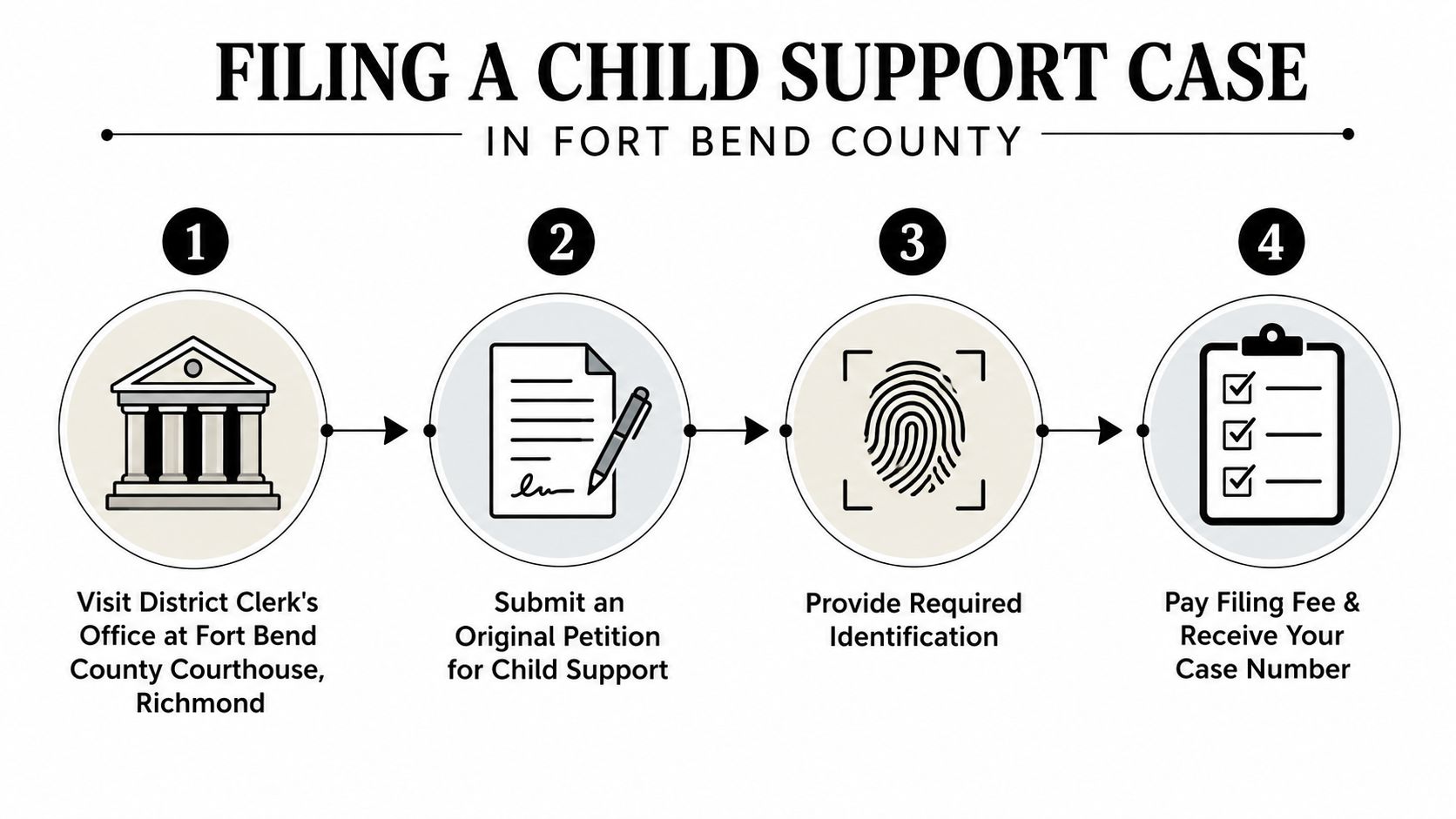
A new case generally begins with the Fort Bend County District Clerk at the Fort Bend County Courthouse in Richmond. The filing may be an Original Petition to Establish the Parent-Child Relationship, a divorce petition containing child-support requests, or another pleading appropriate to the existing legal relationship between the parents.
Prepare the required pleadings and supporting forms before filing. A typical filing package may include a civil case information sheet and the applicable filing fee. Fee-waiver procedures may be available to qualifying indigent filers, but you'll need to follow the clerk's process and provide the requested financial information. Confirm current filing requirements with the clerk rather than relying on a form downloaded from an unrelated county.
Complete service correctly
Filing starts the case, but it doesn't give the court authority over the responding party by itself. The other parent must receive formal service through a constable or private process server, unless they voluntarily execute a valid waiver of citation. Don't assume that texting the petition, emailing it, or handing over a copy satisfies service.
After filing, keep your cause number and monitor the clerk's docket. Fort Bend cases may be assigned to a particular district court, and the assigned court controls notices, settings, standing orders, and hearing procedures. A request for temporary support or temporary orders should be filed deliberately, with facts showing why the court needs to act before final resolution.
The Texas child support filing guide can help you understand the general filing sequence, but local clerk requirements and the assigned court's orders still control your case. If you're seeking a change to an existing order, The Step-by-Step Child Support Modification Process provides a focused overview of what to expect when filing to modify child support.
Don't create payment problems
Once support is ordered, payments in court-ordered cases are routed through TXCSDU. Fort Bend County identifies the San Antonio disbursement unit as the payment destination, reinforcing that parents shouldn't rely on undocumented direct payments.
Common filing failures include using the wrong court, omitting requested relief, failing to serve the other parent, and appearing without proof of service. A continuance or dismissal can cost time and may leave the existing support order unchanged.
How Texas Calculates Child Support Under Current Guidelines
Texas calculates guideline child support from the obligor's monthly net resources, not just gross salary. Texas Family Code §154.062 addresses the resource calculation, while §154.125 establishes the standard guideline method and low-income provisions. Net resources generally begin with income and account for permitted deductions such as Social Security taxes, federal income taxes for a single person, qualifying health or dental insurance or cash medical support paid for the child, union dues, and certain retirement contributions. See the Texas Family Code provision on guideline child support.
Effective September 1, 2025, the cap on monthly net resources is $11,700. Guideline percentages apply up to that ceiling unless the court makes a lawful deviation or orders additional support based on proven needs. The maximum presumptive amounts are:
| Number of Children | Guideline Percentage | Max Monthly Support at $11,700 Cap |
|---|---|---|
| One | 20% | $2,340 |
| Two | 25% | $2,925 |
| Three | 30% | $3,510 |
| Four | 35% | $4,095 |
| Five | 40% | $4,680 |
The cap and amounts are summarized in the Texas child support guideline explanation.
Use net resources, then apply the percentage
Suppose the obligor has $6,000 in monthly net resources and two children before the court. Under the standard guideline percentage, 25% produces $1,500 per month, unless the court applies a different calculation or deviation. That example shows why the parties must prove deductions accurately. A gross-income figure can materially distort the calculation.
At the cap, an obligor with $11,700 in monthly net resources and one child reaches the presumptive guideline amount of $2,340 per month, calculated at 20%. Income above the cap doesn't automatically produce a higher guideline amount. The party seeking support above the guideline base must present evidence supporting a deviation.
You can review the Texas child support calculation guide for the mechanics, but don't submit a calculator result without supporting records. Courts need evidence showing where the income came from, which deductions apply, and whether the claimed figures reflect actual resources.
Know when the court can deviate
Texas Family Code §154.123 permits deviation when applying the guideline amount would be unjust or inappropriate under the circumstances. The court may consider the child's age and needs, each parent's ability to contribute, childcare costs, medical needs, education, and possession arrangements. The statute and its listed factors are available through the Texas Family Code §154.123 text.
A high-income parent may face an above-guideline request when the other parent proves substantial medical, educational, or extracurricular needs. The request succeeds through admissible evidence and written findings, not through an argument that the parent earns more.
Modifying and Enforcing Existing Child Support Orders
An existing child support order stays in effect until a judge signs a new order. A verbal agreement, email exchange, or direct payment arrangement doesn't modify the court's obligation. The Texas Attorney General's support modification process describes modification as a formal court process that includes a hearing.
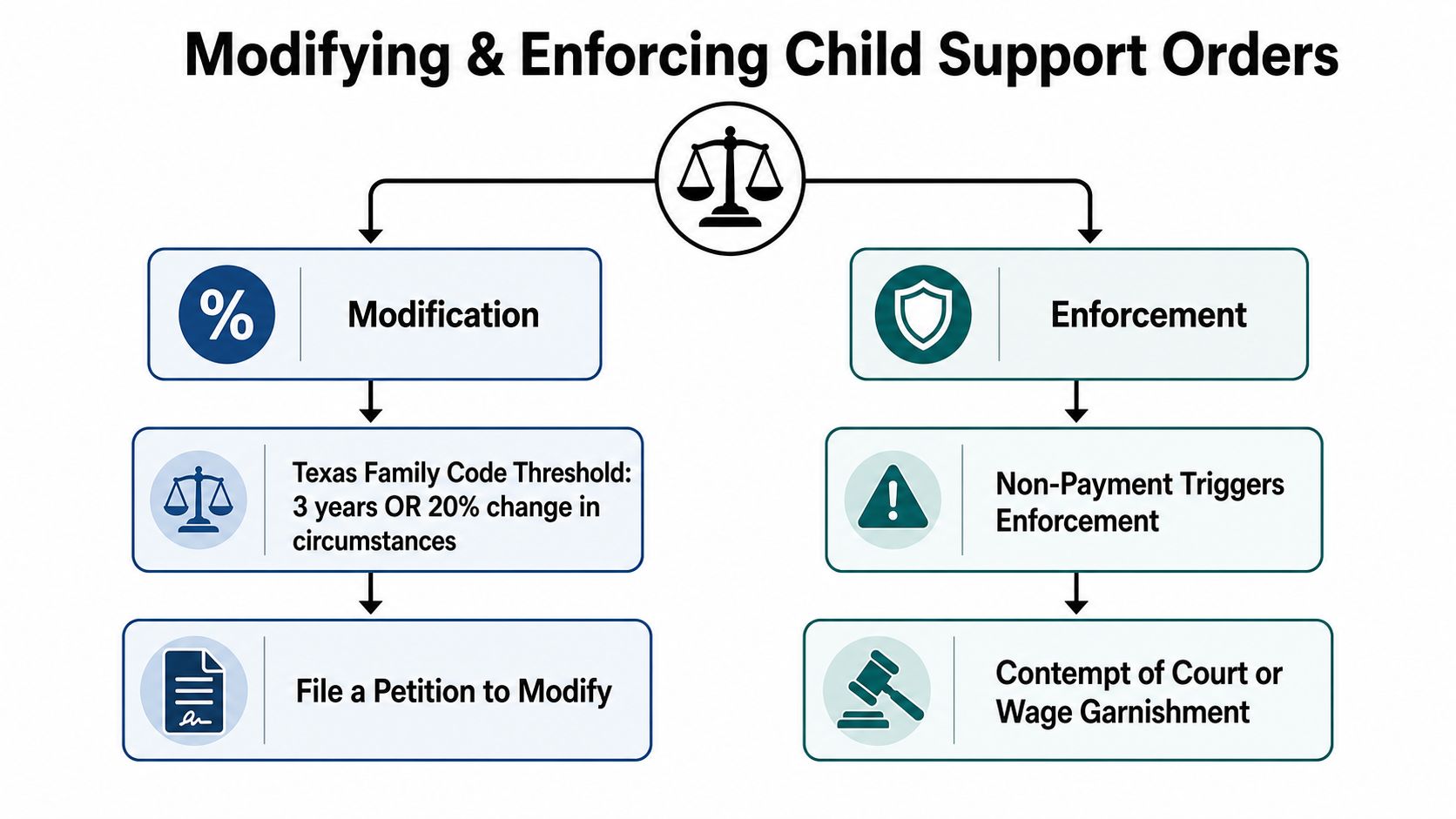
Under Texas Family Code §156.401, the practical modification threshold usually comes through one of two paths. The order is at least three years old and the recalculated guideline amount differs from the current order by 20% or $100, or the moving party proves a material and substantial change in circumstances. The Attorney General's modification standards provide the procedural framework.
Modification requires proof, not frustration
A sustained income change, a new dependent obligation, a change in insurance, or a different primary residence for the child may support modification. A temporary reduction, anticipated job change, or ordinary fluctuation usually won't carry the same weight. Texas courts look for a legally meaningful change connected to the requested order.
File the petition or motion in the court with continuing jurisdiction, serve the other parent, and notify or serve the OAG when required. Then present current pay information, tax records, insurance proof, custody evidence, and a guideline comparison. The court can modify only through a new signed order.
Enforcement starts with an accurate ledger
For unpaid support, first separate current support from past-due support. Verify the arrears ledger, identify credits, confirm employer information, and pursue income withholding when available. A Texas-focused collection summary attributes more than 80% of Child Support Division collections to wage withholding, making documented withholding a central enforcement tool. Review the Texas child support collection summary for that operational point.
A Motion for Enforcement may request contempt remedies under Chapter 157, but the respondent has the right to notice and a hearing. Possible remedies can include income withholding, license consequences, liens, and incarceration when the statutory requirements are met. Don't withhold visitation in response to missed payments. Possession and support are separate court obligations.
The hearing timeline depends on service, docket availability, discovery, and the complexity of the income dispute. Move quickly, but don't file an enforcement case with an inaccurate arrears calculation.
Building Your Evidence and Preparing for the Hearing
The strongest Fort Bend child support presentation is numerical, documented, and easy to verify. Bring records that establish income, lawful deductions, insurance costs, childcare expenses, and the child's needs. A handwritten expense list can support your testimony, but it shouldn't replace source documents.
Assemble a hearing file
Use separate tabs for income, deductions, child expenses, the current order, payment records, and communications. Include:
- Employment records: Recent pay stubs, W-2s, 1099s, tax returns, and employer information.
- Financial records: Bank statements, business records, and documents showing recurring deposits or transfers.
- Permitted deductions: Proof of Social Security, federal tax, qualifying insurance, union dues, and retirement contributions.
- Child-related costs: Health insurance premiums, medical bills, childcare invoices, school records, and documented activity costs.
- Court records: The operative order, prior findings, wage withholding notices, and a current payment ledger.
The Texas child support evidence guide offers a practical framework for organizing documentation, but tailor the file to the specific dispute.
Present the calculation clearly
Prepare a worksheet showing gross income, each claimed deduction, resulting monthly net resources, the guideline percentage, and the requested order. Self-employed parents should explain legitimate business expenses separately from personal expenses. If the other parent controls the records, use discovery tools and subpoenas rather than asking the judge to guess.
Arrive early at the Fort Bend County courthouse in Richmond, dress appropriately, silence your phone, and address the judge respectfully. Bring organized exhibits and copies for the other parties and the court. Hearsay, unauthenticated screenshots, and unsupported statements from relatives invite objections. A bank statement, employer record, certified payment history, or properly admitted business record carries more weight than a verbal accusation.
Courtroom advice: Give the judge a clean path from the document to the number you want ordered.
Handling Complex Income and Custody Scenarios
Complex cases turn on proof. A high-income parent, business owner, voluntarily unemployed parent, or parent with children in multiple households can't expect the court to accept a simple salary figure without examining actual resources and obligations.
When monthly net resources exceed the $11,700 cap, the presumptive guideline calculation stops at the cap. Texas Family Code §154.126 governs situations involving net resources above the guideline level, while §154.123 supplies the deviation factors. The parent seeking more must prove the child's actual needs and connect those needs to the requested support. Medical, educational, and other recurring costs need records, not general claims about lifestyle.
Texas Family Code §154.066 addresses net resources and earning capacity when a parent is intentionally unemployed or underemployed. Work history, education, professional credentials, available employment, and the reason for the income reduction can matter. A parent who leaves a well-paid job without a credible reason may face an income calculation based on earning capacity rather than current earnings.
| Scenario | Legal Standard | Key Evidence Required |
|---|---|---|
| Net resources above the cap | Guideline base stops at the statutory cap, with possible additional support under applicable deviation standards | Tax returns, business records, proof of actual child needs, medical and educational expenses |
| Voluntary unemployment or underemployment | Court may consider earning capacity under §154.066 | Work history, credentials, prior compensation, job-search records, available employment |
| Retroactive support | Texas Family Code §154.009 governs retroactive support and its limits | Child's residence history, prior support, notice, expenses, payment records |
| Unequal or 50/50 possession | Possession affects the analysis, but doesn't automatically eliminate support | Calendar records, school-week responsibilities, transportation, direct expenses |
| Children in multiple households | Multi-family adjustment rules may affect guideline calculations under §154.129 | Existing orders, birth records, proof of support actually paid |
| Self-employment income | Court examines real resources and legitimate business expenses | Profit-and-loss records, bank statements, tax filings, business ledgers |
Retroactive support requires careful attention to Texas Family Code §154.009, including the statutory lookback presumption. Prove what the child needed, what the parent knew, what support was paid, and why the requested amount is justified.
A 50/50 schedule also doesn't automatically cancel support. Texas courts may still designate one parent as the obligor, especially when incomes and direct child expenses differ. Present the actual possession schedule and financial responsibilities instead of relying on the label “equal custody.”
Frequently Asked Questions About Fort Bend Child Support
Does support continue after the child turns 18?
Under Texas Family Code §154.002, support can continue if the child is still enrolled in the required educational program and other statutory conditions apply. Check the precise language of the order and the child's circumstances before assuming payments end automatically.
How does the court verify self-employment income?
The court can examine tax returns, business bank statements, profit-and-loss records, invoices, distributions, and personal expenses paid through the business. If a parent refuses to provide records, request discovery and use subpoenas where appropriate.
What happens if the other parent won't provide financial records?
Ask the court to compel discovery and seek appropriate remedies for noncompliance. Don't rely on accusations alone. Identify the missing records, explain why they matter to net resources, and request a specific order.
Can Fort Bend courts impute income to an unemployed parent?
Yes, when the evidence supports intentional unemployment or underemployment under Texas Family Code §154.066. Show prior earning capacity, qualifications, work history, and the circumstances behind the current income.
Should I use the OAG or a private attorney?
The OAG can assist with administrative establishment, collection, and enforcement functions. A private attorney is useful when you need a personalized litigation strategy, complex income analysis, discovery, deviation arguments, or courtroom advocacy.
Can parents pay each other directly?
Court-ordered payments should route through TXCSDU. Off-the-books payments can fail to appear on the official ledger, so preserve receipts and obtain clear written proof if a direct payment occurs.
What if deployment, incarceration, or disability changes income?
The order doesn't change automatically. File for modification and provide medical, military, incarceration, or employment records showing the material change. Until a judge signs a new order, the existing obligation remains enforceable.
Texas Child Support Law Office of Bryan Fagan handles Fort Bend child support establishment, modification, enforcement, arrears, wage withholding, high-income calculations, retroactive support, and disputed income matters. To prepare your evidence and strategy before filing or appearing in court, visit Texas Child Support Law Office of Bryan Fagan.