 Skip to content
You may be dealing with this right now. A notice arrives, the other parent asks for a change, or missed payments have piled up long enough that informal promises no longer matter. In Pearland, that usually means one thing: you need to stop guessing what Texas child support law says and start preparing for what a judge will look at.
Most parents don't need more internet summaries. They need a practical answer to the questions that decide outcomes in court: what counts as income, what documents matter, whether equal possession changes support, and whether a higher earner can be ordered to pay above the guideline cap. Those are the issues that turn a manageable case into an expensive one when handled too casually.
Why Hiring a Pearland Child Support Lawyer Matters
A child support case often looks simple until the paperwork starts. One parent believes the amount is obvious. The other believes the calculator is wrong. Then you learn that statewide law controls the formula, but local filing practices, hearing settings, and the pace of the court docket still affect how fast your case moves and how well your evidence is presented.
Pearland parents are walking into a system that is large and process-driven. Texas remains one of the largest child-support systems in the United States, with the Attorney General's Child Support Division handling over 1.5 million cases annually and, in one reported year, collecting $4.8 billion for Texas children while serving about one in four Texas children, as reported by the Texas Attorney General child support division release. That scale is one reason cases can feel impersonal if you don't come prepared.
A Pearland child support lawyer matters because the dispute usually isn't just about whether support should be paid. It's about proof. The court wants payroll records, tax returns, prior orders, health insurance information, and a clean timeline. If your income changes from month to month, if you're paid in commission, or if parenting time has shifted, the wrong presentation can produce the wrong order.
When a lawyer becomes necessary
Some cases can start with basic information gathering. Others need counsel early.
- New support orders: If support has never been set, the court needs a complete income picture and a workable order.
- Modification fights: If the other parent claims your income has increased, timing and records become central.
- Enforcement cases: If support is unpaid, the issue shifts from calculation to collection tools and compliance.
- High-income disputes: These cases rarely turn on a simple calculator result.
Practical rule: Online calculators help with rough estimates. They don't resolve disputes about net resources, deviations, or whether the facts support a change in the existing order.
Parents looking for local representation often start with a Pearland child support attorney page because they want someone who understands both Texas law and how these cases move from filing to hearing.
How Texas Calculates Child Support Under the Guideline Formula
A parent walks into court convinced the math is simple. Then the other side argues about bonus income, health insurance, prior children, or whether the September 2025 cap increase changes an older order. That is where support hearings in Pearland usually turn. The percentage chart is the easy part. The fight is usually over which numbers belong on the worksheet and whether the cap affects the case in front of the judge.
Texas child support starts with Texas Family Code §154.125. The court calculates support from net resources, not gross income. If net resources are overstated or understated, the order will be wrong from the start.
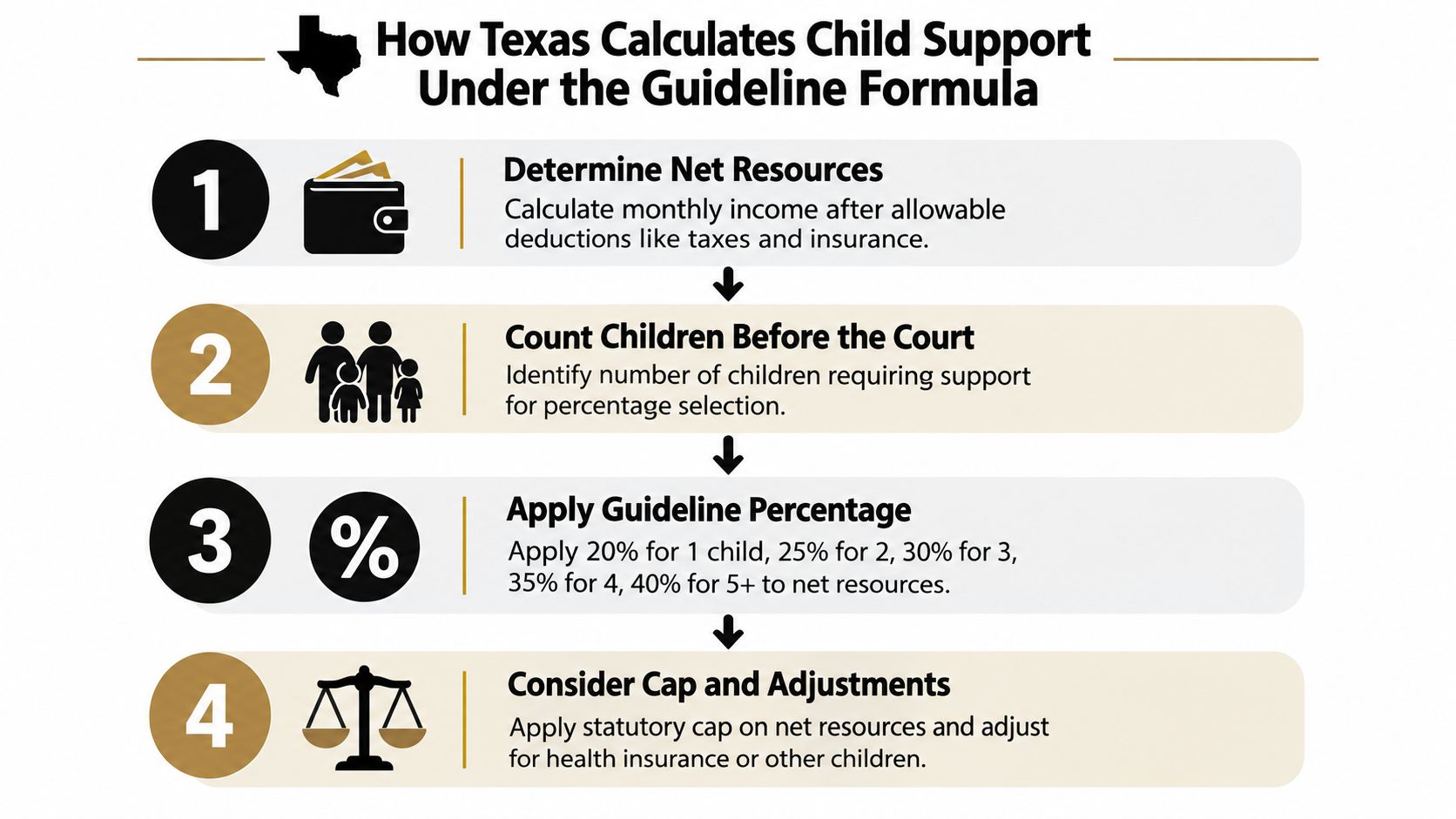
The four steps the court follows
Determine net monthly resources.
This includes wages and can include overtime, commissions, bonuses, self-employment income, rental income, and other sources recognized under Texas law. In real cases, the work is. A salaried employee with clean paystubs is one thing. A parent paid through a business, with irregular deposits or year-end bonuses, is another.Count the children before the court.
The guideline percentage depends on how many children are in the case. If the parent has a duty to support other children outside the case, the worksheet can change.Apply the guideline percentage under §154.125.
Texas generally applies 20% for one child, 25% for two, 30% for three, 35% for four, and 40% for five or more children under Texas Family Code guideline references summarized here.Apply the cap and consider deviation if the facts support it.
Under Texas Family Code §154.123, the court can move away from the guideline result if applying the standard amount would be unjust or inappropriate.
Parents who want the full worksheet logic can start with this explanation of how to calculate child support in Texas. The practical dispute is often not the percentage. It is whether the income was classified correctly and whether all allowable deductions and support factors were handled the right way. That is why What Counts as Net Resources for Child Support often decides the case.
The September 2025 cap change
The high-income issue matters more in Pearland than many articles admit. A large share of contested hearings involve parents whose income reaches or exceeds the guideline ceiling, and those cases do not end with a basic calculator result.
On September 1, 2025, the monthly net-resource cap increased from $9,200 to $11,700, as explained in this Texas guideline cap update. That raises the guideline amount at the cap to $2,340 for one child, $2,925 for two, $3,510 for three, $4,095 for four, and $4,680 for five or more.
That change does matter. It does not automatically reopen every existing order. It does not mean a high earner will always pay above the old amount. It means the higher ceiling can affect new cases and modification cases that properly come before the court after the effective date.
That distinction matters in practice. If support was set years ago and no modification standard is met, the cap increase alone does not guarantee a new order. If a modification is properly filed and the court reaches the guideline analysis under current law, the higher cap can materially change the result.
Texas guideline support at the $11,700 net resource cap
| Number of Children | Guideline Percentage | Monthly Support at Cap |
|---|---|---|
| One child | 20% | $2,340 |
| Two children | 25% | $2,925 |
| Three children | 30% | $3,510 |
| Four children | 35% | $4,095 |
| Five or more children | 40% | $4,680 |
This short video also helps illustrate how guideline support issues are commonly discussed in practice.
What deviation looks like in court
A judge can depart from the guideline amount under §154.123, but the court needs evidence, not a general claim that the result feels unfair.
In higher-income cases, parents often misunderstand what the cap change does not do. It does not give the court a reason to increase support above guideline levels just because one parent has done well financially. The judge still looks for proof tied to the child's actual needs. If someone wants support above the capped guideline amount, that request usually rises or falls on records, testimony, and whether the claimed expenses are child-related.
Examples that can matter include unreimbursed medical costs, significant educational needs, disability-related expenses, or travel costs tied to possession. Vague lifestyle arguments usually do not carry much weight. Clear documentation does.
Common Child Support Case Types in Pearland
Not every child support case is the same. The right strategy depends on what kind of order you're trying to get, change, or enforce. In Pearland, I see parents lose time because they prepare for the wrong kind of hearing.
The six case types that come up most often
| Case type | What triggers it | What usually matters most |
|---|---|---|
| Establishment | No current order exists | Income records, parentage, possession schedule |
| Modification | Circumstances changed after the last order | Timing, updated financials, new facts |
| Enforcement | Support wasn't paid as ordered | Payment history, arrears record, compliance evidence |
| Retroactive support | Support is sought for a prior period before entry of an order | Financial history and timeline |
| High-income dispute | Income reaches or exceeds the guideline ceiling | Net resource proof, child needs, deviation evidence |
| 50/50 custody dispute | Equal or near-equal possession raises support questions | Actual schedule, income comparison, order language |
Establishment and modification cases
An establishment case creates the first support order. The court needs clean numbers and a realistic picture of parenting time. These cases are often more document-heavy than parents expect because the initial order becomes the baseline for future modifications and enforcement.
A modification case is different. The question isn't whether a different amount sounds fair. The question is whether Texas law allows the judge to change an existing order based on later facts.
Enforcement and retroactive support
An enforcement case is about obedience to an order already on the books. The focus shifts from math to proof of nonpayment, wage withholding, arrears, and available remedies.
A retroactive support claim reaches backward. These cases turn on chronology. If the dates are sloppy, the argument weakens fast.
The strongest child support file is usually the one with the clearest timeline, not the one with the most emotion behind it.
High-income and equal-possession disputes
Texas child support guideline calculations are capped at monthly net resources of $11,700, and the Office of the Attorney General notes that the standard guideline formula is designed to apply only up to that ceiling; income above the cap does not automatically increase the guideline amount, so high-income cases often turn on whether the court should set a higher award by analyzing proven needs, discretionary deviation factors, and documentary evidence of actual child-related expenses, as reflected in the Texas Attorney General monthly child support calculator guidance.
That means a higher-income parent doesn't automatically lose because the paycheck is large. It also means the receiving parent doesn't automatically lose if the guideline cap has been reached. The fight moves to evidence under §154.123.
Fifty-fifty custody cases create a different tension. Texas doesn't erase support just because possession time looks equal on paper. The court still examines income, order structure, and whether the guideline amount should apply or be adjusted.
What Happens When You Work With a Child Support Attorney in Pearland
Most parents want to know what the process feels like, not just what the law says. A good child support case moves in a sequence: evaluate, file, serve, exchange records, negotiate if possible, and prepare for hearing if necessary.
The client journey is easier to follow in a visual format:

Step one through filing
The first meeting is usually a fact-sorting session. Bring your prior orders, recent pay information, health insurance details, tax returns if available, and any communication that shows a change in circumstances or a payment problem. The lawyer's job at that point is to identify what kind of case you have.
After that comes filing. If the matter is going through the Attorney General's administrative route, the process differs from a private court action. The state explains that a parent can request review through its Texas child support modification process, which uses a completed form sent to the Child Support Division and centers on changed circumstances. A private attorney, by contrast, usually prepares a petition, files it with the court, and starts formal litigation if needed.
Service, evidence, and negotiation
Once a petition is filed, the other parent must be served unless service is waived properly. This is one of the first places cases stall. If service isn't done correctly, hearing dates can evaporate.
Then comes evidence gathering. In straightforward cases, that may mean exchanging pay records and updated insurance information. In contested matters, it can mean subpoenas, financial tracing, and side-by-side analysis of what income should be included.
Many cases settle before a final hearing, but settlement works only when the numbers are credible. That's where a focused practice can help. Texas Child Support Law Office of Bryan Fagan handles establishment, modification, enforcement, and high-income child support disputes under the Texas Family Code, including issues involving the updated net-resource cap and deviation arguments.
Hearings and what judges want to see
At hearing, the court isn't interested in broad accusations. The court wants organized proof tied to the statute.
Under Texas Family Code §156.401, child support modification in Texas requires a materially and substantially changed circumstance, or alternatively a three-year interval plus a difference of at least 20% or $100 between the existing order and the guideline amount; the statute also allows incarceration over 180 days to qualify as a change in circumstance, as stated in Texas Family Code §156.401.
That standard shapes what you bring to court:
- For income changes: Recent payroll records, tax documents, and proof showing when the change occurred.
- For parenting-time shifts: Calendars, school logistics, and actual possession history.
- For expense-based arguments: Medical bills, travel records, and child-specific costs tied to the request.
- For enforcement: The existing order, payment records, and a clear arrears history.
Courtroom advice: Judges usually respond well to clean exhibits, short explanations, and numbers that can be verified quickly.
Realistic Timelines and Fee Structures for Texas Child Support Cases
Parents usually ask two practical questions early. How long will this take, and what will I spend getting through it? The honest answer is that child support cases move on the facts, the court's calendar, and how much the parties agree on before hearing.
What usually affects timing
A straightforward support matter can move relatively efficiently if service is completed promptly, both parents exchange financial information, and nobody disputes the core math. A contested case takes longer when income is irregular, records are incomplete, or one side seeks a deviation from guideline support.
Cases also stretch when a parent uses the wrong process. Some matters are better suited for an Attorney General review. Others need immediate court action because delay creates more arrears, more uncertainty, or more room for disputed facts to harden.
How fees are usually structured
Texas family lawyers commonly structure child support work in a few ways:
- Initial consultations: Some firms charge for a strategy session. Others treat the first meeting differently depending on scope.
- Hourly litigation billing: This is common when the case may involve filing, service, negotiation, hearings, and post-hearing work.
- Limited-scope work: Some parents only need document review, calculation analysis, or hearing preparation.
- Flat-fee segments: This sometimes fits uncontested or narrow tasks, but it usually doesn't fit heavily disputed support cases.
The more conflict there is over income, possession, or deviation, the less likely a case can be handled as a simple flat-fee matter. A hearing involving commissions, bonus income, or child-specific needs usually requires more preparation than a basic wage-withholding case.
What works when you're budgeting
A good budgeting conversation starts with scope, not promises. Ask the lawyer what work is expected in the first phase, what might trigger additional litigation, and what documents you can organize yourself to control cost. Cases become more expensive when clients drip out records over time or wait until the week before hearing to correct bad facts.
For a fuller discussion of common billing models and cost drivers, this guide on how much a child support lawyer costs in Texas is a practical companion.
Don't choose counsel based only on the cheapest starting number. In child support cases, poor preparation often costs more than careful preparation.
Frequently Asked Questions About Child Support in Texas
A parent walks into court expecting a quick guideline hearing. Ten minutes later, the dispute is really about stock compensation, inconsistent bonuses, equal possession, and whether the September 2025 cap increase changes an older order. That is the kind of child support problem that shows up in Pearland more often than many online guides admit.
Does the September 2025 cap increase automatically change an older order
No. A prior order remains enforceable until a court signs a new one. The increase from $9,200 to $11,700 matters in new cases and in modification cases that meet the legal standard. It does not reopen every existing order, and it does not guarantee a higher payment just because the cap changed.
What are the current Texas guideline percentages
Under Texas Family Code §154.125, guideline support is set at 20% for one child, 25% for two, 30% for three, 35% for four, and 40% for five or more children. Texas also reduces the percentages in lower-income situations.
Using the current cap, the presumptive monthly guideline amounts are $2,340 for one child, $2,925 for two, $3,510 for three, $4,095 for four, and $4,680 for five or more children. In Pearland hearings, that number often settles only the first part of the argument. If a parent earns above the cap, the fight is usually whether the child has proven needs that support an amount above the guideline maximum.
If we share custody equally, does that eliminate child support
Equal possession does not end the support issue by itself. Texas does not use a simple fifty-fifty formula that cancels support automatically.
Courts still examine each parent's net resources, who pays health insurance, how the parenting plan works in practice, and whether a guideline result would be unjust or inappropriate. In higher-income cases, equal time is often raised as a fairness argument. It can matter, but it is not a substitute for evidence.
What proof helps most in a modification case
Bring proof that is current, organized, and tied to a change that happened after the last order. Good evidence usually includes recent pay stubs, tax returns, bonus or commission records, health insurance costs, and records showing a real change in the child's expenses or schedule.
Dates matter. If the paperwork does not show when the change occurred, the court may view the claim as too vague or too old to support modification.
Is wage withholding the only enforcement tool
No. Wage withholding is common because it is efficient and easy for the court to monitor. It is not the only enforcement method.
A support order can also be enforced through an arrearage claim, a money judgment, and other remedies allowed under Texas law, depending on what the existing order requires and how the nonpayment happened. The practical question is not just what remedy exists. It is which remedy fits the facts and gives the court something it can enforce.
Should I go through the Attorney General or file in court
That depends on the dispute. The Attorney General process can work well for straightforward establishment, review, or collection matters.
A court filing usually makes more sense when the case involves contested income, self-employment records, high-income earnings above the cap, equal-possession arguments, or a request for support above guideline levels based on the child's proven needs. In those cases, procedure and presentation matter. A parent who shows up with a clean income analysis and a focused theory usually does much better than a parent who assumes the court will sort it out on its own.
Next Steps for Parents Seeking Child Support Help in Pearland
If your issue is establishing support, changing an outdated order, collecting unpaid amounts, or handling a high-income dispute, the next move should match the case type. Filing the wrong action or showing up with incomplete income proof wastes time and weakens your position. In Pearland cases, early analysis matters most when the dispute involves net resources, equal possession, or whether the court should deviate under Texas Family Code §154.123. That statute allows deviation when the guideline amount would be unjust or inappropriate, including situations involving the child's proven needs, substantial visitation travel costs, or high medical expenses, as described in this discussion of Texas Family Code §154.123.
Texas Child Support Law Office of Bryan Fagan helps parents evaluate whether a Pearland child support case is really about guideline math, modification standards, enforcement, or a deviation fight above the cap. If you need a clear strategy on documents, timing, and courtroom presentation, visit Texas Child Support Law Office of Bryan Fagan and start with a focused review of your order, income records, and next procedural step.


